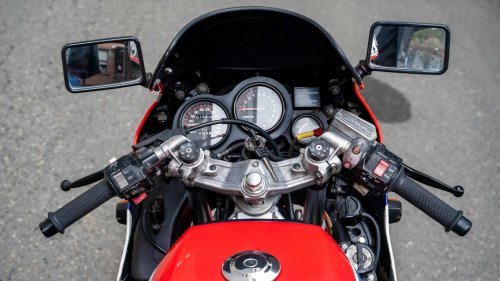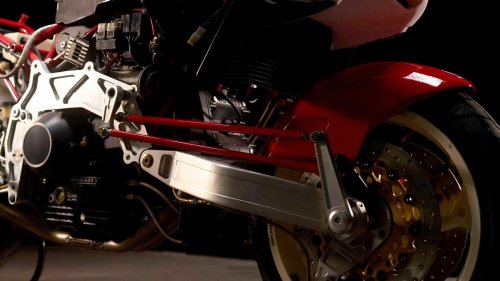
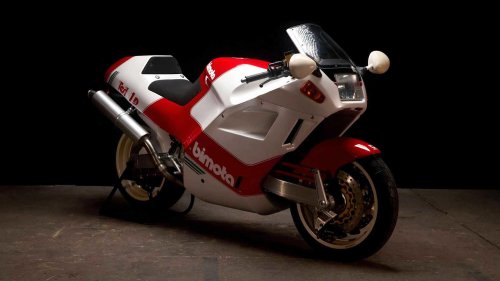
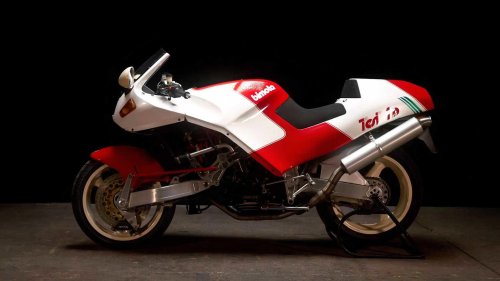
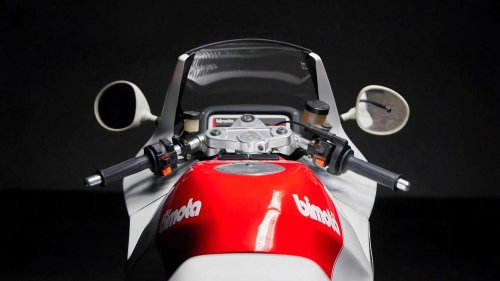
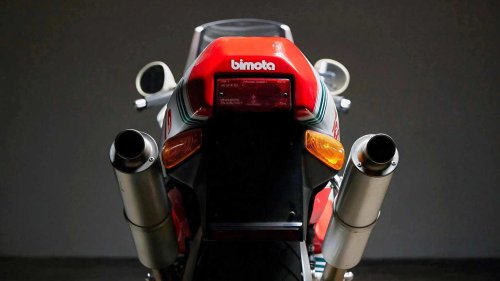


















Founded in Rimini, Italy back in 1973, Bimota has always been more of a boutique brand rather than one focused on large-scale production. The company was established by Valerio Bianchi, Giuseppe Morri and none other than the great Massimo Tamburini, famous for designing legendary motorcycles like the Ducati 916 and MV Agusta F4. These came later on, though, long after Bimota had established its reputation as a chassis development powerhouse. Essentially, they would pick a solid engine from an existing motorcycle and design everything else around it with racing geometry in mind, resulting in plenty of spectacular machines produced in small quantities. Bimota’s first crack at this formula was the HB1, employing a first-gen Honda CB750 mill cradled inside new tubular framework.Engines from several manufacturers have been used over the years, and the company’s endeavors only grew more ambitious as time went on. And although its most recent bikes use Kawasaki powerplants, there was a time when Bimota was more closely associated with Ducati. The model we’ll be looking at today comes from that exact period, packed full of top-notch engineering with an unconventional spin on suspension. But in order to understand the reasoning behind said design, we must first look at the constraints which led the firm to explore alternative setups. The Fork Problem In 1990s Sportbike Design Bring a TrailerTelescopic forks have long been the most common type of front suspension on motorcycles, but they’re not without their drawbacks. Dive under heavy braking is one of them, greatly reducing the suspension’s effectiveness and making it more prone to bottoming out if you hit a bump in the road. Then there is something known as stiction, which essentially refers to friction forces limiting suspension sensitivity and thus impeding shock absorption for a brief instant. Of course, these weaknesses aren’t catastrophic by any means, but the folks over at Bimota sought to try out something a little different in the nineties. Bimota's Radical Bet: Hub-Center Steering Bring a TrailerHub-center steering seemed like a great idea on paper, so it was eagerly put into practice with the Bimota Tesi 1D from 1990. The system does away with conventional fork anatomy altogether, replacing it with a front swingarm, tie rods to handle steering and a shock absorber for suspension duties. It’s far more complex than the standard forks you’ll find on most bikes, but it does address the main concern you’d have with that type of suspension. We’re referring to brake dive here, and it is practically non-existent on hub-center steering since it redirects braking forces straight into the chassis. Steering geometry remains consistent at all times, providing more stability while cornering without the bike’s front end dipping forward.Aside from that unusual suspension arrangement, the Tesi 1D came with an assortment of other premium bits. It rode on Marchesini wheels and was brought to a halt by high-grade Brembo braking components front and back, while the rear suspension comprised an adjustable Marzocchi monoshock linked to an aluminum swingarm. The powertrain sector had Ducati written all over it, with either an 851cc or a 904cc L-twin made available for the various 1D models. They produced 102 and 113 horsepower, respectively, sending this force to the rear wheel by way of a six-speed transmission. As for the frame, it employs machined aluminum Omega-style sections left and right, along with trellis subframes to support the front end and tail section. Why Almost Nobody Owned One Bring a TrailerThe Bimota Tesi 1D never gained a ton of mainstream attention, partly due to it being produced in very small quantities. Exact figures are difficult to come by, as the model was broken down into several variants throughout the early nineties. It is believed that a mere 127 copies of the 851cc version have been produced, along with 20 more featuring the bigger 904cc Ducati engine a bit later on. Then you had variants such as the ES (Edizione Speciale) or EF (Edizione Finale), of which Bimota made 50 and 25 units, respectively. A smaller 400cc version was also built for the Japanese market, and then you also had the more powerful SR. Sources can’t seem to agree on exact production numbers for these, but it’s safe to say there are fewer than 500 total copies of the Tesi 1D in existence. Engineering Reality: Did It Work? Bring a TrailerOne question remains, though: how effective was the fabled hub-center steering in the real world? Well, although it most certainly fulfilled the purpose of eliminating brake dive, the system also came with a few drawbacks which prevented wide-scale adoption. The first of them had to do with tactile feel, as conventional forks did a much better job at providing crucial feedback to the rider. They formed a more direct connection to the road than the multitude of tie rods and linkages found on hub-center designs, and all that additional complexity also meant more headaches when it came to maintenance. A lot more could go wrong with the individual parts, while piecing them together in the first place meant higher production costs right off the bat.Thus, the system didn’t revolutionize the way front suspension is approached, remaining more of an obscure (and undeniably fascinating) engineering curiosity rather than something mainstream. The Tesi 1D’s racing success was fairly limited, too, though it did secure some impressive victories and podium finishes during its time on the racetrack. In the 1991 AMA Pro Twins race held at Daytona, for instance, Alan Cathcart took first place with a 1D against AMA champion and Ducati rider Jimmy Adamo. Cathcart rode in various European Battle of the Twins events, as well, achieving podium finishes in France and Belgium. The Collector's Prize Today Bring a TrailerFast-forward to the present day, the Bimota Tesi 1D is extremely sought-after among collectors with enough cash to make it their own. And you would surely need some serious purchasing power in order to get one for yourself, as even the cheapest examples out there will set you back at least $20k. At the other end of the spectrum, the most extreme outlier might just be a 1991-model SR with one kilometer on the odo, which was auctioned off on Bring a Trailer for a whopping $78,000 last year. Another low-mileage 1D went for just under 70 grand on Iconic Motorbike Auctions around the same period, and an unridden 1992 specimen fetched $76k on Bring a Trailer in 2021. Clearly, the Tesi 1D is one of the finest cult classics money can buy, albeit more obscure than other collectible icons out there.