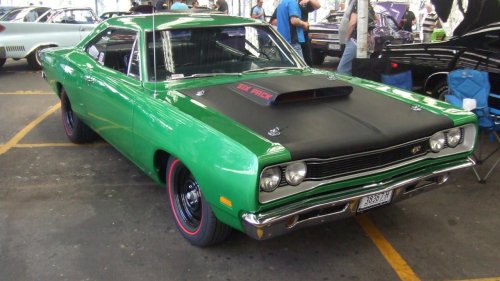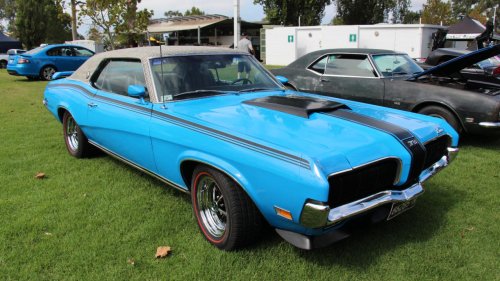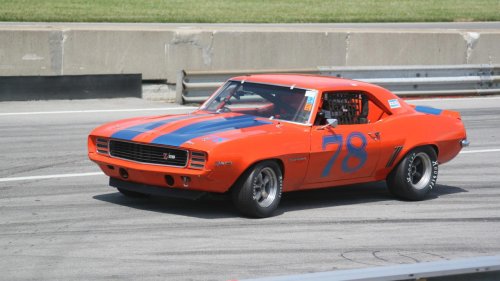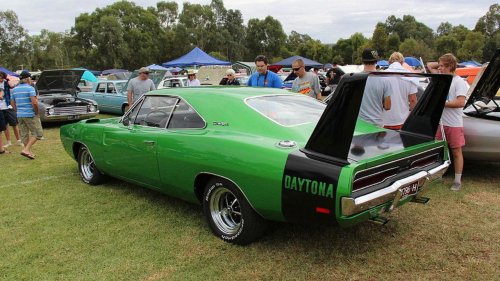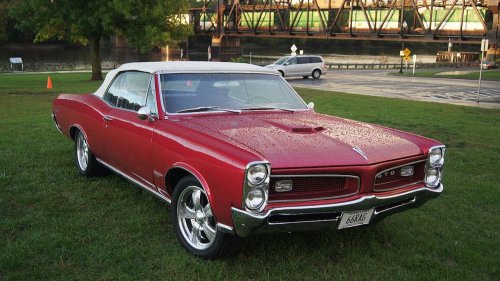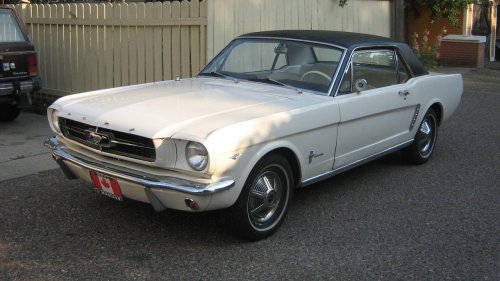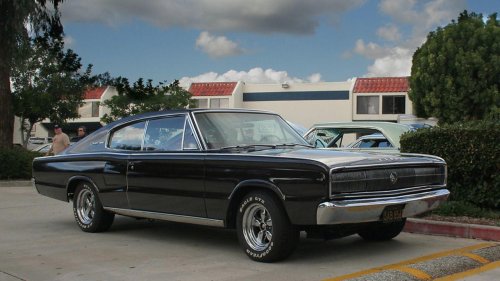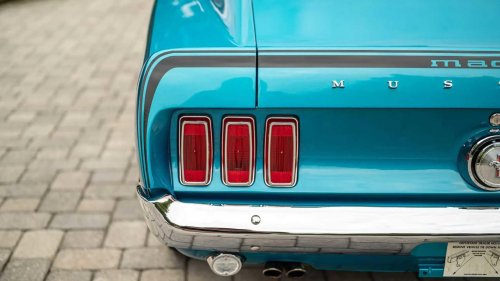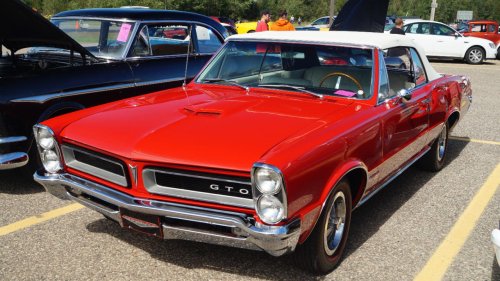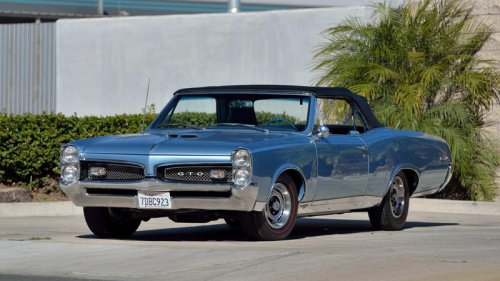
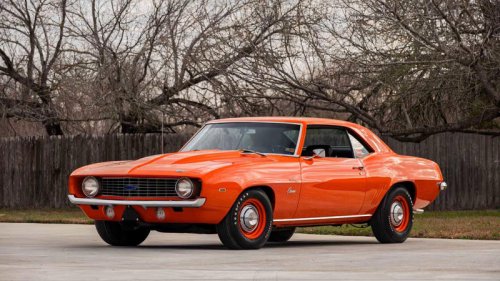
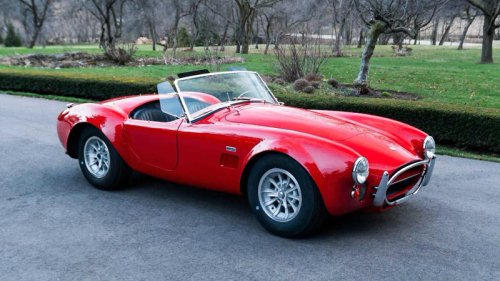
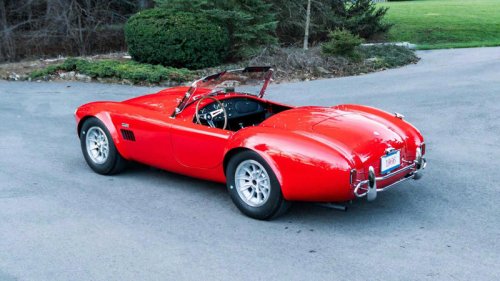
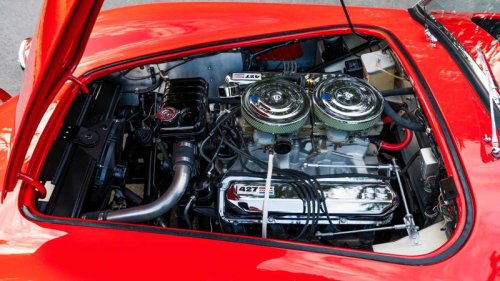
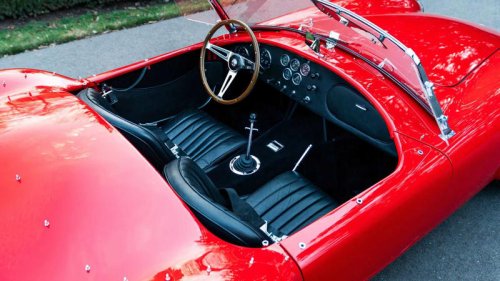
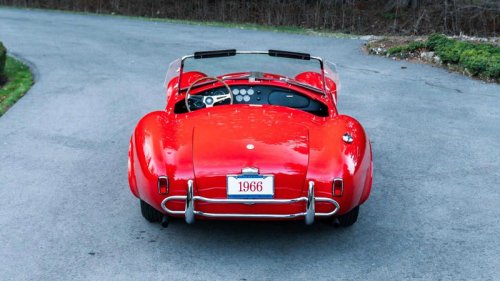



















Nothing could touch the big-hitting muscle cars of the late '60s Golden Era. Right? The 1969 Plymouth Road Runner, the 1969 Mustang Boss 429, the 1968 Dodge Charger Hemi, whichever you choose, no one would stand a chance at the stop light grand prix. But that's not strictly true.While the Big Three were churning out astonishingly powerful and quick V8 coupes, the fastest American car on the road didn't come out of Detroit. It was made in Los Angeles, California, of all places. This car didn't bother with the classic muscle car coupe lines either, and it wasn't a formidable sedan, it was a dinky roadster. But no one stood a chance... Muscle Cars Were Taking Over In The 60s Mecum Even when John DeLorean, Bill Collins, and co, dreamed up the first muscle car at Milford Proving Grounds in the early '60s, they probably couldn't imagine the impact it would have. The Pontiac GTO didn't so much create a movement, it changed the face of American motoring for good.The first muscle car started a revolution, with every carmaker rushing to get a powerful V8 coupe to the market. Whereas hot rods had been the ride of choice for young people in search of high-speed thrills in the '50s, the '60s were defined by muscle machines, and you could buy one straight from the dealership. Muscle cars were selling in their hundreds of thousands by the end of the decade and the Big Three were engaged in a power war that saw street machines with 400 horsepower and beyond. The Big Three Ran The Streets In The 60s Mecum Each big manufacturer brought at least one wild production car to the table. Ford had the 1969 Ford Mustang Boss 429. The engine was designed for NASCAR racing and featured special race-spec engine internals, rated to produce 375 hp and 450 lb-ft of torque. GM's top muscle was the 1969 Chevrolet Camaro ZL1, packing a 7.0-liter all-aluminum ZL1 V8 straight from a Corvette race car. The engine put out an advertised 430 hp, but this was thought to be nearer 500 horses.Coming out of the Chrysler stable was the 1969 Dodge Charger Daytona. With a 426 cubic-inch Hemi V8 producing 425 hp, the Daytona came fitted with a nose cone and table-sized rear wing for stability at 200 mph. These models were pretty much peak muscle car in the '60s, although others may have a personal favorite. But who would have thought an American car made in LA, via Great Britain, would take on the might of the Big Three and win? The AC Cobra Was A Collab Across The Pond MecumCarroll Shelby was never afraid to think outside the box. Even though the Texan will forever be tied to American automobile history and muscular V8s, Shelby grew up on a diet of European metal. After leaving the Army Air Corps, Shelby raced an MG-TC, as well as getting behind the wheels of Ferraris, Maseratis and Aston Martins. After retiring from racing, Shelby pondered what one of these exotic, nimble European cars would be like with a low-maintenance American V8.Coincidentally, AC Cars in Great Britain had just lost Bristol as its engine supplier, and Shelby floated the idea of connecting the company with the Ford Motor Company. In 1962, Shelby created Shelby American, a new company to build this car in California. The AC Cobra was equipped with a Ford 260 and later the 289 ci engines, and a legend was born. But it didn't end there. The Cobra was destined for a 427 ci V8. The 427 Cobra Took Things To The Next Level Mecum The Mark III debuted in 1965 as a collab between Ford, AC, and Shelby. The Cobra had to be drastically updated to both fit the 427 side-oiler big-block Ford and allow the dinky British sports car to handle the power. The fenders were extended to fit larger wheels and tires, the traverse leaf springs were ditched in favor of coil springs all round. Even the frame tubing was thicker, growing from three inches in diameter to four.The 427 came in two flavors, a base 425 hp and 485 hp The Cobra 427 also has ventilated discs at each corner and a four-speed manual. Now, 425 hp was pretty tasty in a Dodge Charger Daytona, and that weighed in at around two tons. But the 1965 Shelby Cobra 427 had a curb weight of almost half that, weighing 2529 lbs. Suffice to say, the Cobra's performance was quite dramatic. The 427 Cobra Was Faster Than Anything Else Mecum When a well-known car mag got hold of a street legal 1965 Cobra 427 for testing, it arrived with the 485-hp 427. The $7,000 car turned out to be not just quick by the standards of a car with zero driver aids in the '60s, but pretty fast by 2026 standards too. The sprint to 60 mph in the Cobra when tested was a scant 4.3 seconds, with 100 mph arriving in 8.8 seconds, and the quarter mile polished off in 12.2 seconds. Top speed was a frankly terrifying 165 mph.Let's put these figures into perspective. Top speed aside, the acceleration is almost exactly the same as a 200 mph Ferrari F40. The twin-turbo V8 '80s supercar (which arrived 20 years after the Cobra) hits 60 mph in 4.2 seconds, 100 mph in 8.3 seconds, and covers the quarter mile in 12.1 seconds. And it has a roof and relatively modern tires. In short, the AC Cobra was wild. So how did it stack up against the muscle cars of the '60s? How The Cobra Stacked Up Against The Fastest Muscle Cars Mecum How The Fastest Cars Of The '60s Compared The AC Cobra was in reality the fastest car of the '60s over the quarter mile. While the Big Three's muscle cars were ferociously fast, nothing could keep up with a Cobra 427. A stock ZL1 is one of the fastest muscle cars of the time, capable of running low 13s in the quarter-mile. Both a 1969 Dodge Charger 500 and a Daytona will cover the quarter mile somewhere between 13.5 and 13.9 seconds. A 1969 Ford Mustang Boss 429 would do the same distance in 13.7 seconds.Obviously, these times are not shabby at all, and compare well to even modern muscle cars, but the Cobra's light weight gave it the advantage. Bear in mind that the Cobra's $7,000 new price tag in 1965 translates to only around $72,618 today, and you realize that the Shelby machine was not just fast, it was a bargain too. But those days are long gone. Buying An OG Cobra 427 Today Is Not Going To Be Cheap Mecum As you might imagine, buying a 1965 Cobra 427 isn't going to be cheap. Early 427s were meant for racing, but Shelby apparently only completed 53 of the 100 cars required for homologation for the ’65 season, says Hagerty. It is thought that 31 of the Competition Cobras were then converted for road and sold as the “Semi-Competition”, or “S/C”. The general thinking is that 348were built, including some 428 cars. A 1965 Shelby Cobra 427 (CSX3101 - CSX3200) with 425 hp costs $1,400,000 in good condition. A 1965 Shelby Cobra 427 S/C with 485 hp will set you back $2,250,000. But for that money, nothing can touch you from this era.