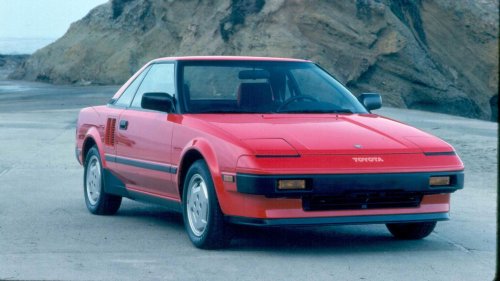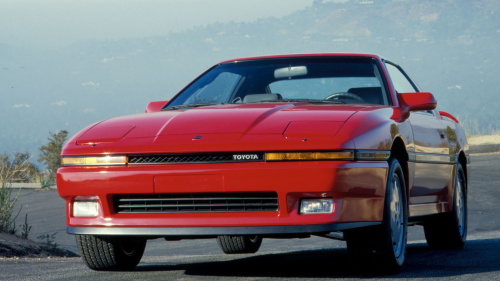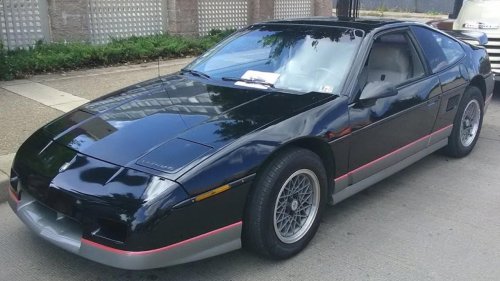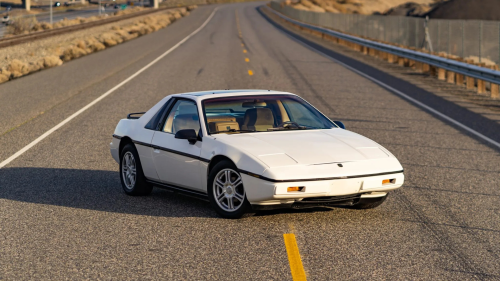
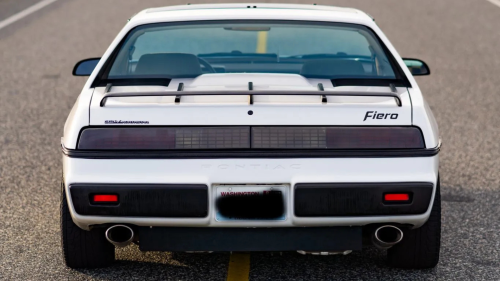
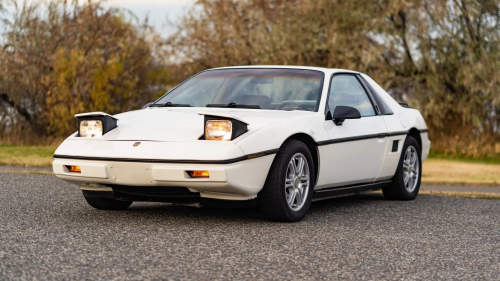
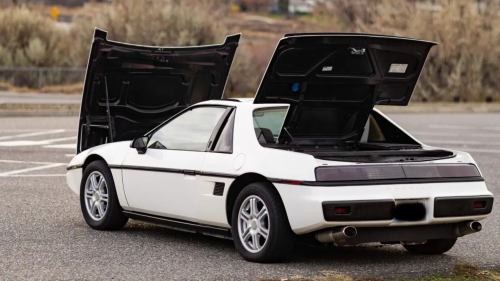
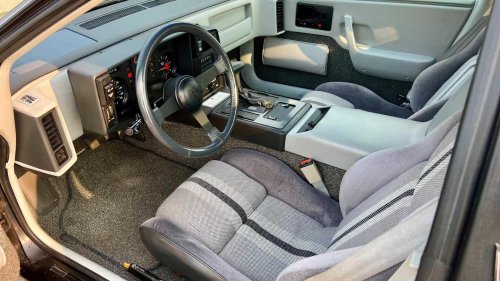
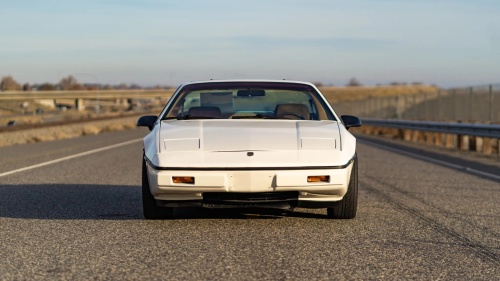
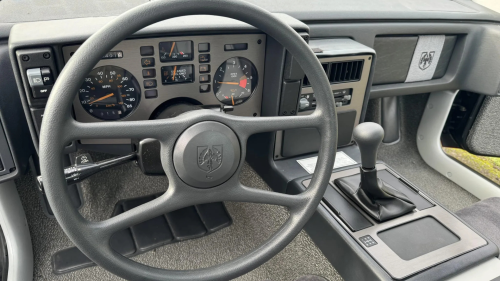
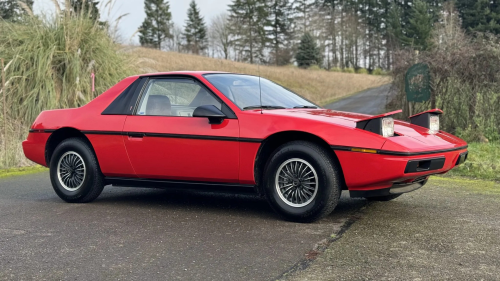



















Think successful small mid-engined mini supercars of the '80s, and the Toyota MR2 probably comes to mind. The small Toyota MR2 (or MidShip Rear-drive 2-seater), was simply adorable, featuring a 1.6-liter four-cylinder engine borrowed from the AE86 Corolla, with a 16-valve cylinder head and Denso electronic fuel injection. Quite simply, there was nothing quite like it, so no wonder that it went on to be not just a sales success, but also an icon almost overnight.But what if we told you that the very same year the MR2 was launched, there was an almost identical and just as pioneering small mid-engined sports car already on sale — and this one way outsold the Toyota? And that model was not only from America, but it was offered with a V6, as well as dinky four-pots. But unlike the MR2, this mid-engined marvel was all but discarded from both performance car history, and even the history of the manufacturer that built it. The Pontiac Fiero Is A Forgotten Sales Success Story via Bring A TrailerMention the to most gearheads, and you'll probably get a thinly disguised smirk at best, and a tirade of negativity at worst. The truth is that the Fiero has been so maligned in the world of performance cars that some of the fiberglass Ferrari kit cars that are bolted onto it are probably held in higher regard.But while the Fiero is an easy target, it was, as a concept, a pioneering chapter in American car manufacturing, and, what some people forget, a huge success. While GM executives were still bickering about the idea of one day sticking an engine in the middle of a Corvette (it finally happened in 2019 with the Corvette C8), the Fiero became one of the first affordable mini-supercars for the masses. And the buying public seemed to love it. Here's How Many Fieros GM Managed To Shift via Bring A TrailerGoogle the Pontiac Fiero, and you will likely see a number of articles on the first page mentioning the word "failure." For a failure, the Fiero sure did sell well, however. The Fiero sold between '84 and '88, and during those five model years, GM managed to shift 370,168 units (according to Hagerty). That's a big number, but how exactly does it sit in context with other cars at the time?For starters, the C4 Corvette (the darling of American sports car manufacturing in the '80s) sold less than that number, and that car was built for 12 years, so three times longer than the Fiero. Between '84 and '96, GM sold 358,180 C4 Corvettes.But what is just as remarkable is how the Fiero compares to the Toyota MR2. The W10 MR2 is seen as one of the most iconic small sports cars ever built, with a whizzy 120-horsepower 1.6-liter four-cylinder engine, and all the ingredients to make it a mini exotic that almost anyone could afford. But the Fiero arrived in the fall of 1983, for the 1984 model year (while the MR2 appeared for 1985), and in its first year alone, 136,840 were built and sold (Hagerty).The MK1 MR2, by comparison, sold 166,104 units globally in its entire five-year run — that's more than 200,000 less than the Fiero, which was primarily only sold in North America too. Why The Fiero 'Quietly Dominated' Its Era via Bring A TrailerTo really get a better sense of why the Fiero quietly dominated its era, it helps to look at what else people could choose in the mid-'80s. The Toyota MR2 is the obvious comparison. The MK1 MR2 earned its reputation via great handling and a high-revving four-cylinder, but despite its icon status today, total global production for the AW11 across its full run remained well below the Fiero’s North America-only numbers.The Mazda RX-7 was another affordable performance darling of the time, with rear-wheel drive and a lightweight rotary setup. It sold a total of 446,412 units between 1980 and 1990, which is commendable, but in the Fiero's '84-'88 span, the RX-7's tally comes up to 231,868, which is well down in comparison.The Ford Mustang, meanwhile, outsold almost everything in America by sheer volume, but it played a completely different game. It was front-engined, mass-market muscle, not an experiment in packaging or layout. Even the Porsche 914, often cited as the Fiero’s spiritual predecessor, had exited the market years earlier and had never achieved similar production scale. Against that backdrop, the Fiero’s sales success looks less like an accident and more like a one-off moment GM never repeated. The Fiero Is A Mini Exotic via Bring A TrailerWhen it came to engines, few people would probably argue that the 92-horsepower, 2.5-liter “Iron Duke” four-banger (mated to either a four-speed manual or three-speed automatic) in the Fiero was much of a match for the 120-horsepower 1.6-liter unit in the MR2 that had been nicked from the AE86 Corolla, with a 16-valve cylinder head and Denso electronic fuel injection. But the Fiero was also offered with a 140-hp 2.8-liter V6, which was a bit more grown-up. When you think about it, the Fiero made perfect sense for the tail end of the Malaise Era, offering smaller, more efficient engines in a more exotic package than many muscle cars.One equally endearing aspect about the Fiero was how exotic it felt for the money. A mid-engine layout was something buyers associated with Ferraris and Lamborghinis, not sub-$8,000 American two-seaters. Add in the space-frame chassis, composite body panels, and styling that looked nothing like a commuter car, and the Fiero was seemingly a slam dunk. What Went Wrong For The Fiero MecumThe Fiero sold like hot cakes in the beginning, with almost 140,000 cars shifted in its debut year, but then things got a little too fiery for the Fiero. The car started to get dogged by stories of engine fires, with the Los Angeles Times reporting allegations that nearly 150,000 Pontiac Fieros are in danger of going up in flames because of escaping oil. The National Highway Traffic Safety Administration received 148 complaints regarding the Fiero, including reports of six injuries, the newspaper reported.The four-cylinder was plagued with oil starvation issues, and there was the obvious problem of just 92 horsepower. The faster 2.8-liter V6 couldn't stop the sales freefall, which was down to 76,371 for 1985. The Fiero survived until 1988, before being retired without a clear replacement. The MR2, on the other hand, continued for three generations and is one of the best-loved sports cars to come out of Japan. Here's Why The Fiero Is Better Than You Think via Bring A TrailerThe Fiero was America's first mass-produced mid-engined car, way before the Corvette C8 rewrote the rulebook and became a huge sales success. The Fiero may not look like much now, but at the time, it was cutting-edge, with a true mini supercar appearance. But you could use the Fiero every day, as long as it didn't catch fire or break down, and the $7999 price tag for the 2.5-liter version was also very tempting.Then there was the construction, a full space-frame structure that was totally independent of its outer body panels. The panels themselves were radical, made from composite materials and fastened with a quick-mount system. There were even speakers in the headrests. This budget supercar couldn't have been more exciting. The Fiero Is A Cult Purchase Today via Bring A Trailer There are, of course, owners' clubs, and in many eyes, the Fiero has achieved a kind of cult status. This fact is emphasized by the sale of the last of 370,168 Fieros to roll off the assembly line, a red 1988 GT, in 2020. That car sold for a record $90,000, which surpasses even some mid-engined Ferraris. Speaking of which, the Fiero has always been a base for kitcar replicas of Italian and American exotica, with likely a large number giving up their mid-engined platforms. All this leads to the fact that a decent, stock Pontiac Fiero is a bit of a diamond in the rough these days.Interestingly, the Fiero still sits in a very small club today. Affordable, mid-engine classics remain rare, with the used market largely limited to the Toyota MR2 and the Fiat X1/9. Both are lighter and more European in feel, but neither matched the Fiero’s original production scale or its mainstream American appeal. That scarcity only strengthens the case for why the Fiero’s success in the 1980s was such an anomaly. Buying A Fiero In 2026 via Bring A Trailer If, by now, you are suddenly craving a small two-seater, mid-engine sports car from the '80s that's not a Toyota MR2, then you are in luck. Despite all the talk of these cars being cult, collectible cars, Fieros are still dirt cheap. Base four-cylinder '84 Fieros sell for $4,200 in good condition, according to Hagerty, with '87 cars selling for $5,800.The six-cylinder GT cars sell for a little more, with '86 examples going for $6,100, and '87 cars fetching $7,500. Who knows if the prices of Fieros will continue to increase, but for these figures, you can afford to buy one, drive it, enjoy it, (possibly fix it), and you might even make a profit at the end.Sources: Hagerty.com, Los Angeles Times.