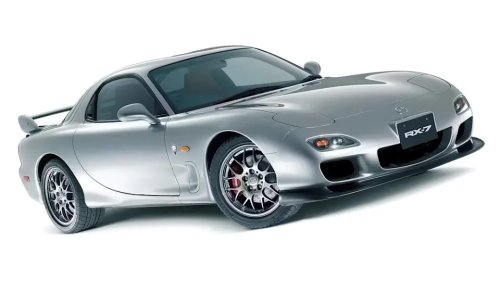
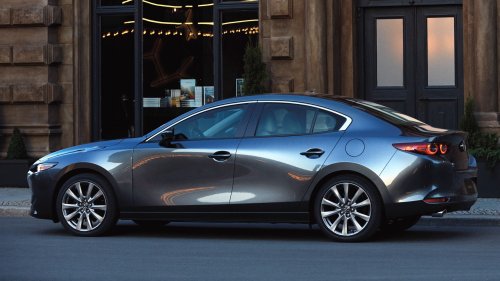
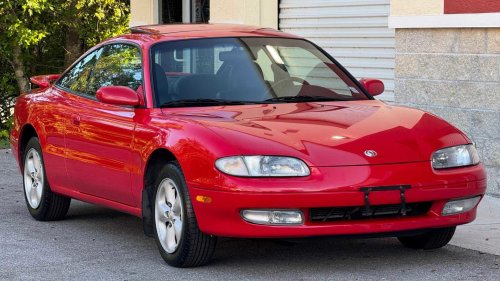
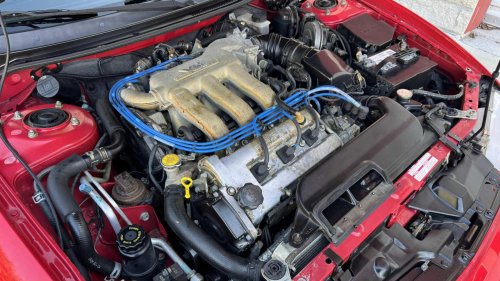
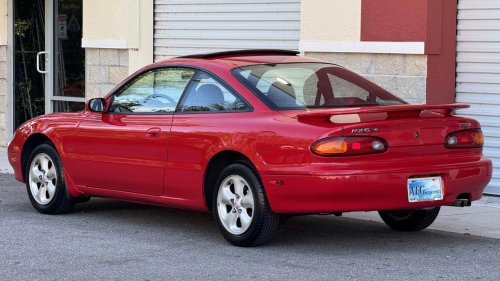
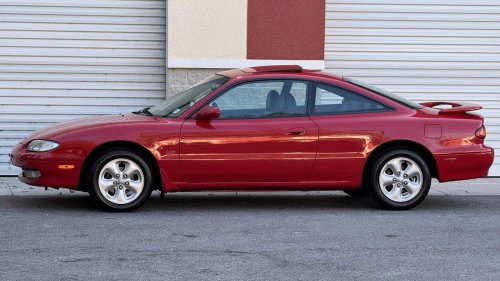
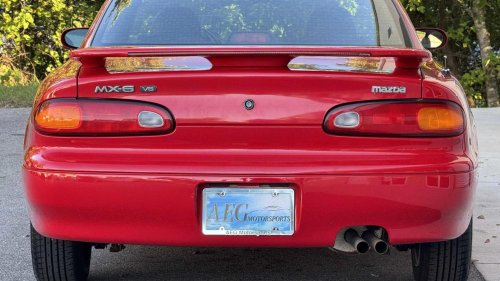
In the early 1990s, Mazda was doing something remarkable, and most of the automotive world was paying attention to the wrong cars. The RX-7 FD was getting all the coverage. The Miata had already become a phenomenon. The 787B had just won Le Mans, becoming the only rotary-powered car in history to do so.In the middle of that noise, a sports coupe arrived on Mazda's showroom floors with technology that its European rivals had not yet figured out how to package affordably, fitted into a body that looked like it belonged on a motor show stand in 1996. It sold modestly, got overshadowed immediately, and disappeared from production in 1997 with barely a eulogy. The case for revisiting it now is stronger than it has ever been. When Mazda Was Building Its Best Cars Bring a TrailerBetween 1989 and 1993, Mazda launched the NA Miata, the FD RX-7, the 323 Familia Turbo, the Eunos Cosmo, and the second-generation MX-6, all within a few years of each other. The 787B won Le Mans in 1991. It was an extraordinary creative period for a manufacturer that had spent the previous decade being taken seriously mostly by people who already knew what a rotary engine was.The Miata made Mazda globally famous. The RX-7 FD confirmed the company could produce a world-class sports car. There was another that was supposed to be the affordable entry in that lineage, a car that brought genuine sports coupe engineering to buyers who could not stretch to the RX-7. It had the technology to make that argument convincingly. It just did not have the name recognition to compete with what it was parked next to. The Sports Coupe Nobody Remembers Bring a Trailer The second-generation MX-6, launched in 1991 for Japan, Australia, and Europe and arriving in the US as a 1993 model, was built on the GE platform shared with the 626 and the Ford Probe, assembled at AutoAlliance International in Flat Rock, Michigan for the North American market. On paper, that sounds like the setup for a deeply ordinary car. In practice, the top-spec version came with a 2.5-liter DOHC V6 producing 164 hp in North American trim, four-wheel steering as a factory option in markets outside the US, and a body that period reviewers consistently praised for anticipating the rounded, organic sports coupe aesthetic that would define the mid-decade.The Honda Prelude was its most direct rival. The Prelude had four-wheel steering too, which is worth noting. What the MX-6 had that the Prelude did not was a smoother, higher-revving V6 that felt more like a sports car engine and less like a refined economy unit. Nobody talks about either of them now. Meet the Mazda MX-6: The Sports Coupe That Had Four-Wheel Steering Before Porsche Did Bring a TrailerThe 1991-1997 MX-6's headline technology was its four-wheel steering system. An electronically controlled rear rack turned the rear wheels opposite to the fronts below 35 km/h, or 22 mph, tightening the turning circle for parking and low-speed maneuvering, then switched to turning them in the same direction above 80 km/h, or 50 mph, for high-speed stability and lane change response. The maximum rear steering angle was five degrees, which Mazda determined was the threshold where the effect was mechanically significant but still transparent to the driver. This was not a novelty feature. It worked, it was reliable, and it genuinely improved the car's handling envelope at both ends of the speed range.For comparison: Porsche introduced rear-axle steering on the 991-generation 911 in 2012, more than two decades after the MX-6's system went on sale. BMW offered it on the 7 Series from 2008. Ferrari fitted it to the 488 GTB. All of these systems operate on the same fundamental principle that Mazda had already packaged into a $20,000 sports coupe in the early 1990s. The MX-6 was not the only car of its era to offer four-wheel steering, but it was one of very few to offer it at this price point, and it remains one of the most driver-focused sports coupes Mazda ever produced. The Engine and What Made It Different Bring a Trailer The North American LS trim received the KL-DE, a 2.5-liter DOHC V6 producing 164 horsepower at 5,600 rpm and 160 lb-ft of torque at 4,800 rpm. After 1995, output dropped slightly to 160 hp due to OBD-II emissions compliance changes. The engine was smooth, refined, and free-revving by the standards of its segment, with a character that suited the MX-6's grand touring positioning better than a turbocharged four-cylinder would have.What North American buyers never received was the KL-ZE, the higher-compression version of the same engine fitted to JDM specification cars, producing 200 hp and 165 lb-ft of torque, with revised camshafts, ported heads, and a different intake manifold that shortened and widened the runners for better top-end flow. The KL-ZE was a genuinely different engine in character as well as output, with a higher redline and a more aggressive power delivery above 5,000 rpm. It is one of the more sought-after engine swaps in the MX-6 community today. A trademark application for the MX-6 nameplate was filed in Japan in October 2018, suggesting the name may yet return. What a Mazda MX-6 Is Worth Today Bring a TrailerMarket data places the average second-generation MX-6 sale at $7,411 across all variants, with the highest recorded auction result of $12,750 for a clean 1993 LS in July 2023. The lowest recent sale was $2,100 for a high-mileage 1994 LS in July 2025. These are not numbers that reflect rarity or collector status. They reflect the MX-6's continued obscurity, which for a buyer who wants an honest 1990s Japanese sports coupe at a genuinely accessible price is a significant advantage.A clean, manual-transmission LS V6 with documented service history can still be found in the $6,000 to $10,000 range, which is a remarkable amount of sports coupe for the money. The caveat is that good examples are genuinely scarce because most were used without ceremony and never properly preserved. If you want one worth having, patience and inspection matter more than budget. Why The Mazda MX-6 Failed to Connect and Why That Makes It Interesting Now Bring a Trailer The MX-6 failed commercially for reasons that had very little to do with its engineering. In the US market, it was a front-wheel-drive coupe sharing a platform with the Ford Probe, and that association made it difficult to position as a serious driver's car in the way the RX-7 clearly was. Four-wheel steering was available only on a single model year in the first generation for the US market and was never offered on the second-generation North American car at all, removing the most technically compelling element of the car from the market where it would have had the most impact.The JDM and Australian specifications, which included both 4WS and the more powerful KL-ZE engine, were a categorically better car than what US buyers could purchase from a dealer. That gap between what the MX-6 could be and what most buyers actually got goes a long way toward explaining why it never built the following it deserved.Mazda discontinued the MX-6 in June 1997, with the last car rolling off the Flat Rock line on 20 June. No replacement was announced. The Mazda 6 coupe that arrived years later was a different car entirely in character and positioning. The MX-6 simply stopped, leaving a gap in the Mazda lineup that was never explicitly filled. In retrospect, the car's discontinuation looks less like a product decision and more like a brand realignment toward the RX-7 and Miata as the twin pillars of Mazda's sporting identity, with everything in between quietly retired. That left the MX-6 without a narrative, and a car without a narrative tends to disappear from the conversation regardless of its technical merits. Why the Mazda MX-6 Still Matters Bring a Trailer The argument for the MX-6 is not that it was misunderstood in its time, because it mostly was not. Period reviewers liked it, owners were largely satisfied, and the V6 in particular was praised consistently for its refinement and character.The argument is that the engineering it contained, specifically four-wheel steering, a DOHC V6, a rigid coupe body, and a chassis tuned for handling rather than comfort, represented a level of technical ambition that its price point did not require, and its sales figures did not reward. A car that was genuinely ahead of its era in at least one meaningful way, sold at a price that put it within reach of buyers who mostly wanted a Camry coupe, and then watched it get ignored in favor of the cars on either side of it in the showroom.What that leaves in 2026 is one of the most affordable entry points into early 1990s Japanese sports coupe ownership, with a parts ecosystem that is still reasonably healthy given platform sharing with the 626 and Ford Probe, and an engine in the KL-ZE that the broader tuning community has kept well-documented. For a buyer who wants a driver's car from this era and does not need the cachet of an RX-7 or the roadster experience of a Miata, the MX-6 makes a quiet, technically honest case for itself that it was never quite loud enough to make on its own.Sources: Classic.com, Bring a Trailer, Mazda.



















 +53 others