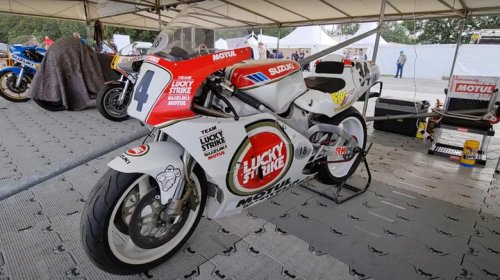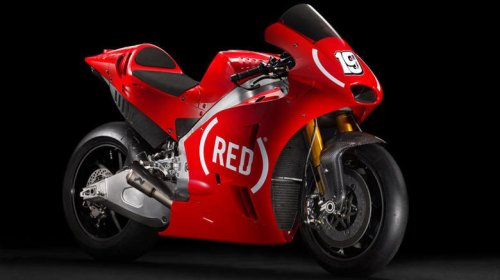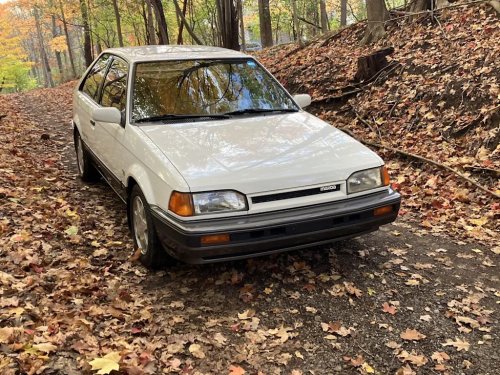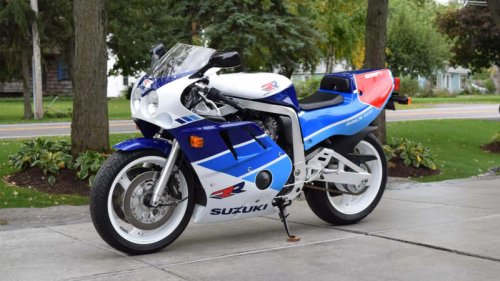
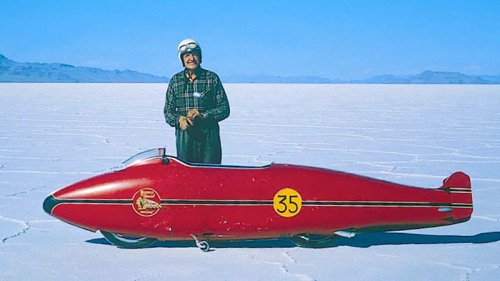
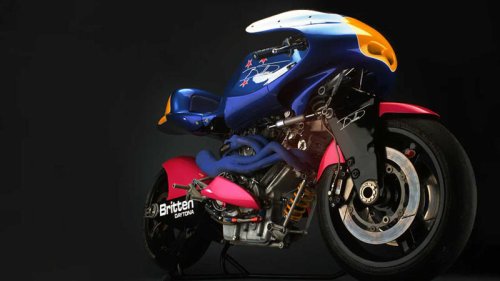
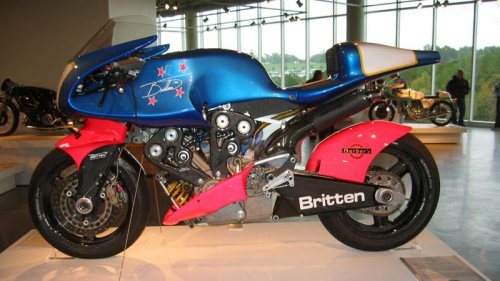
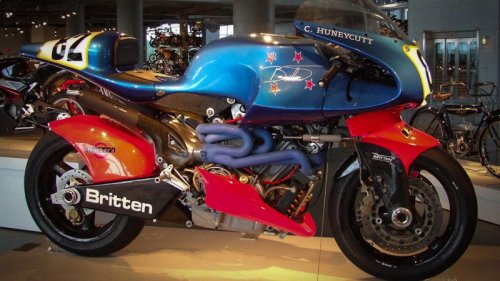
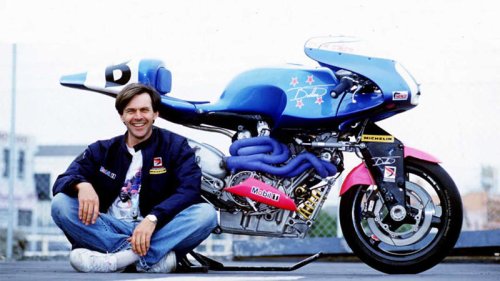
















Low-run sports bikes are nothing new. There’s been plenty of bikes with limited production, from homologation specials to experimental prototypes and vanity projects to go alongside the mass-manufactured bikes you see every day. There's one bike, though, that is as rare as it is technologically advanced.Hand-crafted in a small workshop on the other side of the world, this bike from New Zealand is worth over half a million USD if you can find one. But with only 10 having ever been made, finding one for sale is even harder than finding the money to buy it. Low-Run Sports Bikes Can Still Be Seen MecumThere have been plenty of low-run motorcycles that riders can see on the roads today. Bikes like the Suzuki GSX-R750RK, of which only 500 were made, still roam the streets. Even the Honda NR750, which had only 200 units, can still be seen if you’re lucky enough.Race bikes can also make their way onto the track for vintage races, or places like Goodwood where there’s more precious metal than all the world’s mines combined. But there's one bike so rare, so powerful, that you're going to struggle to see it anywhere in the world. The History Of The Britten V1000 Motorcyclemuseum.orgThe Britten V1000 was an outstandingly unique bike, but to understand the bike you need to understand where it came from. Despite being roughly the same size as Colorado, New Zealand is responsible for more than its fair share of motorsports legends. McLaren founder Bruce McLaren hailed from Auckland, with F1 contemporaries Denny Hulme and Chris Amon also being Kiwis. The subject of the The World’s Fastest Indian movie, Burt Munro, was a compatriot, too.The country has a long history of shed culture, where people take matters into their own hands and create the machines they want. Munro did that with his record-setting Munro Special motorcycle, while another motorcycle pioneer was John Britten.The New Zealander had a penchant for everything mechanical, first starting with a go-kart aged six and working his way up through machinery. His first foray into bikes came with the Aero D Zero—a Ducati Darmah-powered aerodynamic motorcycle made in 1985. Another, the Aero D One, came soon after, while precursors to the Britten showed what he was capable of. The Britten V1000 Is Born Britten.co.nzHis earlier bikes had used parts from other bikes, but that wasn’t what John wanted to do. He wanted to create his own bike entirely from scratch. So that’s what he did, with some friends in his Christchurch shed, around 1991.While most shed builds will make a bike as close to normal as possible, John and his team made the bike wildly different. For a start, there’s no frame, instead using the engine (which he also created himself) as a stressed member. This means the engine was a structural part of the bike, with suspension and swingarm mounted directly to it. Not only did this save weight and increase rigidity, but it ensured that every revolution was transmitted straight into the rider themselves. Continuing the true shed build nature of the bike, the engine components were heat-treated in Britten’s wife’s pottery kiln.Wikimedia RedhawkriderOf course, a bike needs suspension, and the Britten V1000 was typically outlandish. Instead of the normal telescopic forks you'd find on a motorcycle of the time, the Britten V1000's front wheel was attached to a steering upright. These uprights were connected to wishbones to control wheel movement, while the steering was controlled separately. A shock absorber behind the wheel, attached to the engine, gave the rider 120mm of suspension travel and could be adjusted while the rider was moving—uncommon for the time. This all led to reduced brake dive, better wheel control, improved stiffness, and better aerodynamics, given there was no need for bulky suspension. Rear suspension also had the Britten touch with the swingarm made from carbon fiber, which was very uncommon at the time.Britten opted for an under-seat exhaust exit to enable greater lean angle and reduce drag, making it out of titanium rather than stainless steel to again save weight. Silencing was minimal because it would have cost precious ounces, and this gave the V1000 its distinctive bark.There were other interesting aspects to the bike too, like the fact that it had programmable fuel injection when other race bikes still had carburetors, that the carbon fiber swingarm doubled as the oil tank, and that the radiator was moved underneath the seat to enable even less drag.Wikimedia Thilo Parg Everything served multiple purposes and weighed as little as possible, to the point where the bike weighed just 304 pounds wet when 500cc Grand Prix bikes weighed upward of 308 pounds, despite having half the displacement. This made it a fantastically light race bike, capable of great results. The Britten Stuns On Track… When It Finishes With so much innovation in the bike, it was never going to be one that was "finished." So, to get some real-world testing, Britten took it racing. An earlier iteration’s first outing was at the 1989 Daytona Battle of the Twins, which was a series designed to show off two-cylinder bikes and was a common stomping ground of Ducati and Harley-Davidson. Here, the bike made it all the way to the first corner before coasting to a stop due to fuel injection issues. Two years later, the V1000 proper would secure second and third place in the race, while in 1992, rider Andrew Stroud would lead the race ahead of factory Ducatis until a rectifier (one of the parts not made by Britten) failed on the penultimate lap.These all presented opportunities to improve the bike and, in 1994, Stroud would take the bike’s first victory at BOTT. The Britten would repeat the feat a year later, winning by a staggering 43 seconds. It saw success elsewhere, too, with the 1995 BEARS (British, European, American Racing Series) title, setting the fastest lap at the 1993 Isle of Man TT, and setting multiple speed records including the world flying mile time for motorcycles under 1000cc at 188.092 mph in 1993. Though Production Ceased, Britten’s Memory Lives On Britten.co.nzJohn Britten passed away from cancer on September 5, 1995, aged 45. Britten had wanted just 10 of the bikes to be created, but only 6 had been made when he passed, so his team continued until the 10th and final bike was finished in 1999. Today they’re either in private collections or museums, with one (bike number seven) at the Barber Motorsport Museum and another at the Museum of New Zealand Te Papa Tongarewa.John Britten was truly an engineer’s engineer who did nothing by halves. He took a bike made in his New Zealand home halfway across the world and beat the might of Ducati with it. That there are only ten in the world and two are in museums speaks volumes about how well-regarded both he and his bike are. While all ten still exist, the Britten V1000 isn’t a bike you’ll see on the roads. It’s not one you’ll pass, or know someone with, or see at your local spot. With only one museum in each hemisphere having one, it’s a bike you’ve got to make a pilgrimage to. It’s a fitting legacy for a bike that came out of a garage in New Zealand and beat the rest of the world.Sources: CarThrottle, Britten.co.nz, MCN, Goodwood, Cycle News