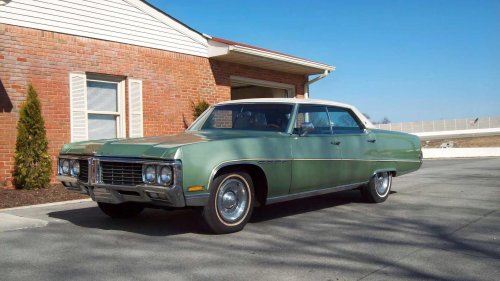
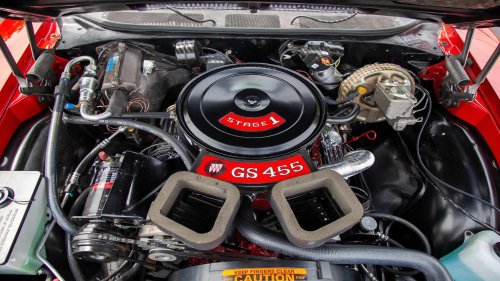
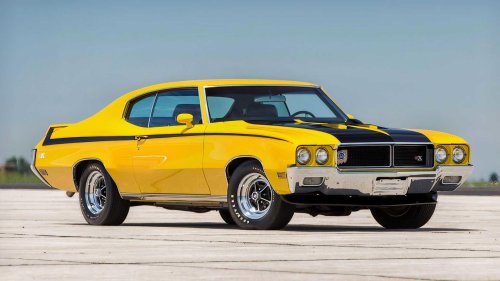
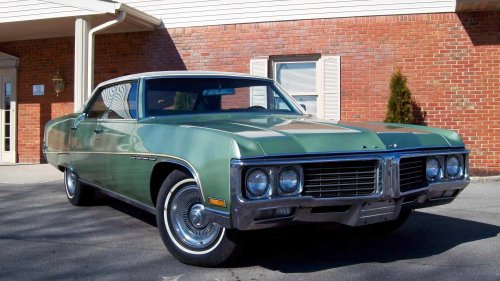
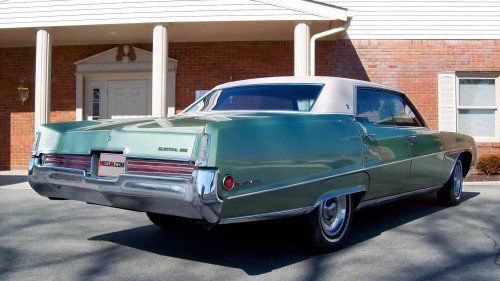
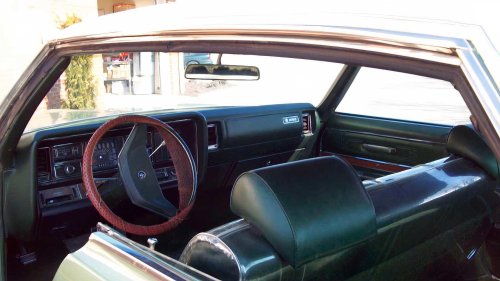
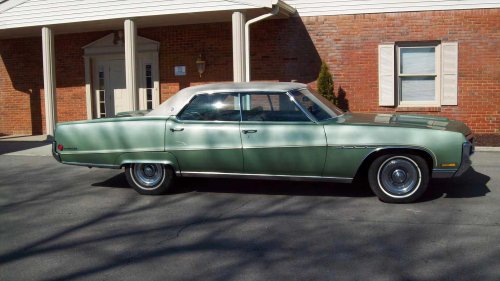




















The never-ending one-upmanship and the infamous horsepower wars between American manufacturers in the '60s and early '70s forever marked that time as the golden era of the country's automotive industry. Back then, the phrase “there's no replacement for displacement” reigned supreme, and since the safety and environmental agencies had not begun the crackdown on the auto industry, most American automakers followed a "why not?" mantra when creating their cars.As such, some of the machines it produced are absolutely ridiculous by today's standards, packing big-block V8 engines and race-inspired technologies that probably shouldn't have been available to the average Joe. Think cars like the 1969 Chevrolet Corvette ZL1, 1970-1971 Plymouth Hemi ‘Cuda, 1969-1970 Ford Mustang Boss 429, and many others.But muscle cars and sports cars weren't the only ones that pushed the envelope when it came to over-the-top performance. One early '70s family sedan away with one of the era's biggest and most ludicrous big blocks, becoming an early definition of a sleeper car. Majestic and long-bodied, this stately luxury sedan looked like something a monarch could be chauffeured in, but under the hood, it hid a monstrosity that could leave sports cars in the dust. 1970 Buick Electra 225 Sedan: The Unexpected Torque King Via Mecum Auctions The Electra started life in 1959 as the Buick flagship full-size luxury model, replacing the Roadmaster line. Available in multiple body styles, the Electra was part of Buick's plan to save itself after sales dropped drastically towards the end of the 1950s, and its mission was to offer a mix of sophisticated styling, luxury, and high-performance V8 engines. The Electra, alongside other new models like the mid-level Invicta and entry-level LeSabre, helped reshape Buick's reputation throughout the '60s, and by the end of the decade, Buick was one of GM's best-selling brands, known for building “banker’s hot rods” for middle-class buyers who wanted more luxury than Pontiac and Chevy offered but couldn't quite afford the opulence of a Cadillac.In 1970, GM finally ended its ill-advised ban on its brands installing engines larger than 400 cubic inches in mid-sized and smaller cars (except the Corvette), which had been in effect since 1963. While the Electra 225 was already using big-block V8s and wasn't affected due to its full-size proportions, the ban had served as a major barrier to engineers who wanted to push the limits of performance, and lifting it was akin to uncaging a predator that had watched helplessly for years as cross-town rivals dominated with 7.0-liter behemoths.Oldsmobile, Pontiac, and Buick all rolled out engines with 455 cubic inches of displacement, and The General could finally face off against Hemi-powered Mopars and big-block Fords. Buick's version famously powered the 1970 GSX Stage 1 and made it one of the fastest muscle cars of the day, but the same engine was standard in the 1970 Electra 225 sedan. No matter how much the 225-inch-long body, elegant lines, bold grille, chrome accents, and plush interiors tried to hide it, the 1970 Electra 225 sedan had an engine that generated more torque than every bona fide supercar of the day. A Masterpiece of An Engine Bring a Trailer | User: StlcmWhen GM lifted the engine ban in 1970, Pontiac, Oldsmobile, and Buick all introduced 455 cubic-inch V8 engines, but while they were similar in displacement, they were engineered from different philosophies. Buick's 455 started life in 1967 as a 430 cubic-inch V8 that replaced the legendary “Nailhead” V8, which had been Buick's top engine since the mid-50s. Buick engineers bored out the 430 in 1970 to create the 455, resulting in an output of 370 hp at 4,600 rpm and a whopping 510 lb-ft of torque at 2,800 rpm – more than any other muscle car of that era and long after it.While the Oldsmobile and Pontiac 455s had similar power outputs, what made the Buick 455 special was its ability to achieve the peak 510 lb-ft of torque at a very low 2,800 rpm, earning it the nickname “the torque king”. On top of that, it weighed less thanks to thin-wall casting. This low-rpm punch ensured that a 455-equipped Electra 225 could power away from stoplights much faster than its land yatch proportions led you to believe, leaving uninitiated supercar drivers in the dust.Of course, the Electra's torque advantage wore off quickly thanks to its weight and cornering ability of an elephant. When speaking to Hagerty in 2021, Buick engineer Denny Manner said that low-end torque was key to the 455's development process since that's how buyers perceived speed, especially since Buicks were typically heavy due to the luxury elements. Unfortunately, 1970 was the first and last year the Electra 225 made such power, as a compression ratio change in 1971 dropped its power figures. The 455 Lived In Other GM Icons Mecum While everyone welcomed GM's decision to lift the engine ban in 1970, it was just too late as environmental agencies started cracking down on high-displacement and high-compression engines shortly after. However, GM brands Buick, Oldsmobile, and Pontiac still built several superb models with big and powerful 455 cubic-inch V8s in 1970, including some that have become muscle car legends. However, while the engines had the same displacement, the philosophy behind the overall construction processes was different.In the Buick family, the most notable model that used the 455 engine was the 1970 GSX Stage 1, which was a special limited and high-performance version of the 1970 GS 455. Oldsmobile's 455 “Rocket” V8 was used in the fabled 1970 442 W30, while the 1970 GTO and 1971 Firebird Trans Am got Pontiac's version. The Electra Was Never Supposed To Be A Performance Machine Via Mecum Auctions The 1950s decade is best described as “a tale of two decades” as far as Buick is concerned. The decade started on a high note, with Buick peaking in 1955 as the third-best-selling brand in the US. However, production dropped drastically in 1958 compared to 1955 figures, thanks to a general economic recession and quality control issues related to the luxury-priced “Limited” model's new air suspension and transmission system. Buick was also criticized for excessive styling at a time when affordability was becoming more of a priority, with its models earning a reputation for being overly long, heavy, and covered in too much chrome.In 1959, Buick made a dramatic change to its lineup, retiring old nameplates like the Special, Century, and Roadmaster, and introducing new ones like the LeSabre, Invicta, and Electra. The new models offered cleaner, less ornate styling and more performance, helping Buick turn the dire situation around. The Electra replaced the Roadmaster as the flagship full-size sedan and was based on the GM C platform. Two versions were initially available — the normal-sized Electra that was discontinued in 1961 and the Electra 225, a longer version whose name referenced its 225-inch overall length and earned it the nickname “Deuce and a Quarter.”Via Mecum Auctions The Electra 225 was sold in multiple body styles, and it always employed Buick's best V8 engine to haul the massive weight. It was in production from 1959 to 1990 across six generations, with the third-generation version, particularly the 1970 model year we're discussing today, achieving the highest levels of design thanks to its flowing Coke bottle lines and performance thanks to the 455 engine. The 1970 Electra 225 Was Luxury And Elegance Personified Via Mecum Auctions As Buick's flagship full-size luxury model, the 1970 Electra 225 was meant to offer “near-Cadillac” comfort and had all the bells and whistles of a proper American luxury automobile of the era. For starters, its 225-inch overall length gave it plenty of interior space where occupants were treated to padded dashboards, optional leather seats, two-speed electric windshield wipers, elegant woodgrain accents, six-way power-adjustable front seats, automatic climate control, AM/FM radio, cruise control, power steering, power brakes, and more.Although the tailfins and excessive chrome were long gone by 1970, the Electra 225's exterior still exuded luxury thanks to Buick's signature “Ventiports” on the front fenders, Super Deluxe wheel covers, and fender skirts. Looking at the 1970 Electra 225, it was hard to imagine that it had 510 lb-ft of torque. The 1970 Buick Electra 225 Is An Underrated Collector Car Via Mecum AuctionsSource: Hagerty Valuation ToolGolden Age America cars with big-block V8 engines have enduring appeal among collectors, but the 1970 Electra 225 remains criminally underrated with a valuation of just $23,400 in Hagerty's concours condition. The last 1970 Electra 225 sedan sold at public auction we found was on the Hagerty marketplace last October, and it sold for just $8,934, which is peanuts compared to the similarly-engined Buick GSX, which costs five figures today. Of course, the long and heavy Electra 225 is nowhere near as muscular, fast, or rare as the GSX, but it's a far more affordable way to get supercar-like power from the '70s. The Buick Electra Is Back, Or Is It? BuickAs one of the most defining Buick models of the 20th century, the Electra 225 is one of those nameplates Buick fans always wanted to see make a comeback in the North American market. It took more than three decades after the original Electra's discontinuation, but Buick finally introduced a new Electra in 2023, but contrary to fans’ hopes and expectations, the new Electra is a series of electric cars built for the Chinese market, for now. Buick is yet to announce whether the EVs will eventually be sold Stateside, but a renewal of the “Buick Electra” trademark in the US last December signals that GM is keeping the name alive for potential future use. While the new Electra models may be perfect for the modern EV-dominated automotive landscape where silence has replaced thunder, they'll never match the elegance, grunt, and character delivered by the 1970 Electra 225 sedan.Sources: Hagerty.