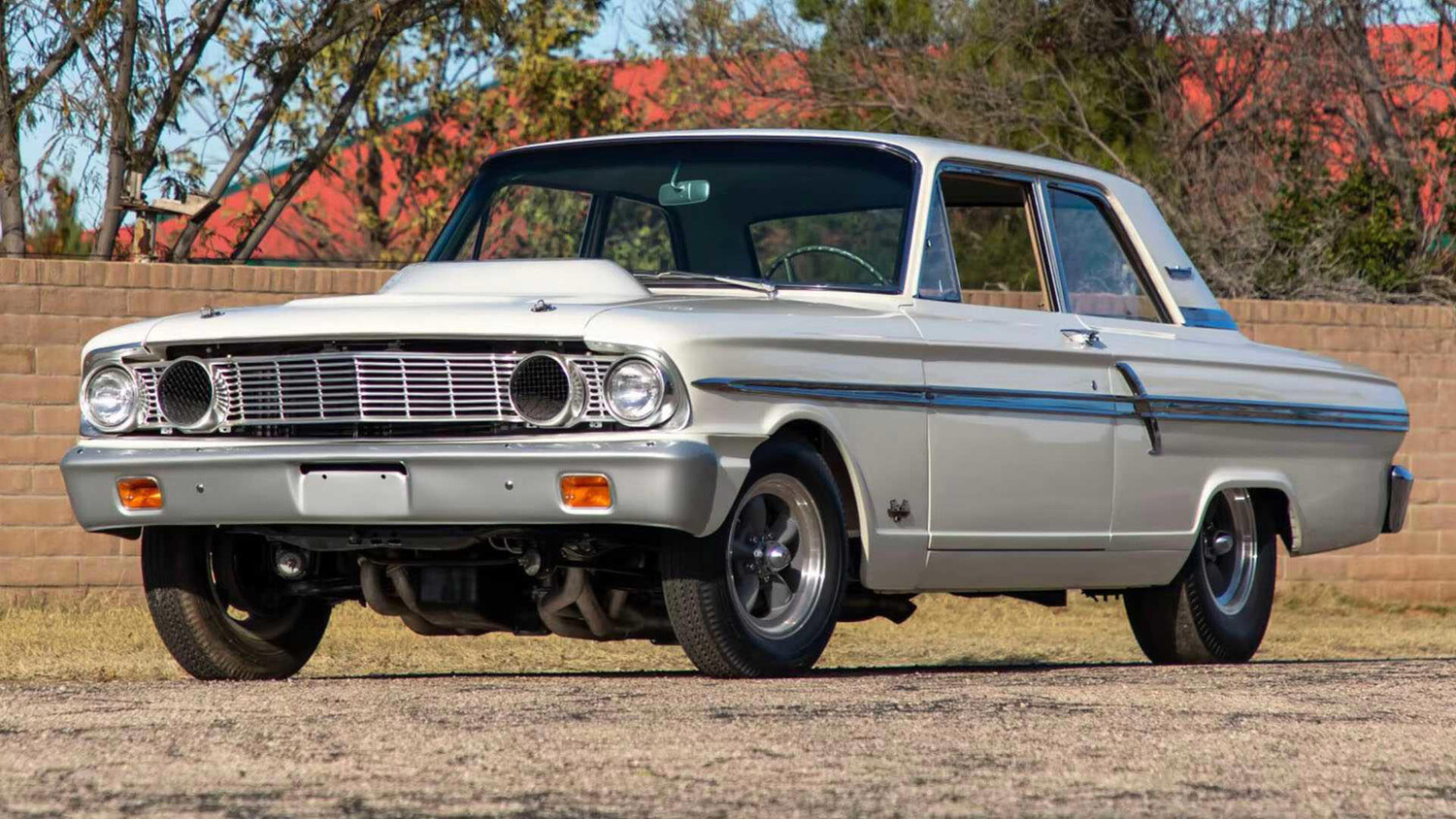
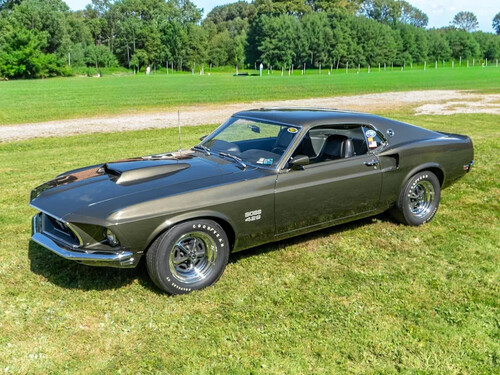
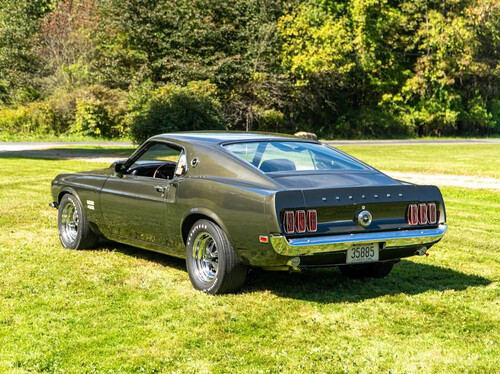
Think fast Fords of the '60s, and just one name normally pops up: the Mustang. It's hardly any surprise that Ford's iconic muscle car hogs the limelight, such was its propensity to churn out more smash hits than the Beatles during this time. There were the Shelby GT350 Mustangs with a 289 V8, while the GT500 was fitted with Ford’s massive 428 FE V8 engine, not to mention the introduction of the Boss Mustangs in 1969 with a 302 ci or 429 ci.Such is this iconic model's reputation during the time, it's hard to imagine that there was a fire-breathing drag strip monster from Ford that existed before the 'Stang had been launched. In fact, it was unleashed the same year as the Pontiac GTO, the car that is credited with kicking the whole muscle car genre off in the first place. This forgotten Ford of the '60s has double the kind of horsepower you would expect to see in some fairly modern supercars, dressed up in a bodystyle that your grandpa might have driven to the hardware store. Is it a sleeper? Is it a muscle car? What we do know is that this model is frighteningly fast – even by today's standards.HotCars used secondhand experts Hagerty and Classic.com for prices in the article below. Performance stats are taken from period reports and tests. This article is not designed to be a buying or investment guide. The Ford Fairlane Thunderbolt Was A Supercar In A Bingo Body Via: Mecum Auctions It's 1963, and on repeat on the radio is Little Deuce Coupe by the Beach Boys. The song talks about a stroked and bored Deuce Coupe that's 'the fastest set of wheels in town', hitting 140 mph flat out. Popular culture in America was obsessed with breaking the rules and living fast, epitomized by the hot rod scene. This wild new craze even had a legitimate sibling: drag racing. Pitting two cars together on a strip was fast becoming a legitimate, major sport with official rules, organized tracks, and exploding fan interest. Not missing a trick, the big manufacturers were getting involved too, under the mantra of "Win on Sunday, Sell on Monday." Drag Racing Was Huge In The '60s And The Big Manufacturers Wanted To Join The Party In the early '60s, Ford was one of the brands getting involved in drag racing, bringing its gargantuan Galaxie to the Super Stock party. The problem was, there is only so much weight-saving that can be done to such a big car, unless you start removing key components such as the wheels and body panels, so Ford decided to come up with a different type of drag racer called the Thunderbolt. The Thunderbolt Went On A Serious Diet Via: Mecum Auctions Ford decided to look to the Fairlane 500 as its next drag racing star. The car was a useful foot shorter than the Galaxie, as well as having naturally a shorter wheelbase. When the drastic weight-saving measures that had been used on the Galaxie were applied to the Fairlane, Ford got the car down to just over 3200 pounds, the NHRA minimum to compete in the Super Stock class. Not only did Ford remove the sound-deadening material, seam sealer, heaters, spare tire, radio, carpeting, and anything else that wasn't bolted on, the company also added fiberglass doors, front fenders, and hood.The finishing touch was to add plastic side windows, too, and the factory seats were replaced with a pair of Econoline van buckets. The Ford Thunderbolt was starting to take shape. But despite all these weight-saving measures, the interiors of the Thunderbolts didn't look that much different from a standard production car – you just didn't get any of the luxuries of the time. The Powerplant In The Thunderbolt Was Extremely Potent Even By Today's Standards Via: Mecum Auctions Then there was the powerplant. Ford had to dramatically alter the area under the hood just to fit the mammoth 427 from the Galaxies, with tubular headers carefully fitted around the suspension components. Under the teardrop-shaped hood bulge, Ford installed the High-Riser 427ci motor, featuring a 12:1 compression ratio, dual four-barrel carburetors, and long-tube headers. There was a ram-air induction system hooked up to massive holes in place of the high-beam headlights. Transmission choices were either a four-speed manual gearbox with a final drive ratio of 4:57.1 or a three-speed automatic with a 4:44.1 final drive. Here's How Quick The Fairlane Thunderbolt Really Was Via: Mecum Auctions From the front, the Thunderbolt looks menacing, but the rest of the car, aside from the huge tires all around, looks fairly standard, with no giant wheel arches to puff out the body. But under the hood, this is a seriously potent machine. The Thunderbolt was officially rated at 425 horsepower, which is a lot for an early '60s car, but experts like Hagerty say that it is actually 'well into the 500-hp range', with torque rated at 480 lb-ft. To put this into perspective, the 1969 Ford Mustang Boss 429, with its NASCAR-developed 7.0-liter V8 engine, has an official 375 horsepower and 450 lb-ft of torque. The Fairlane Thunderbolt Could Destroy Pretty Much Anything The Fairlane Thunderbolt was astonishingly quick in a straight line. The sprint to 60 mph can be dispatched in 4.7 seconds, according to Hemmings, which puts it on a par with some seriously quick machinery of modern times. A Mustang Boss 429 will run a quarter mile in the high 13s, but the earlier Fairlane is much quicker. Dick Brannan, who has a stack of drag racing wins to his name, covered a quarter mile in a Thunderbolt in 11.08 seconds at 128 mph. That's half a second off some of the fastest supercars ever built. The fastest car of the '60s was the AC Cobra 427, which could cover the quarter mile in 12.2 seconds. Buying A Ford Fairlane Thunderbolt Today Mecum Auctions Dearborn Steel Tubing built 100 Thunderbolts – 41 four-speed and 59 automatics – but there are rumors that the figure may have been slightly higher. With such rarity comes a huge price tag. The new price for the Ford Fairlane Thunderbolt was $3,780, but these days it's a touch higher than that. Expect to pay an incredible $201,000 for a Thunderbolt in good condition in 2025 – and then it is your choice if you feel like taking it to the drag strip again or not. Looking at the market for recently sold Thunderbolts, this seems spot on, with many sales sitting around the $200,000 to $250,000 mark. In fact, Classic.com puts the average price of sale of Thunderbolts at $253,000.There is a much cheaper option, however. Such is the iconic status of the Thunderbolt, there are plenty of tribute cars around, too. This project car was sold in 2022 for $26,250. What is perhaps even more incredible than the prices of Thunderbolts is the price of 429 Boss Mustangs. Expect to pay $212,000 for a 1969 Ford Mustang Boss 429 in good condition, says Hagerty, and $190,000 for a 1970 car.Sources: Hemmings.com; Hagerty.com; Classic.com