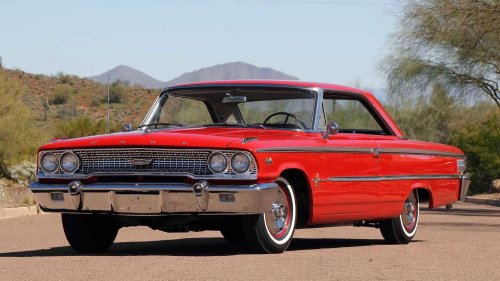
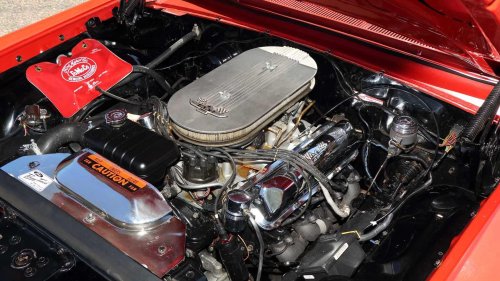
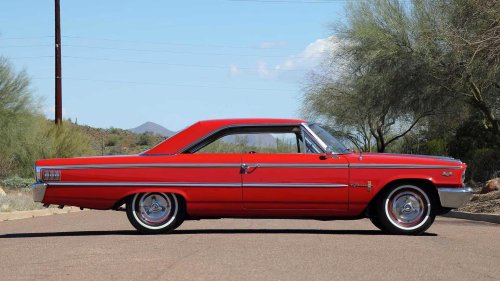
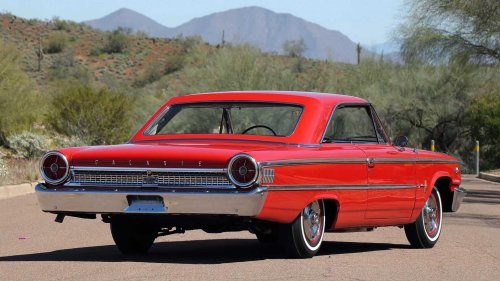
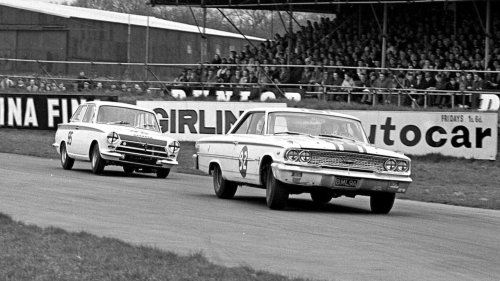
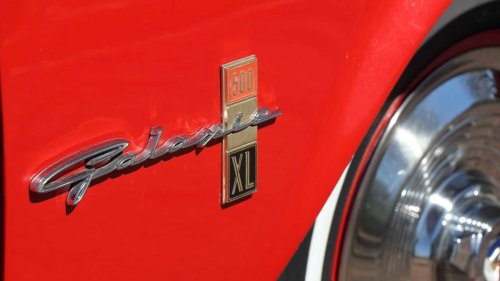
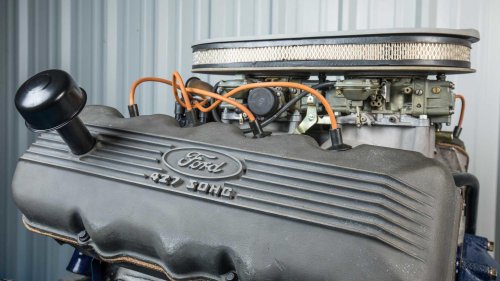
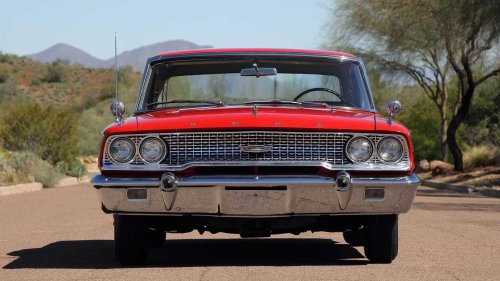

















Back in the 1960s, the Big Three were deeply invested in the horsepower wars, as supremacy on the track translated into sales in the showroom. It was truly a time when “Race on Sunday, Sell on Monday” bore fruit. At the start of the decade, General Motors was a dominant force thanks to its big block Chevrolet and Pontiac Super Duty competitors, and even Chrysler was showing some promise with its Max Wedge V8. In other words, Ford needed something that could hold its own on the oval. What resulted looked like any other family sedan of the day— long, boxy, and anonymous enough to blend into traffic. However, beneath the car’s understated exterior, the Blue Oval fitted it with a monstrous 427 V8. Though the powertrain was developed primarily for race competition, NASCAR rules mandated that such engines be provided for road-going cars as well. As such, consumers could go out and buy a Ford that had real dealrace-bred DNA.It was a bit of a sleeper car in that it didn't advertise its performance, as there were no stripes, wings, or flashy badges. Buyers also had to spring for a four-speed manual transmission and forgo many creature comforts like heating. Nevertheless, this forgotten Ford sedan raced its way to legendary status, and it’s a shame that more enthusiasts don’t appreciate it for its worth. With this in mind, we’ll be taking a look at what made this car so special. Ford Made The Galaxie A Racer With The R-Code Mecum Ford's answer came in the form of the 1963 Galaxie 500, and once NASCAR made a rule change stipulating a maximum engine displacement of 7.0 liters, the Blue Oval quickly punched its 406 FE V8 out to a healthy 425 cubic inches (though it rounded up to 427). Two versions of the engine made their way into the full-size Galaxie 500 during that shortened model year: a 410-horsepower single-four-barrel Q-Code and an even more potent 425-horsepower dual-four-barrel R-code. From that point, Ford campaigned the Galaxie 500 in NASCAR, NHRA, and even FIA endurance racing, with the 427 FE V8 even going on to power legendary vehicles like the Le Mans-winning GT40. Taking The Ford FE V8 To New Heights Mecum Ford originally introduced the FE big block (short for Ford-Edsel) in 1958 as a replacement for the aging Y-block V8. At the time of its debut, the 332 engine measured some 331.8 cubic inches in displacement, though it wasn't long before it grew to become a 352, then a 390, and then a 406. When fitted under the hood of the Galaxie 500, the 406-cubic-inch V8 produced a respectable 405 horsepower thanks to its Six-Pack intake and carbs. Not content to settle, however, Henry Ford II instigated the Blue Oval's Total Performance initiative that called for absolute competitive domination.Accordingly, the 427 shared the same 3.78-inch stroke as its predecessors, but Ford gave it some beefy 4.23-inch pistons along with an 11.5:1 compression ratio. The over-square design made for high-revving power, while other details like a reinforced block, thicker cloverleaf cylinder mold, and cross-bolted mains helped to provide additional strength during racing. On the street, it was rated for a healthy 425 horsepower and 480 lb-ft of torque, and the addition of the NASCAR Hi-Riser intake bumped power well over 500 ponies. When the 427 debuted in 1963, it featured a top/center-oiler design, but Ford eventually revised the engine in 1965 and made it a side-oiler to provide lubrication to the crank before the valvetrain. That year, it also benefited from a forged crankshaft. Ford Built A Run Of Factory Lightweights Mecum Along with introducing the 427 FE V8 as an option on the Galaxie 500 for the 1963.5 model year, Ford also created a limited run of factory Lightweight models originally for drag racing competition. Having reached the limit of available engine displacement, automakers took to shedding mass however possible. In the years before, Pontiac had introduced its infamous Swiss Cheese cars, and Ford needed something with a better power-to-weight ratio. Regular road-going R-Codes were largely conventional cars apart from their potent engines, but their Lightweight counterparts were purpose-built for competition.Mecum The standard steel bumpers were swapped for aluminum versions, while the hood, front fenders, and trunk lid were replaced with svelter fiberglass. As if that wasn't enough, Ford removed the hood hinges as well as the heater, even going so far as to mount the body on a lighter version of the frame that was typically reserved for the base six-cylinder models. When you also factor in interior weight-saving measures like cardboard visors and door panels as well as carpet deletion, the Galaxie Lightweight tipped the scales at 3,420 lbs— 420 lbs lighter than a regular production model. The NHRA required 200 models to be built for homologation purposes, and it's thought that just 212 examples rolled off the line in that first year. Ford brought the model back for 1964, but a change in production requirements (up to 500 cars) in 1965 meant the end for the Lightweight. The 427 FE V8 Was A Multi-Discipline Engine Bonhams When the FE 427 took to competition in 1963, Ford's efforts immediately paid off on the track. At the 1963 Daytona 500, a pair of Galaxies raced to a 1-2 finish thanks to their powerful V8s and slippery Sports Hardtop rooflines. That season, Ford clinched a total of 23 wins, giving the Blue Oval enough to dethrone Pontiac for the manufacturer's title. Over the next two years, Ford only improved on its efforts, taking home 30 wins in 1964 and an authoritative 48 wins in 1965. Ford Galaxie R-Code Street Performance Specs FordAnd here's the thing: as part of its Total Performance onslaught, Ford didn't pull any punches. The specially-prepped Galaxie Lightweight models also competed in NHRA and FIA racing, proving the versatility of the 427 FE V8 as well as the aerodynamic improvements in the sedan's bodywork. On the strip, Dick Brannan set the first national record ever held by Ford in NHRA Super Stock racing. Meanwhile, over in Europe, Jack Sears drove a Holman & Moody Galaxie Lightweight to a win in every race he finished, allowing him to clinch the 1963 British Saloon Car Championship and bring an end to Jaguar's long-standing dominance. Ford's 427 FE Raced To Le Mans Glory Mecum Special aluminum components dropped engine weight from 685 lbs to 555 lbs The Le Mans 427 ran a lower 10.5:1 compression ratio than the production Galaxie Ford fitted the 427 with a NASCAR camshaft and a bundle-of-snakes exhaust header Of course, you can't mention the 427 FE without acknowledging its Le Mans success. Ford raced to a historic 1-2-3 finish that year with its GT40, outpacing Ferraris with far more exotic and high-strung V12s. By running a larger displacement with fewer cylinders, the Blue Oval's engine was comparatively understressed, allowing it to lope along at much lower RPMs. NASCAR Outlawed Ford's Cammer Hemi-Killer BonhamsFord 427 Cammer SpecsDespite Ford's successes with the 427 FE, Chrysler and its 426 Hemi were hard to ignore— especially because of Richard Petty's talent and his upset at the 1964 Daytona 500. The Blue Oval wasted no time developing its competitive answer, and just 90 days later the legendary 427 SOHC V8 was born. Though the project had started with a pushrod FE engine, the resulting Cammer boasted some considerable differences, among the most notable being the nearly seven-foot-long timing chain.Beyond the addition of camshafts above the cylinder heads, the Cammer also boasted hemispherical combustion chambers, a forged steel crankshaft, as well as an idler shaft that oil pump and the distributor. When equipped with a single four-barrel carburetor, the engine made 616 horses, while the dual four-barrel carb setup brought that number up to a resounding 657 ponies.Ford went to NASCAR looking to get approval for its new V8 just a few weeks into 1964. However, President Bill France banned the Cammer before it could even appear in competition, as it was deemed to be a special race engine rather than a regular production offering. It was for this same reason that NASCAR disqualified the 426 Hemi later that year, causing Chrysler to withdraw from racing until it could homologate the block for competition. Ford, meanwhile, continued to campaign its push-rod 427, ever-hopeful that the higher-ups might change course on the Cammer ruling. Though it never made its way to the dirt oval, the SOHC 427 did find a home on the drag strip. How Much A Galaxie 500 R-Code Costs Today Mecum If you're looking to get your hands on a two-door Galaxie 500 R-Code— be it a regular production version or a rare factory Lightweight model —be prepared to pony up, as the Ford full-size isn't exactly a common sight on the road. The 427 FE added a significant expense to the Galaxie line, as it tacked on an extra $570 to the $2,730 base price and required buyers to equip the car with an $188 T10 four-speed transmission. Just 3,857 vehicles received the R-Code engine for 1963, and that number continued to dip with each subsequent year until the much smoother 428 became an option in 1966. Ford Galaxie 500 R-Code Base Two-Door Valuations Hagerty, BJPer Hagerty's Price Tool valuations, the first-year R-Codes command a premium over later models. However, across the board you should expect to pay upwards of $70,000 for a two-door hardtop in 'Good' condition. As Classic.com doesn't allow for engine-specific market selection, we're unable to calculate average sale prices for the Galaxie R-Code. Even still, there's a clear disparity in value. For instance, without filtering by trim, the 1963 model year averaged $44,555 over the past five years. However, the second and third-highest results came in the form of an ex-Willment Racing Lightweight that sold for $316,079 and a 500XL model that sold for $148,500. Lightweight Models Are True Unicorns Recent high sale: $316,079 SCM Median Value: $159,500 Hagerty 'Good' (1964): $277,000 Number produced (1963): 212 Number produced (1964): 50 Given that the Lightweight models were produced in much more limited quantities (and few exist today), they're especially desirable among collectors— especially with racing pedigree.