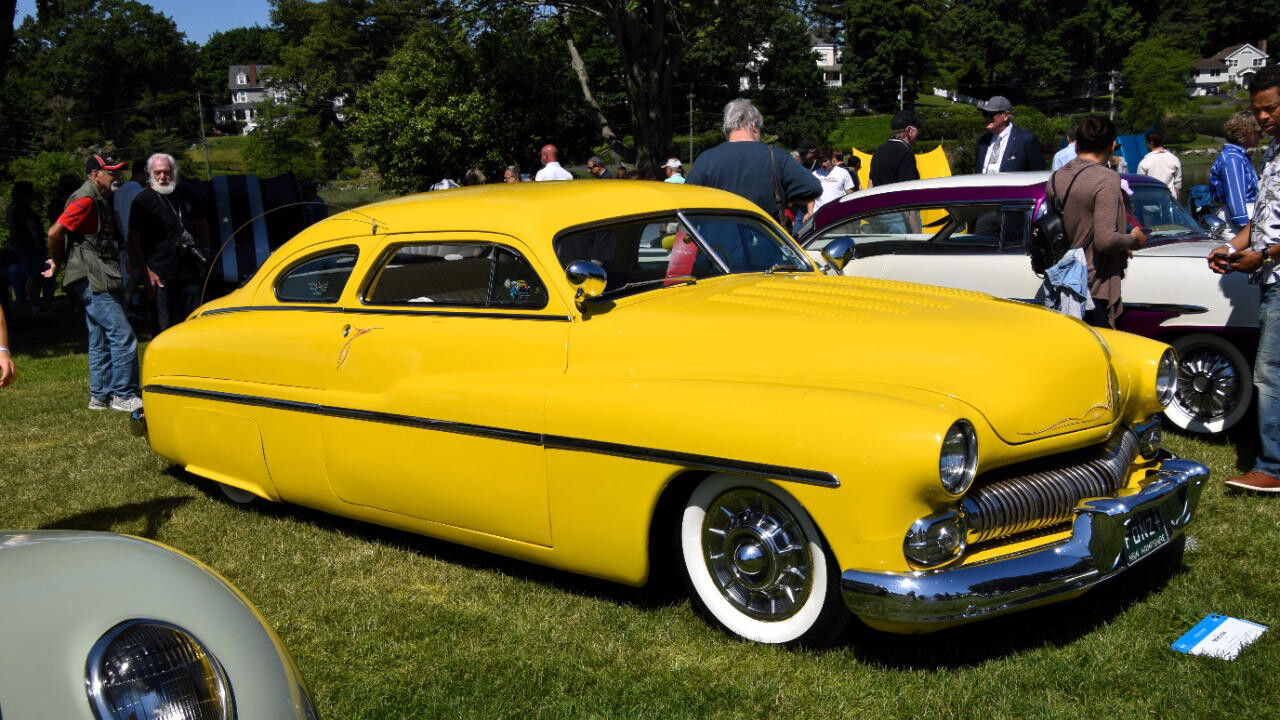
When the 1950 Mercury Eight became a custom car iconThe 1950 Mercury Eight did not simply roll off the assembly line as another postwar American sedan. Within a few short years, it became the definitive canvas for customizers, the shape that turned “lead sled” from slang into a visual language. Its transformation from solid family car to custom icon traces a story of design, culture, and a handful of visionary builders who saw radical potential in its steel. From postwar family car to custom favorite The Mercury Eight began as Ford’s full-size offering under the Mercury division, positioned between Ford Deluxe and Lincoln models in the company’s hierarchy. The third generation, introduced in 1949, marked a clear break from prewar styling and set the stage for the 1950 model that enthusiasts celebrate today. Contemporary accounts describe the 1949 Mercury Eight as a landmark vehicle that launched Mercury’s postwar design shift and helped define the look of the early postwar era. That third-generation Mercury Eight quickly attracted attention from customizers. Sources that survey classic car history note that, within its era and long after, the Mercury Eight was popular with custom enthusiasts, particularly in Southern California, where the custom scene was taking shape. The car’s long, low proportions, generous fender lines, and substantial body panels gave builders room to sculpt, smooth, and personalize. By the time the 1950 Mercury Eight appeared, the platform was already recognized as fertile ground for experimentation. Why the 1950 body was perfect for a “lead sled” Customizers gravitated to the 1950 Mercury Eight because its factory design already hinted at the sleek profiles they wanted to create. The car sat relatively low for a full-size American model, with a rounded roofline and flowing fenders that could be extended into a full fade-away treatment. The long hood and substantial rear quarters balanced visually once the roof was chopped, which helped the modified cars look intentional rather than distorted. Builders also appreciated the car’s construction and mechanical layout. The Mercury Eight used a body-on-frame design that tolerated significant cutting and welding. Its flathead V8, while not exotic, provided dependable power and responded well to traditional hot rod tuning. Accounts of the period describe how the third-generation Mercury Eight became a favorite in the budding Southern California custom car scene precisely because it combined distinctive style with mechanical familiarity. Later profiles of individual cars highlight how customizers pushed the platform. One 1950 Mercury Eight Convertible is described as carrying a bored and stroked flathead V8 along with “Impeccable Looks,” a combination that turns the car into both a performance upgrade and a statement of history. That mix of visual drama and mechanical authenticity became part of the model’s enduring appeal. Sam Barris and the first chopped Mercury The turning point came when Sam Barris, working alongside his brother George, decided that the new Mercury was the ideal car to customize. According to detailed accounts from Barris Kustom, when the 1949 Mercury models arrived, Sam immediately bought one for himself. He used it briefly as a daily driver, then, after less than 100 miles, he and friend Johnny Zaro tore into the body to create the car Sam really wanted. The result is widely recognized as the first chopped 1949 to 1951 Mercury coupe. Descriptions of the Sam Barris Mercury list a 4-inch chopped top, a full fade-away fender line, Buick side trim, a modified 51 Ford grille, custom taillights, and Frenched headlights. When the car appeared at the Oakland Grand National Roadster Show, it won Best Custom, and later histories credit Sam Barris as the builder of the first full “lead sled” from a Mercury Eight. The techniques used on Sam’s car became a template. Chopping the top to lower the roof, shaving handles and trim, molding the fenders into a continuous line, and reworking the grille opening into a smooth, symmetrical shape all became hallmarks of Mercury customs. The fact that Sam Barris performed this work on a Mercury Eight, rather than on some more exotic chassis, helped cement the model as the default choice for ambitious custom projects. The Hirohata Mercury and the lead sled ideal If Sam Barris proved that a chopped Mercury Eight could be elegant, the Hirohata Mercury showed how far the style could go. Masato (Bob) Hirohata approached Barris Kustoms in the early 1950s seeking a car that would stand out anywhere. George and Sam started with a 1951 Mercury and, in a remarkably short build, transformed it into what later commentators describe as the custom that sparked the lead sled hot rod style. The Hirohata Mercury featured a heavily chopped roof, reworked side windows, a distinctive side trim treatment, and a completely reshaped grille surround. The car’s stance was low and level, with the body appearing to float just above the pavement. The Petersen Automotive Museum notes that the Hirohata Mercury, built for customer Bob Hirohata in 1953, remains a standout more than 70 years after its customization and is considered a defining custom Mercury Eight. Although the Hirohata car used a 1951 body, its proportions and techniques were directly in line with the 1950 Mercury Eight that had already become a favorite among customizers. The Hirohata build showed how the basic Mercury shape could support extreme modification while still reading as a cohesive design. That achievement encouraged other builders to treat 1949 to 1951 Mercury Eighths, including 1950 models, as raw material for artistic expression rather than simply transportation. From show circuit to cultural symbol As more custom Mercury Eighths appeared at shows and on the street, the 1950 model in particular began to acquire a reputation beyond the enthusiast community. Later commentaries describe the 1950 Mercury as an absolute icon of classic car culture, especially in the world of lead sled customs. Enthusiasts praise its low-slung silhouette and generous curves as the perfect foundation for personalization. Individual cars have carried that aura into modern times. One custom sedan built from a 1950 Mercury was named “The Rebel” in honor of the car driven by James Dean in “Rebel Without a Cause,” tying the Mercury shape to a broader image of youthful defiance. Another widely shared custom coupe, finished in glossy black with gleaming chrome accents and whitewall tires, is described as a postwar icon with unmistakable style and hot rod potential. These modern tributes show how the 1950 Mercury Eight continues to symbolize mid-century cool. Even among heavily modified examples, builders tend to preserve key visual cues that identify the car. The thick C pillars, the gentle crown of the roof, and the long, unbroken beltline often remain intact, even when grilles, bumpers, and lights are completely reimagined. That balance between recognizability and reinvention is part of what turned the 1950 Mercury Eight into a cultural symbol rather than just another old car. Why the legend still matters More than seven decades after the first chopped Mercury Eight, the 1950 model still inspires new builds and digital tributes. Enthusiast groups describe the 1950 Mercury Eight Coupe as a legend in the world of automotive customization, praising its ability to carry glossy black paint, deep metallic colors, or elaborate flame jobs with equal authority. Social media posts celebrate cars nicknamed “The Dark Legend” or “Custom Mercury Eight Coupe,” often emphasizing how the low roof and long body create a dramatic presence on modern streets and at shows. Restored customs such as the original Sam Barris Mercury and the Hirohata Mercury appear at high-profile events and museum exhibits, where they are treated as historic artifacts. The Pebble Beach Concours d’Elegance has recognized the Sam Barris 1949 Mercury 9CM coupe, restored to its early 1950s appearance with the 4-inch chop, Buick trim, and modified 51 Ford grille that defined its look. The Petersen Automotive Museum presents the Hirohata Mercury as a benchmark for custom design. These institutional endorsements reinforce what builders and fans have long believed: that the Mercury Eight, and particularly the 1950 version, occupies a special place in American automotive history. More from Fast Lane Only Unboxing the WWII Jeep in a Crate 15 rare Chevys collectors are quietly buying 10 underrated V8s still worth hunting down Police notice this before you even roll window down