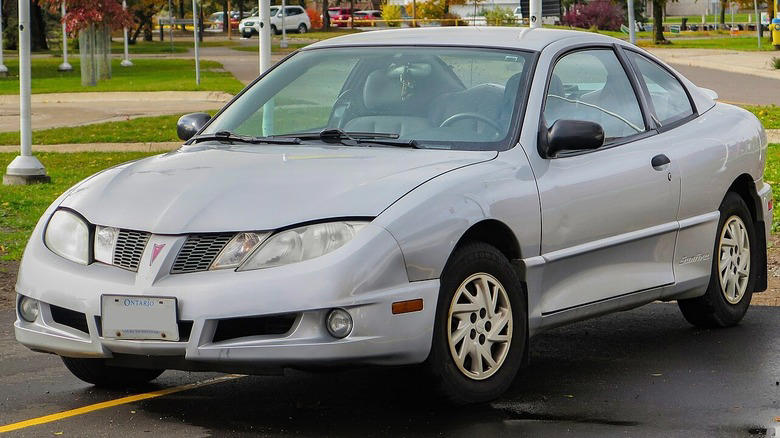
A slow but steady declineBecause the Sunfire was the result of what basically was an emergency measure to get something out the door during massive corporate restructuring, this effectively placed it on borrowed time from Day One, despite its relative success. That doesn't mean it was a bad car; in fact, many contemporary and post-launch reviews praised the Sunfire for its styling and responsive handling characteristics. Plus, it's one of the last of an era where the vast majority of a car's systems were analogue, featuring a pushrod engine, cable-operated throttle, 5-speed manual, wind-up windows, and so on.Although many enthusiasts find these factors to be nostalgically endearing today, back then, it was rapidly showing its age. Plus, the economic environment was vastly different between the mid-1990s when the Sunfire was introduced and the post-9/11 economic downturn. Coupled with soaring fuel costs, major changes swept through all of the Big Three in an effort to adapt to the changing times. GM's new compact debuted right at the start of this new economic era, codenamed the "Delta platform," with the introduction of the 2003 Saturn Ion. This meant GM now had a car which superficially resembled the Sunfire in both form and function, but with vastly more modern underpinnings. The Delta platform specifically targeted the economical import market, finding success in this role with the 2004 Chevrolet Cobalt, effectively rendering the J-body obsolete. Subsequently, the last Lordstown-built Sunfire left the factory in May 2004, and the final foreign-built Sunfire was assembled in June 2005, closing out the J-body line for good.



















 +12 others