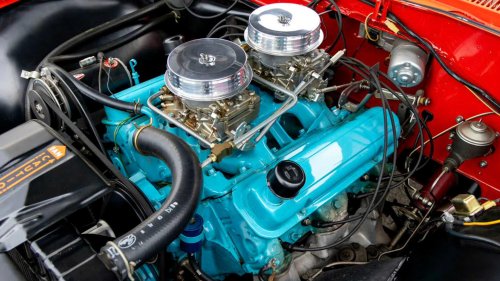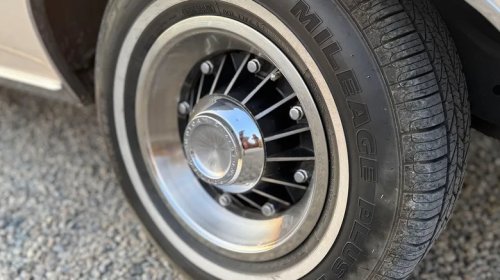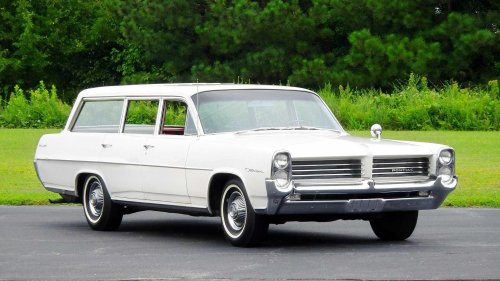
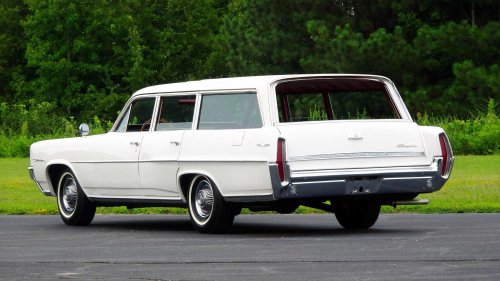
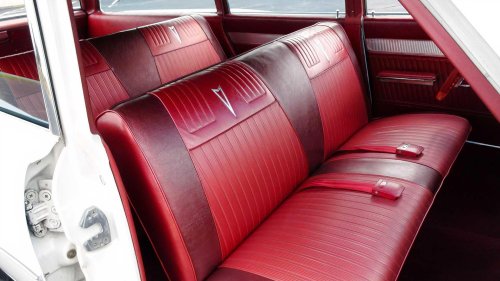
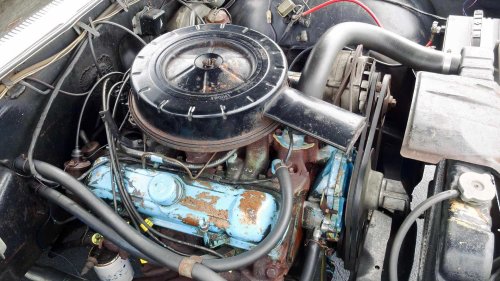
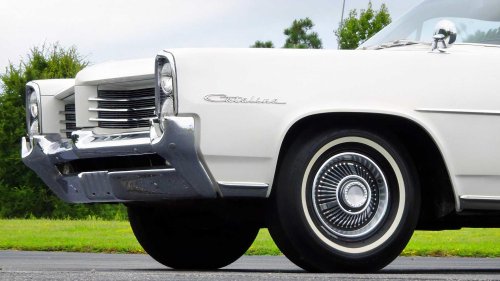
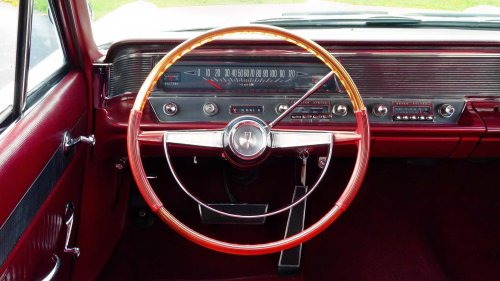
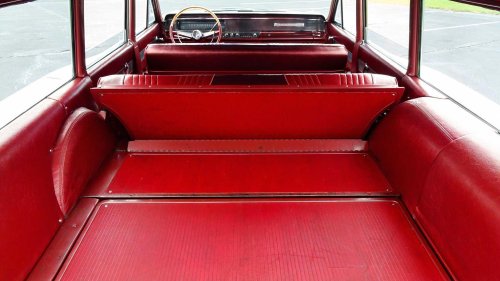



















Even though vehicles today are much larger on average than they were some decades ago, it's still not so easy to transport a large group of people in an everyday vehicle. Even the boldest three-row SUVs struggle. They may offer you some thinly-padded and hidden-away third rows, but if you really want to move nine people on a regular basis today, you're going to have to do some very involved shopping to come up with a solution.However, back in the early 1960s, things were rather different. Manufacturers were able to come up with solutions that could effectively carry nine people effectively, honestly, and without embarrassment. The 1964 Pontiac Catalina Safari wagon is a good example of that, and it's probably one of the clearest expressions of a purpose-built people transport carrier that you can get.Some examples are still around today, and while they may be more than six decades old, they may certainly still be coherent and appealing to those who do hunt in packs. A Catalina Safari reminds us that cool people movers did exist and were designed for real-world use. The '64 Catalina Safari Was Built To Carry Nine People Properly Raleigh Classic AuctionsPontiac engineered the Catalina Safari from the ground up specifically to carry nine people without any contradiction or compromise. It chose its platform and designed the vehicle's proportions to support this purpose while carefully laying out the interior and picking the powertrain to make sure that everything worked just right. Crucially, there was no attempt to streamline or slim down the vehicle to make it look lighter or smaller than it turned out to be.Pontiac used General Motors' full-size B-body platform with a 123-inch wheelbase and an overall length that was beyond 210 inches. This meant that the company could fit three full seating rows to accommodate adults in the very back, and not just kids. There was no question of any cramped or occasionally used third row. Instead, you'd find bench seats in the front for three, a similar setup in the second row, and a rear-facing third row which you could fold flat into the cargo floor if you didn't want to use it. So, this wasn't a seven-seat vehicle with some kind of emergency bench at the back but a true nine-passenger car in both intent and design.Raleigh Classic Auctions Mechanically, the Catalina Safari was well capable of doing its job without moving beyond its comfort zone. You’d get V8 power as standard with plenty of torque and no complaints. The car also looked like it could carry nine people as Pontiac never made any attempt to hide the fact. It came with a very long hood, an expansive greenhouse and heavy chrome detailing to announce its arrival. And while many modern people-movers today try desperately to look as if they are discreet or sporty, there was none of that here. Instead, you’d just get visual and mechanical confidence to create a good alignment between form and function. Full-Size American Wagon Engineering Before Minivans And SUVs Existed Raleigh Classic Auctions If you look back at the early 1960s American automotive scene, you might find a number of full-size wagons serving as daily transport, long-distance cruisers, or regular load carriers. Manufacturers were responding to the demand in the marketplace and made sure that they engineered these vehicles robustly with good attention to detail. OEMs tended to prioritize ride quality over handling for sure, with long travel suspensions, and compliant spring rates. And as wagons like the Catalina Safari had generous tire sidewalls as well, they were able to absorb rough road surfaces with ease. Overall, the Catalina Safari was calm and stable rather than engaging and that's probably just what you’d want in the shape of a nine-passenger vehicle.Remember that this was well before the era of electronic gadgetry, so you didn't have any software solutions trying to make up for undersized hardware. Instead, companies were conservative in their engineering approach and achieved their durability through physical scale. You'd get oversized cooling systems, under stressed engines, and everything else designed to tolerate abuse rather than to chase efficiency. Powertrain Options And How Pontiac Approached Performance, Even In Wagons Raleigh Classic Auctions Pontiac had a sterling reputation in the 1960s, revolving around its redoubtable coupes and muscle cars. The Catalina Safari undoubtedly benefited from that philosophy, and Pontiac didn't fit any smaller or highly stressed engine into this vehicle but ensured that it came standard with plentiful V8 power. You could choose between different carburetion setups to balance responsiveness with smoothness according to your desires. But even if in its most conservative form, the 389 V8 punched out plenty of low-end torque, and this was far more important than peak horsepower in a vehicle with a heavy load. If you wanted more capacity, you could opt for the 421 V8, which was available within the Catalina range.Automatic gearboxes were most popular as they were so easy to deal with and great for relaxed cruising. Acceleration was positive and authoritative rather than hurried, and you could get up to highway speeds without too much effort. You could also climb long grades without drama and even with your full complement of club mates onboard. The Lost Art Of Honest People Moving Raleigh Classic Auctions Onboard the Catalina Safari, the first thing that you notice is the expansive glass area. There are very thin roof pillars and a rather low belt line to give everyone good visibility in all directions. And unlike many modern designs, where you'll often have to sacrifice sight lines for style or structural complexity, here you'll find a cabin that feels intuitive and open. Bench seating is, of course, the dominant interior feature to maximize flexibility and capacity and there's no attempt to create individual zones, as everyone effectively shares the same space, which was perfectly fine given the communal nature of travel in that era. Of course, those at the very back were looking through the rear window, and this was a hallmark of classic American wagons. It certainly gave those passengers a unique perspective on the road and allowed the kids to make faces at any following drivers.Raleigh Classic Auctions The car's materials and controls reflect clarity and durability with tactile switchgear, legible instrumentation, and few bells and whistles. Don't expect to be impressed by any over-the-top interior design, as instead, you get a straightforward approach which somehow contributes to the Catalina Safari's charm. What This Nine-Passenger Wagon Represents Today Raleigh Classic Auctions Collectors weren't too fussy about full-size American wagons for quite a while as they tended to look at them as purely utilitarian and certainly unfashionable. However, that perception may have shifted a little as enthusiasts reassess their historical and cultural significance. One of these wagons could appeal today to someone who is looking for authenticity rather than trendy appeal, and if you really want to be different with your people moving aspirations, the Catalina Safari wagon would certainly be a cool alternative to the homogenous current market. You'd get something with an unmistakable American presence, a clear sense of purpose, and plenty of V8 power, and something that's definitely not shaped by marketing narratives or regulatory constraints. Recent auction results show $21,500 achieved for a smart and original example, and $32,500 for another some years back, in excellent condition throughout. These achieved values align with the figures also provided by Hagerty, who suggest around $14,000 for one in good condition, but upwards of $33,000 for the very best.If you really do need to transport nine people, you’re usually looking at a purely functional rather than a glamorous task. But as the 1964 Pontiac Catalina Safari wagon shows, you can still do it with an element of fun. Today, Pontiac's wagon feels every bit as confident and complete as it did when it started out, by embracing scale, mechanical simplicity, and clarity of purpose. And crucially, the passage of time has done little to dent its appeal.