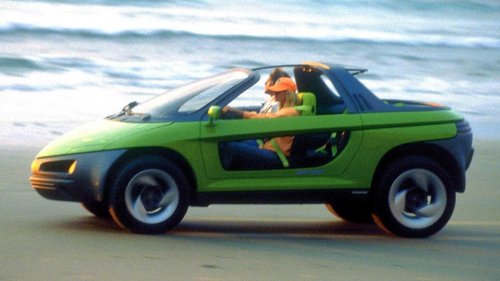
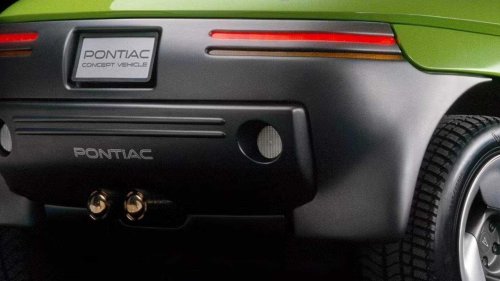
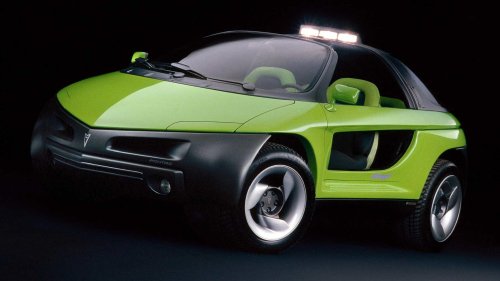
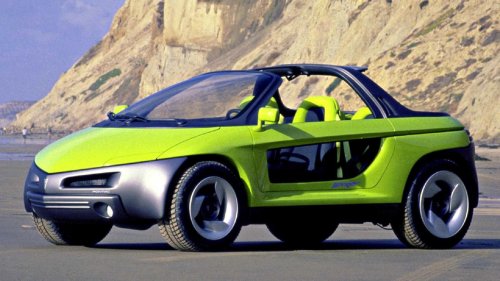
Before SUVs became America’s default family uniform, Pontiac had a strange, bright idea sitting under the Detroit auto-show lights. It mixed the stance of a dune buggy, the cargo tricks of a compact SUV, the loose attitude of a weekend camper, and the gadget habit of a late-1980s concept car.That prototype also showed what pioneering ideas Pontiac had at the time. The company could see young buyers changing before showrooms caught up. They wanted image, freedom, storage, weather gear, and enough tech to make a catalog editor sweat. GM let the division build the idea, show it, and make people stare. Then the company let it vanish. Pontiac Saw The SUV Future Coming Before Most Buyers Did Mecum By the late 1980s, the sport-utility vehicle had not yet swallowed the American driveway whole. The Ford Explorer had not even arrived as a 1991 model yet. Minivans still looked like the clever family answer, and many compact SUVs still felt like honest little tools with vinyl floors and wind noise. But automakers could already smell change in the air, along with sunscreen, ski wax, and probably a spilled can of Tab.This was basically the start of a new sport-utility era. Younger buyers wanted a car or truck that could work all week, then play hard on weekends. The imagined use case was very clear: surfing, mountain biking, and back-country off-roading.Automakers were starting to also sell identity. A vehicle could promise that its owner had a life beyond commuting, even if the wildest trip it took was to a grocery store with a decorative fake mill wheel. Pontiac, of all GM divisions, understood that pitch best. GM Let Pontiac Dream Big, Then Rarely Let The Dreams Escape Pontiac Pontiac had a habit of making concept cars that felt braver than the cars GM later let it sell. In the late 1980s, its auto-show pieces drew attention from critics and show goers. The 1987 Pursuit, for example, explored a performance four-seat coupe idea, while the 1988 Banshee pointed toward future Firebird styling. Pontiac’s studio clearly had people who could think past trim packages and body cladding.That pattern went back much further. The Pontiac Banshee XP-833, a sleek two-seat sports car from the 1960s, looked close enough to production that people still argue over what killed it. Some blame Chevrolet pressure, since the car could have cut into Corvette territory. Whether that explains the whole story or not, it shows the bigger GM problem. A great Pontiac idea still had to survive the family meeting.So, that 1989 concept did not come from nowhere. It came from a division that knew how to turn desire into sheet metal, fiberglass, carbon fiber, or whatever the budget and the show deadline allowed. Pontiac could imagine an enthusiast vehicle with real personality, though GM could admire the imagination, park it under lights, then ask the hard corporate question: How many can it sell, and whose lane does it invade? The 1989 Pontiac Stinger Was Pontiac’s Wildest Outdoor Machine GM Then Pontiac finally gave the thing a name. At the 1989 Detroit show, it rolled out the Pontiac Stinger, a neon-green outdoor machine that looked like a dune buggy had gone through a futurist MBA program.The Stinger had far more going on than a loud paint job. Pontiac laid it out as an all-wheel-drive four-seater with a 3.0-liter four-cylinder engine and active air suspension that could raise the body by four inches. The motor had a 16-valve layout, made 170 horsepower, and was tied to a three-speed automatic with four-wheel drive and anti-lock brakes.The hardware had serious Pontiac fingerprints as well. The engine used a special double-overhead-cam version of Pontiac’s Super Duty four-cylinder, itself tied to the Iron Duke/Tech 4 family. It also relied on a non-production four-valve head, multiport fuel injection, and a low-restriction exhaust. The driveline drew from the all-wheel-drive system used in the Pontiac 6000 STE and SE sedans. That is the kind of parts-bin wizardry engineers do when nobody from accounting stands too close.GM Then came the features. The Stinger used a carbon-fiber body over a steel frame, removable glass panels, removable roof sections, and door openings that could take beverage coolers in place of lower glass. Pontiac packed in a camp stove, fold-out picnic table, umbrella, vacuum, cellular phone, CD player, first-aid kit, toolbox, fire extinguisher, and even a hose. A car with its own hose sounds silly, but after a beach day, that’s not a gimmick. That is customer research with sand in its shoes. The Stinger Wasn’t A Joke, It Was A Crossover Before Pontiac Had One GMIt is easy to laugh at the Stinger because it looks like peak 1989. The green-and-gray body, the removable panels, the gadget overload, the raised rear seats. It all screams "concept car" in big block letters. Yet the core idea made sense. Pontiac wanted one vehicle to blend car comfort, open-air fun, light off-road use, and weekend utility. The brand aimed to mix elements of a car, Jeep, truck, and van for young, active buyers.The Stinger also had the size and layout of something far more modern than its styling suggests. It measured 164.8 inches long, rode on a 98-inch wheelbase, and weighed about 3,000 pounds. That made it compact, not huge. It had independent pneumatic suspension at both ends, disc brakes with ABS, wide tires, and adjustable ride height. In other words, Pontiac was sketching a small lifestyle crossover before that phrase became dealer-lot wallpaper.GM Possibly the smartest bit was that the Stinger tried to give people a vehicle that could commute, carry gear, go roofless, rinse off, and still feel sporty. That idea would become normal later. Pontiac even circled back to some of the same “activity vehicle” thinking with the Aztek more than a decade later, although that one arrived wearing an outfit only a brand manager could love. The Stinger had the same seed, just with better jokes and brighter shoes. Why GM Shelved The Stinger GM GM appears to have shelved the Stinger, but the record does not show a clean, dramatic boardroom moment where one executive slammed a folder and killed it. Production planning remains unclear. What sources do show is simpler, though. Pontiac showed the concept, people remembered it, and it never reached showrooms.The likely reasons sit right on the car. The Stinger used carbon-fiber body panels, removable glass, active pneumatic suspension, special seating, a prototype-style engine, all-wheel drive, and a cabin full of custom accessories. That sounds fun at an auto show, but also expensive in a production meeting. Even the engine had a non-production four-valve cylinder head.Timing also worked against it. Pontiac saw the outdoor lifestyle market early, but the mass SUV boom had not fully proved itself yet. The Explorer would help light that fuse in the early 1990s, and buyers later showed they loved vehicles with car-like comfort, cargo space, and an outdoorsy image. Pontiac had the instinct in 1989, GM just did not turn that instinct into a showroom vehicle. Whatever enthusiasm existed inside Pontiac, the concept did not survive GM’s production process.Source: Pontiac




















 +51 others