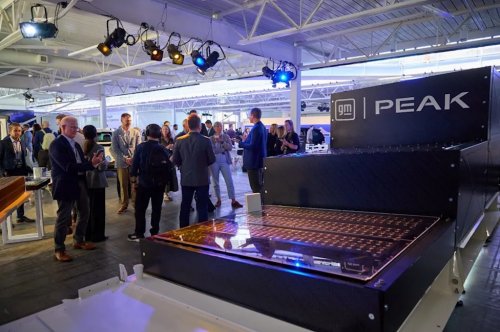
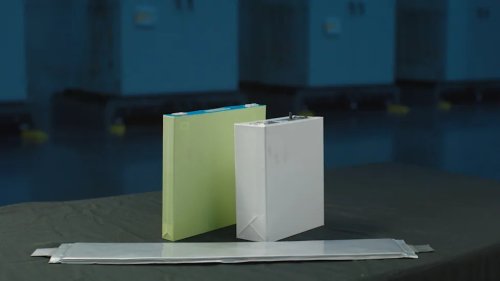
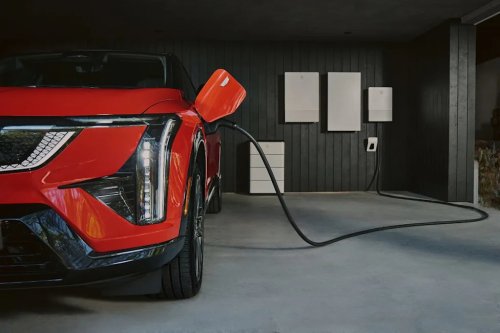
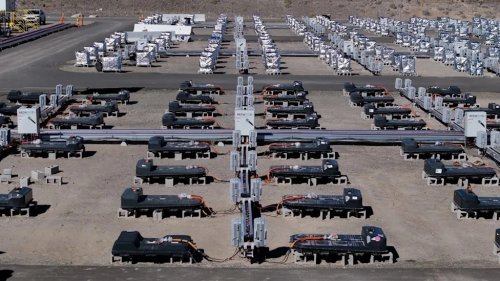
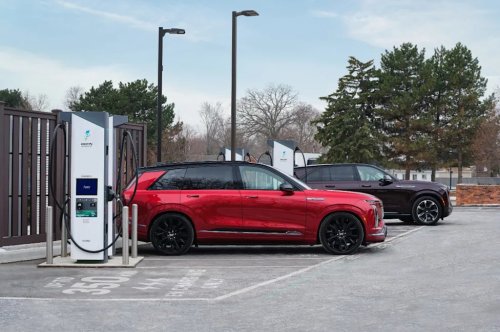



















GM Is Becoming an Energy Company GM (GM)GM announced a big plan to start building sodium-ion batteries for stationary storage uses. The big batteries can buffer demand spikes on the grid.GM is also activating vehicle-to-grid services for existing customers.GM launched Energy Pass, one universal interface for public charging.General Motors has branched out from making electric batteries and electric cars to making the batteries that will help store energy for the entire electric grid. And they won't be lead-acid, lithium ion, or even nickel metal hydride. The new cells, packed into 20-foot-long containers weighing 50 tons, will be sodium ion, or Na+.Obviously, 50 tons would upset the fore-and-aft weight balance of even the Hummer EV, so these aren't made for cars, trucks or SUVs. They'll be used instead to store electricity for the grid. Thus, the sodium ions.AdvertisementAdvertisement"When you're talking to a utility, a hyperscaler, or other power providers in need of energy storage solutions, their priority is not maximizing range or minimizing weight, it is delivering reliable, affordable power over long periods of time in real-world conditions," said Kurt Kelty, vice president, Battery & Sustainability. "That is what makes sodium-ion battery technology so compelling, and it is why we at GM are developing next-generation sodium-ion battery cells purpose-built for grid-scale storage, in partnership with Peak Energy and backed by a strategic investment from our GM Ventures arm."Cells for sodium-ion batteries.' expand='GM (GM)The advantages are:A 20 to 30 percent cost savings vs. comparable batteries of other chemistries over a 20-year service life.A very long service life, good for 10,000-20,000 cycles, 10 times that of EV car batteries.They don't produce anywhere near as much heat as typical car batteries like lithium ion or lithium iron pohosphate, so Na+ batteries do not require energy-intensive cooling.A 20-foot-long container-looking battery can power 300 homes for 24 hours. Or be used to buffer peak loads on the grid to prevent blackouts. Or store electricity made during cheaper hours of the day and deploy it during high demands.Sodium is one of the most common elements on the planet, no one country controls the supply. It's even widely available in the US.Problem is, and there's always a problem, it'll take GM at least five years to start making these. Right now it's in the Road Map stage of development.AdvertisementAdvertisement"GM is announcing its commercial energy storage system (ESS) technology roadmap, anchored by our plan to develop and deploy sodium-ion batteries for industrial-scale grid applications, in partnership with Peak Energy."Other GM AnnouncementsIn addition to the Na+, GM made several other announcements:GM is activating a vehicle-to-grid for existing customers using theGM (GM)250,000 General Motors EVs already on the road capable of bidirectional charging. With no new hardware required, the fleet of EVs is "ready to serve the grid" as an energy storage and use resource. To do that, GM is releasing a firmware update that gives current GM Energy vehicle-to-home (V2H) systems full vehicle-to-grid (V2G) capability. Customers who already own the equipment receive this automatically. It might be more of an idea at this stage, since "we need utility and regulator collaboration," the General said.Additional energy storage systemRedwood Materials partners with GM to use repurposed batteries to power an energy center.GM (GM)partnerships include working with Redwood Materials for second-life battery packs, including new plans to utilize second-life batteries to power a GM manufacturing facility, and leveraging Ultium cells capacity for accelerated production of LFP cells for LG Energy Solution's ESS business.GM launches Energy Pass: one universal interface for public charging. I tried this out and it worked. Rather than argue with someone on an 800 line, you just plug in, at least at select charging networks.Energy Pass works, I tried it.GM (GM)Other manufacturers have this already, most notably Tesla, but GM's adopting it will make the difference to get more people used to charging EVs. With Energy Pass, GM EV owners can find, start, and pay for charging across Tesla, Electrify America, and IONNA stations in North America—with EVgo and ChargePoint coming soon—through a single interface built into the myChevrolet, myCadillac, and myGMC apps. With these five networks, Energy Pass will integrate into nearly 70 percent of all accessible US DC fast charging. Finding a charger, starting a session, and paying for it now happens in one tap—inside the same app already managing a customer's vehicle. No separate accounts, no network-by-network friction, no screaming at a charging pedestal in the middle of nowhere.GM also confirmed that all new 2027 model year GM EVs will have native NACS inlets, with a rollout through the remainder of 2026.So GM has not given up on EVs and is, in fact, expanding on an electric future.