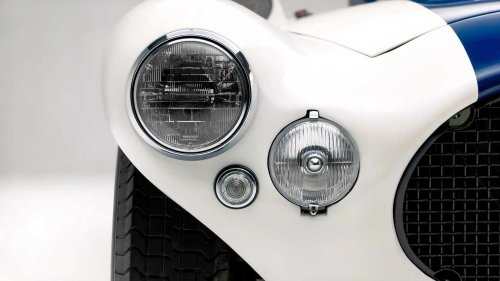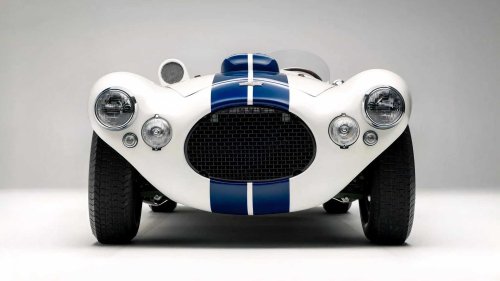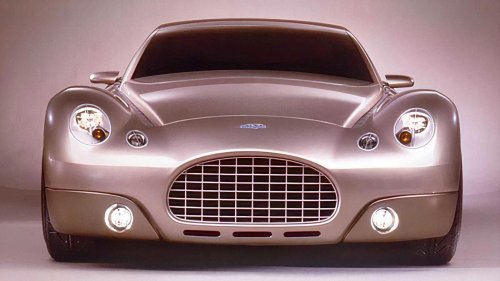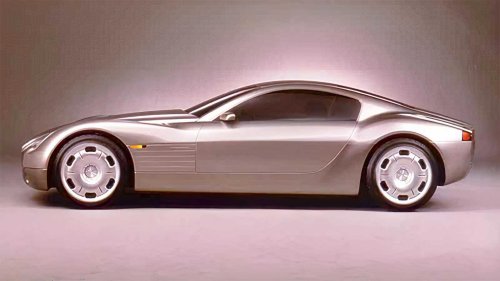
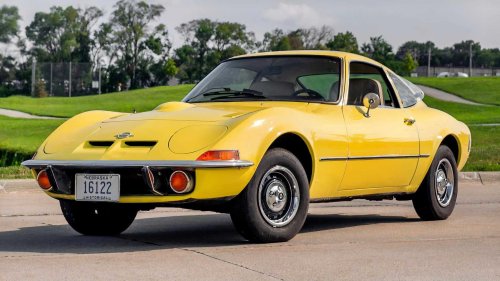
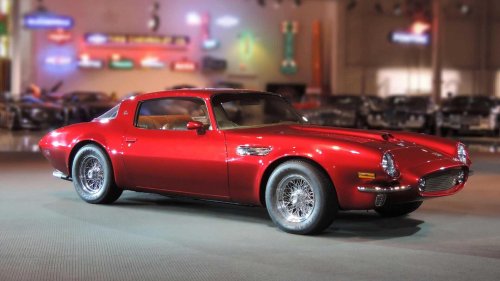
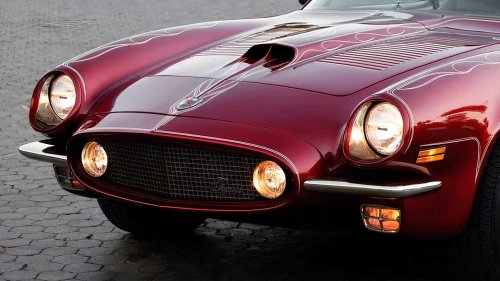



















Cross-continent cars are nothing new. For decades, automakers have blended ideas from different countries to create vehicles that combine the strengths of multiple automotive cultures. But for all the cooperation between some countries, there have been scant few cars to combine American and Italian parts, particularly those with American bodies and Italian engineering. There was one concept that tried to do that, but General Motors put a stop to it before it could ever get going. American And European Cars Were Two Sides Of The Same Coin MecumThough America and Europe were both very much in the car-making business by the late 1960s, they went about it in entirely different directions. American cars were big, heavy, and focused on straight-line power, often using whopping great V8 engines to propel them down the highways. You had the muscle and pony cars that turned fuel into noise, and the ostentatious land yachts with their dramatic styling and length portraying their owner’s wealth and status.European cars, meanwhile, went in almost the opposite direction. There, cars focused on lightness, fuel efficiency, handling, and smaller, more efficient engines that provided a balance between displacement and performance. This was partly due to the role that cars played on the two continents; the US saw them as status symbols and an extension of self, while European countries took them in their own directions—Germany going for reliability, France for versatility, and Italy for performance and beauty. And while it seems the two markets are diametrically opposed, there have been some cars that met in the middle. Though Rare, Transatlantic Cars Had Worked Bring A TrailerThrough the 1950s and 1960s, there were several European cars that took engines from American vehicles. Cars like the Jensen C-V8, which was a British four-seater GT car with a Chrysler V8 in it, or the Shelby Cobra which used the British AC Ace as its base and fitted a Ford V8 engine up front.It wasn’t just the Brits that turned to American power, though, as GM’s European subsidiary Opel also contributed to transatlantic collaborations, with cars like the Opel GT arriving in 1968. But while the UK, US, and Germany all played together, there was precious little uniting America and Italy. The two countries had very different views on what a car should be, and untamed power didn’t quite match with the elegance you’d expect from Italian marques. There had been some, like the De Tomaso Mangusta, which used a Ford V8, and the Cunningham C3, which used a Chrysler V8, but Italian-engined American cars were a considerable rarity. That was until one car that took the best of American design and paired it with the finest Italy had to offer, creating something truly unique in the process. The Pontiac Pegasus Is A Car As Mythical As Its Namesake GMThose familiar with GM will know the name Bill Mitchell. He spent 42 years in automotive design at GM, spending 19 years as its Vice President of Design and had a hand in the design of over 72.5 million cars, including the 1955-1957 Chevrolet Bel Air, the 1966-1967 Buick Riviera, and the 1961-1976 Corvette Stingray. Not a bad resume. He was also behind arguably one of GM's most outlandish concepts: the 1971 Pontiac Pegasus.The Pegasus actually started with a sketch by fellow designer Jerry Palmer, per Hagerty. The sketch depicted a refreshed Camaro that took inspiration from the 1958 Ferrari 250 Testa Rossa, which Mitchell liked enough to commandeer for Pontiac. The design was further refined, with Mitchell creating something that blended European elegance and Pontiac muscle, and the second-generation Firebird (released the year prior) was used as a base.That base is barely recognizable in the Pegasus, though. Gone was the split-grille, and in was a round, open grille similar to the Testa Rossa’s. The headlight channels from the Testa Rossa also made an appearance, separating the headlights from the hood and giving it a much more European-looking front end. At the rear, the window wrapped around the back of the car—dissimilar to the open-roofed Testa Rossa, but that wraparound window would make an appearance on the 1975 Firebird. Even the interior was changed, taking in Ferrari parts, including the gauges, seats, and shifter.Despite the copious design changes, though, the most interesting part of the concept was the engine. Rather than simply keeping the Firebird’s engine, or liberating something else from GM’s plentiful warehouse, Mitchell leaned into the Italian styling and went to Il Commendatore himself, Enzo Ferrari. Both Mitchell and Ferrari were friendly, and the Italian marque was keen to find some American allies after their Ford takeover had fallen through in the mid-60s. Ferrari, perhaps surprisingly, obliged and gave Mitchell a 4.4-liter Colombo V12 similar to that in the Ferrari 365 GTB/4 "Daytona". The naturally-aspirated engine packed 352 horsepower and would be the crown jewel of Mitchell's concept. Despite Promise, The Pegasus Remained A Myth Despite the Pegasus’ high-revving engine, glorious aesthetics, and melding of American and Italian automotive sensibilities, GM wasn't interested. It was never supposed to be a production car, instead being just another proof of concept and side-project for Mitchell and designers who wanted to see if it could be done.The car proved that it could be done, of course, but it wasn’t without expense. That Ferrari engine alone wouldn’t have come cheap, as the 365 GTB/4 Daytona cost $19,500 new (over $180,000 today) at a time when the base Firebird was $2,666. Then there were the changes required to fit the engine into the Pegasus’ body. GM also saw little case for an expensive Italo-American hybrid at a time when emissions regulations were tightening and the muscle car market was already shifting. The Pegasus answered the question of "what if," but not strongly enough for GM to consider it a "why not." GM’s Ferrari-Powered Pontiac Gets Put To Pasture General Motors Some concept cars never get further than the paper they’re drawn on, so in that sense the Pegasus was a success. Some concepts get turned into real-life cars, but then never turn a wheel—instead showing up at shows or on social media, essentially as a fancy paperweight that gets stored away and forgotten. The Pegasus was none of these. It was a bona fide, fully-working car and, on his retirement in 1977, he took the car with him to drive it. The car remained in his possession until his death in 1988, when it was returned to GM, and it now sits in GM's Heritage Collection.The Pegasus remains as a fusion of the American and Italian automotive worlds. Ones that exist on opposite sides of the planet, with completely different philosophies, but which are joined by that inescapable desire to drive exciting, beautiful cars. While it’s a shame that it never made it to full production, we can at least be happy that it was made at all. Many don’t even get the chance.