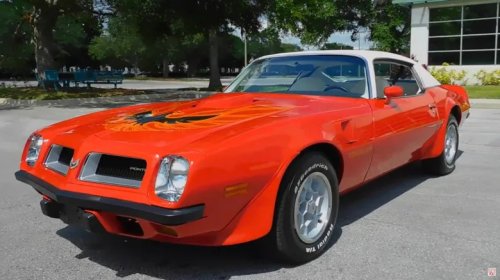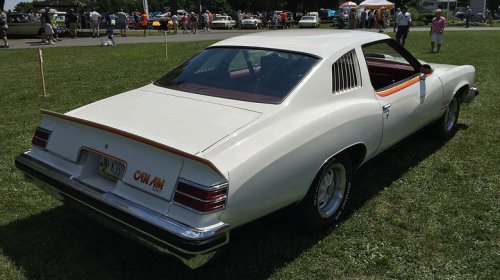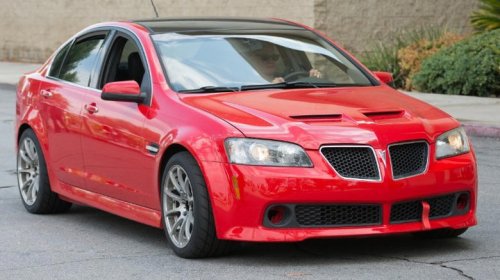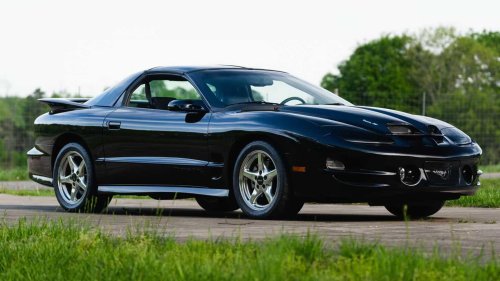
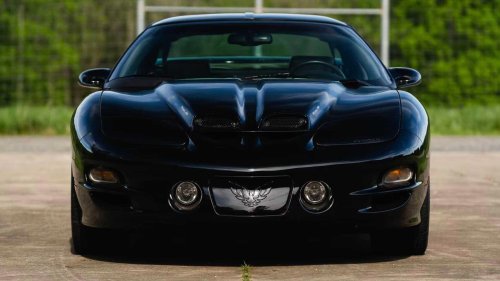
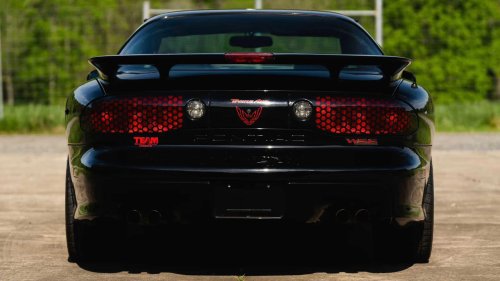
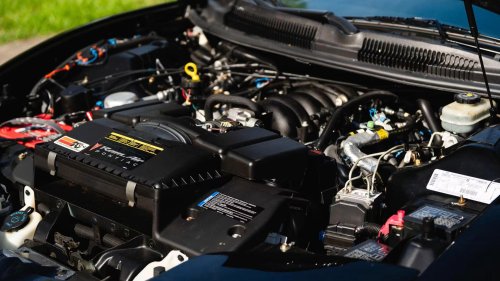
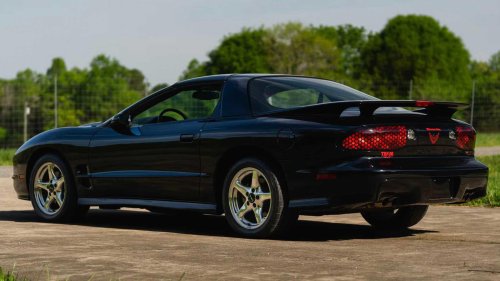
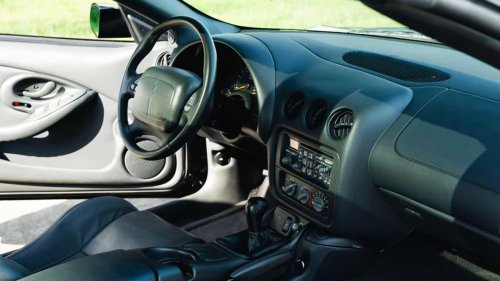



















It would be easy to think that peak Pontiac was around about the time when Burt Reynolds put on a cowboy hat and a red shirt. But there is more to the Trans Am than its Smokey and the Bandit years. True, these 1976 Trans Ams have the most iconic appearances, matched only by Reynolds' mustache, but with 200 horsepower, they aren't exactly fire-breathing muscle car monsters. The '70s had started to rein in the muscle car scene, with an oil crisis and emissions regulations cutting down the freewheeling power of the '60s American sports cars.The '80s and '90s saw carmakers trying different ideas, such as turbocharging, in the pursuit of power, but nothing seemed to replicate the good old days of V8 '60s muscle cars. It wasn't until the fifth-generation Ford Mustang arrived in the mid-2000s, as well as the likes of the Dodge Charger and Challenger, that the muscle car scene was well and truly revived.Well, that's not strictly true. There was one last Pontiac Ram Air that arrived before this that may look like an oddity, but it is one serious muscle car. This was arguably Pontiac's last old-school muscle car before the firm went in another direction and ultimately closed down. This is a model that is still affordable, but beware: prices are going up. Get one of these modern classics while you can. The Trans Am WS6 Was The Last Old School Muscle Car From Pontiac Via: Mecum Auctions The fourth-generation Trans Am arrived in 1993 and would be the company's last. Not many people would have thought that when it rolled into showrooms that year, but then not many would have expected it to still be around in 2002 either, perhaps. This long run for the Trans Am could have easily lost steam halfway through, with Pontiac relying on a few lazy special editions to keep it moving steadily off the forecourts. But just as with the Turbo Trans Am from the previous generation, the company was saving the best until last. The Firebird WS6 Was The Pinnacle Of '90s Muscle Via: Mecum Auctions For 1996, the LT1 engine option in the Trans Am was producing a healthy 285 horsepower, but Pontiac also offered the WS6 performance package. The optional extras included different tailpipes and a tweaked suspension (including higher rates for the front and rear springs, and a larger front antisway bar), but most importantly, there was a “Ram Air” hood. Ram Air has been something of a Pontiac magic wand since the '60s, essentially its trademark way of teasing more power out of its motors.Pontiac had offered an over-the-counter parts package to GTO customers in 1965 that could boost performance. While it wasn't officially called Ram Air, it introduced the principle. A steel pan with foam gasket was joined to an open hood scoop insert that had been cut open, meaning cold air from outside could be forced into the engine. In 1968, Pontiac introduced the name Ram Air as the highest-optioned engine for GTOs, with the two words becoming a Pontiac trademark on top-end muscle cars over the years. Those Dragon Nostrils Had A Function Via: Mecum Auctions The twin nostrils on the Trans Am weren't just for show, they worked as a cold air induction system that helped to bring the LT1's output to 305 horsepower and 335 Ib-ft of torque. The WS6 package was then rolled out for the convertible Trans Am for the following year. In 1998, the Firebird received the lighter and more powerful LS1 V8 from the C5 Corvette. In 2000, a WS6 Trans Am was pushing out 320 horsepower and 345 lb-ft of torque. For comparison, a 996 Porsche 911 had 296 horsepower from its flat-six. The Trans Am WS6 Ram Air Is A Fast Car 1998 Pontiac Trans Am WS6 Engine2000 Pontiac Trans Am WS6 Specs The WS6 Ram Air proved that the days of the growling V8 muscle car were well and truly back. An independent test of a WS6 Trans Am found that the car could hit 60 mph in five seconds flat, and cover the quarter-mile in 13.5 seconds. As pointed out after the test, this was quicker even than the iconic '69 Pontiac GTO Judge, which had a superior 370-gross-horsepower from its 6.6-liter V8. By 2001, a six-speed Hurst shifter was available, and there were a few other subtle but effective improvements.A billet-steel camshaft increased output by five horsepower and gave more torque lower down in the rev range. Reduced tolerances in the crankshaft cut out any cold-knock that was seen in earlier models, and exhaust flow was improved. Pontiac even went to the trouble of fitting larger fuel injectors for maximum fuel delivery. The sprint to 60 mph was now knocked down to below five seconds. The Firebird Ran Out Of Airspace In 2002 Via: Mecum Auctions The WS6 Ram Air continued until 2002. The end of the line came in 2002, when the Firebird flew just one last time. This came in the form of the 2002 Collector’s Edition, which was a WS6 finished in bright yellow paint with black accent stripes and black alloy wheels. After that, Pontiac brought back the GTO as an American version of the Australian Holden Monaro. The last true muscle car from Pontiac was the G8 GXP, a super sedan fitted with a Corvette-derived, 415-horsepower 6.2-liter LS3 V8. Pontiac then closed its doors for good in 2008. Buying A WS6 Ram Air In 2025 Used Prices Of Pontiac Firebird WS6s 1996 Pontiac Firebird Trans Am WS6coupe: $14,800 2000 Pontiac Firebird Trans Am WS6coupe: $17,300 2001 Pontiac Firebird Trans Am WS6 coupe: $18,600 2002 Pontiac Firebird Trans Am WS6coupe: $19,000 2002 Pontiac Firebird Trans Am WS6cabriolet: $18,600 Source: Hagerty Valuation Tools (Good Condition) WS6 cars are fairly rare, as Pontiac didn't sell a huge number of Firebirds in the late '90s, says Hagerty. The automotive specialist says that of around 31,000 Firebirds sold in 1996, around 2500 of these were WS6-equipped. The following year, WS6 sales were under 3,900. However, in 2000, customers got wind that the Firebird was on its way out, which helped to create more interest in these dying cars. For this year, there were around 8,000 sold, with around 7000 WS6 Trans Ams being shifted in 2001, up to 15,000 in the car's final year.Via: Mecum Auctions The styling of the WS6 Ram Air cars is very much an acquired taste, with an overstyled bling that seems to cross with a Fast & Furious OTT aesthetic. But two decades on, just as with the ostentatious Supras of that movie, these of-the-era looks are more appreciated. Much overlooked in the early 2010s, by the end of that decade, interest was increasing and prices were going up. This is probably helped in a small part by the fact that Jay Leno no less is a fan of the car. WS6 Cars Are A Bargain - For Now Early cars are where the bargains are, with a 1996 Pontiac Firebird Trans Am WS6 coupe costing just $14,800, according to Hagerty Valuation Tools. But it's worth remembering that the WS6 was constantly improved, not to mention getting the Corvette's LS1 engine, so it pays to spend a little more on a later car. A 2000 Pontiac Firebird Trans Am WS6 coupe costs $17,300 in good condition, whereas a 2001 Pontiac Firebird Trans Am WS6 costs $18,600, and a 2002 car comes in at $19,000. The convertibles often carry a premium - a rag-top 2002 WS6 has a good condition price of $29,200.