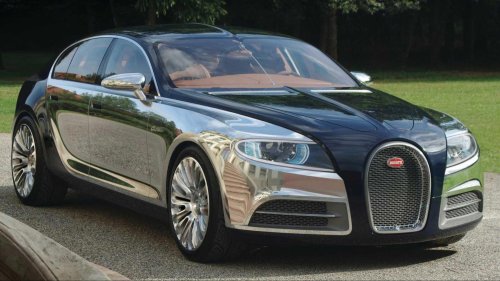























The first thing that comes to most people's minds when they hear the word "Bugatti" are record-beating supercars with exorbitant price tags – those made since the brand has been under Volkswagen's ownership. After all, these modern Bugatti hypercars are what made the brand mainstream. But what if we told you, these aren't really the coolest Bugattis? Or at least not the rarest.The iconic hypercar brand has made plenty of luxury and sports cars that haven't been as successful over the years. For example, one car on this list fell victim to financial issues, a few got abandoned because Bugatti prioritised developing new hypercars over them, and one was even part of a failed bid to reboot the classic version of the company. What they all share in common is that none of them were ever sold to the public, and you'll probably never see one in real life. Bugatti Atlantic The first car on this list is the most recent Bugatti model to not end up making it to the production stage. The Bugatti Atlantic was a secret project built back in 2015 in Volkswagen's plant in Wolfsburg, and it would have signalled an expansion of the brand.The Atlantic was supposed to be a cheaper Bugatti, sharing more parts with other Volkswagen Group cars as a way of keeping the cost down. It was a hybrid, with a 4-liter twin-turbocharged V8 and four electric motors. The internal combustion engine only drove the rear wheels, while the electric motors drove all four, thanks to one being dedicated to each wheel. It also effectively had two transmissions. The internal combustion engine had a 7-speed dual-clutch automatic, while the electric motors had their own single-speed direct drive transmission units. Coupe and roadster versions were both planned, as were fully-electric models that didn't have the internal combustion element of the powertrain.When you think about all that, the Bugatti Atlantic should have been an easy sell. The idea of a cheaper Bugatti with a full hybrid powertrain and the potential to have fully electric variants looked very appealing back in the mid-2010s. But, that's not how things turned out. Volkswagen was rocked by the emissions scandal. The Bugatti Atlantic ended up in the crossfire of all the difficult corporate decisions the Volkswagen Group had to make, and it ended up being axed for good. This happened not long before it was due to be shown at Pebble Beach in 2015 and the Geneva Motor Show in 2016. With those public appearances cancelled, the Atlantic was locked away in storage for years. It finally got shown to the world in 2020, and everyone was left lamenting the incredible car it could have been. Bugatti 18/3 Chiron The Bugatti Chiron, which became the Bugatti Veyron's successor, wasn't the first car to be given that name. Bugatti had already used the Chiron name on an earlier concept car that it made before the Veyron even existed. The Bugatti 18/3 Chiron could have been Bugatti's first model under the Volkswagen Group's ownership, and in some ways, it was crazier than the Veyron.The 18/3 Chiron was going to be powered by a 6.25-liter W18 engine that would have produced 555 bhp and 479 lb-ft of torque. It would have had a 5-speed manual transmission, and the power would have gone to all four wheels through the "Viscous Traction" system from the Lamborghini Diablo VT.While the Bugatti 18/3 Chiron never ended up being made, its influence has lived on right up to the present day. It laid the foundations for the record-smashing Veyron, and all the other Bugatti hypercars that came after it. This includes today's V16-engined Tourbillon, which, thanks to that glorious engine, feels like it's in the spirit of the 18/3 Chiron. Bugatti EB 118 MPW57, via Wikimedia CommonsBack in its original heyday, Bugatti was known for making luxurious grand touring cars as well as sports cars. So, it only made sense that the more modern interpretation of Bugatti might have a go at trying to design a grand tourer. The modern Bugatti company's only attempt at doing this so far is the Bugatti EB 118. This was a two-door coupe that debuted at the 1998 Paris Motor Show. Its styling took cues from the Bugatti Type 50 and the Bugatti 57SC Atlantic, with the seam running through the center of the car being a callback to the latter. It was planned to have the same monstrous 6.25-liter W18 engine as the 18/3 Chiron. This power would have gone through a 5-speed automatic transmission to the same Lamborghini-derived all-wheel drive system as the 18/3 Chiron.The EB 118 was actually a production-ready car, at least in terms of its design. It might have needed to be given a more realistic engine than the crazy W18, but it could have been the next great grand touring Bugatti. Unfortunately, that never ended up happening. Bugatti decided it wanted to focus all its efforts on what would eventually become the Veyron, and the EB 118 was consigned to history. Bugatti EB 112 BugattiHave you ever wondered what Bugatti might make if it tried to build a sedan? Well, the Bugatti EB 112 might help to answer your questions. The EB 112 surfaced in 1993 and was built by Roman Artioli's Italian version of Bugatti. It had a striking design that was penned by Giorgetto Giugiaro, and a bit of an odd powertrain for a luxury sedan from the '90s. While it had a 6.0-liter V12 that produced 450 hp and 479 lb-ft of torque, like you might see in some of the most exclusive sedans of the day, it had an unusual transmission choice: a 6-speed manual. That makes it possibly one of the only V12 sedans ever, at least in modern times, to have a manual transmission. Clearly, this was a car that was supposed to be driven, rather than be driven in.Only three prototypes of the EB 112 were ever made. The first working prototype is the red one in the image above. Another one was black, and a third one was in an anthracite gray color. The red EB 112 was the only one that actually worked in the period. The other two were only partially completed before Artioli's Bugatti ran into massive financial difficulties.After the EB 112 project was canned and the Italian iteration of Bugatti went bankrupt in 1995, wealthy Monegasque businessman Gildo Pallanca Pastor purchased the 3 prototype EB 112. He then not only finished building them, but also made sure that the black one was made road legal so he could drive it around himself. He could sometimes be seen driving around Monaco in this car, until he sold it to German collector Marc Gindorf in 2016. The red one ended up being owned by Italdesign, while the anthracite one was sold to a wealthy Russian. Bugatti EB 218 Italdesign The Italian version of Bugatti might have failed at producing a sedan, but that didn't stop Volkswagen's version of Bugatti from having a stab at it as well. The EB 218 was essentially an update of the EB 112. Like the EB 112, it was penned by Giorgetto Giugiaro. The main visual difference between the EB 112 and the EB 218 is that the EB 218 is more conservative. It had a typical sedan shape, instead of the more striking hatchback-like shape of the EB 112. It was set to use the same W18 engine as the EB 118 and the 18/3 Chiron, and the same Lamborghini-derived all-wheel drive system. It also would have had the same 5-speed automatic transmission as the EB 118. That would have easily made it one of the fastest sedans in the world, had it been produced.Unfortunately, Bugatti's attempt at making a sedan failed again. The EB 218 never saw the light of day, and it's likely because of the same reason that we didn't see a production version of the EB 118 either. Bugatti 16C Galibier BugattiBy this point, you're probably thinking that Bugatti seems to never be able to make a production sedan. With how the 16C Galibier also managed to never make it beyond the concept stage, that's a fair assumption to make! This was the third attempt at making a Bugatti sedan, and it's definitely the one that feels the most mature. It shares a lot of design language with the Veyron, and how it's shaped from the B-pillar back is very reminiscent of the Porsche Panamera.If it had gone into production, the Bugatti 16C Galibier would have used an 8-liter twin-supercharged W16, driving all four wheels through an 8-speed automatic transmission. Bugatti never gave it any proper claimed performance figures, but it did hint that it could have had over 1,000 hp and a top speed of at least 235 mph. It likely would have sounded incredible too.There was a lot of effort put into making the 16C Galibier look like it could be a viable production car. It was displayed in public multiple times, there were plenty of teasers shown, and Bugatti's top brass made sure to talk up its potential. But, Bugatti changed its plans and decided to focus on building a Veyron successor instead of creating what could have been the world's fastest production sedan. While the Bugatti Chiron did end up being an incredible car and a worthy successor to the Veyron, we can only wonder about how awesome the 16C Galibier could have been. Bugatti Gangloff Most of the cars in here did actually exist in the real world, in some form or another. The Bugatti Gangloff, however, has only ever existed virtually! This was a design study by Paul Czyżewski, and it takes cues from Bugattis of both the modern and the classic era. Specifically, it evokes the Veyron and the Type 57 SC Atalante Coupe. The latter of those cars was built by a coachbuilder called Gangloff, giving Czyżewski the inspiration for its name.It isn't known what kind of engine the Bugatti Gangloff would have. But, that probably doesn't matter. It'll only ever exist virtually. That's a shame in some ways. It could look really cool as a one-off build for a very special customer, in the vein of the Bugatti La Voiture Noire. Perhaps a billionaire needs to take a liking to Paul Czyżewski's design, and actually campaign for Bugatti to make it for them... Bugatti Type 101 Virgil Exner/Ghia Roadster Alan Raine, via Wikimedia CommonsThe oddest of the cool Bugattis listed here that never saw production is the one that's also the oldest. The Bugatti Type 101 Virgil Exner/Ghia Roadster was based on the Bugatti Type 101 of the early 1950s. In fact, its chassis was the last Type 101 chassis that was ever produced! It was a personal project of automotive designer Virgil Exner, who got Ghia to do the coachbuilding for him. Like all Type 101s, the Virgil Exner/Ghia Roadster was powered by a 3.3-liter straight-8 that originated from the Type 57.After the car was finished in 1965, Exner exhibited it at the Turin Motor Show. It was a major part of an attempt by him to revive the brand in the mid-1960s. But, Exner's plan failed, and no more of these were ever built. Exner kept hold of this car for several years, and it would occasionally turn up at Pebble Beach.