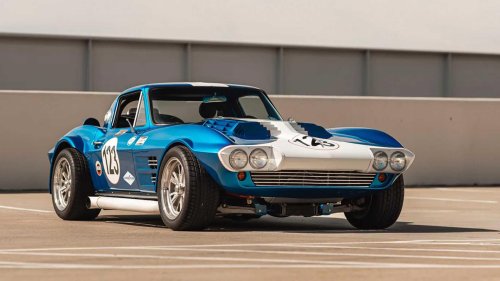
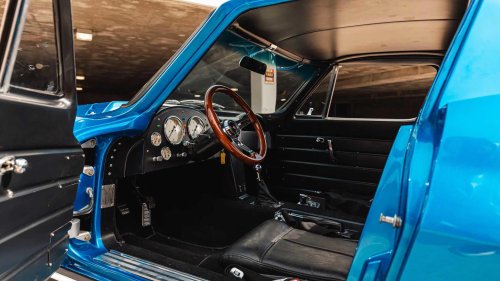
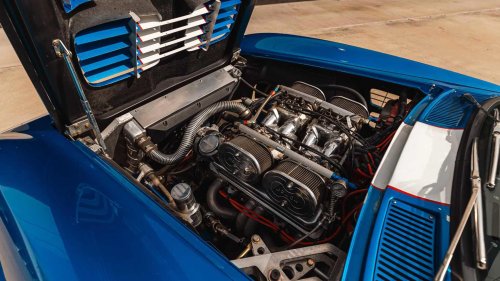
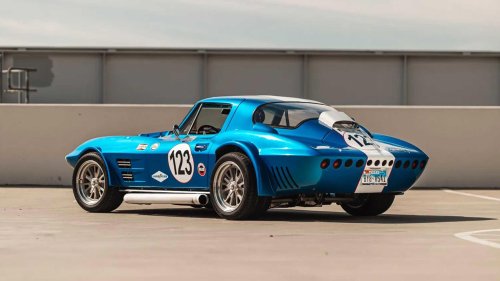
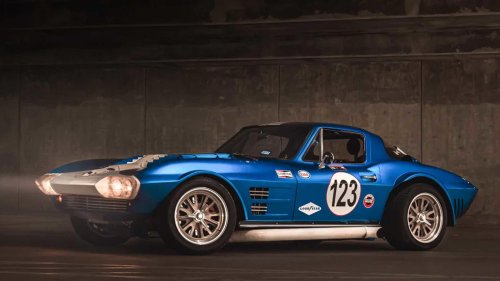
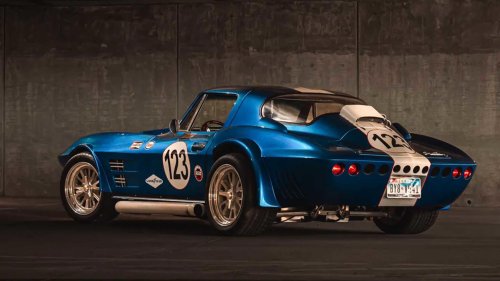
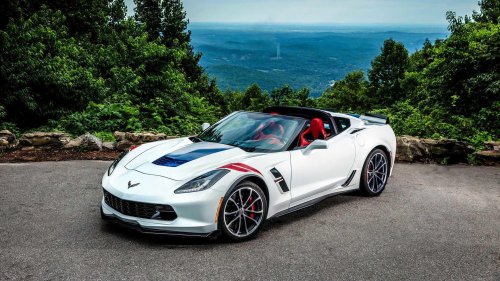
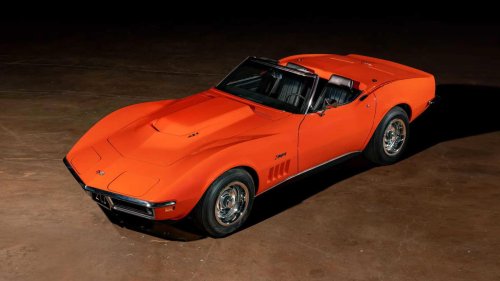
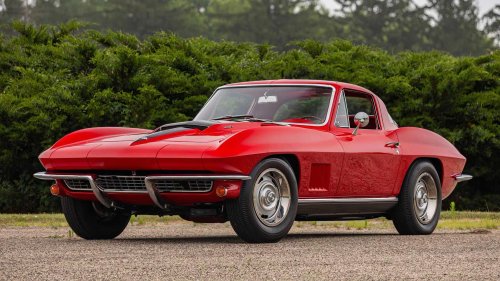
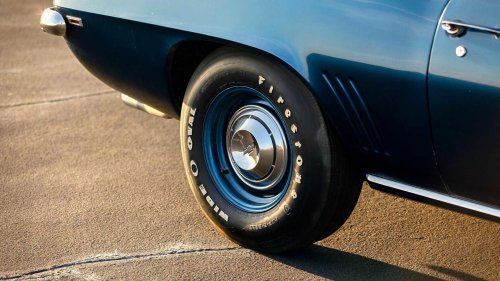
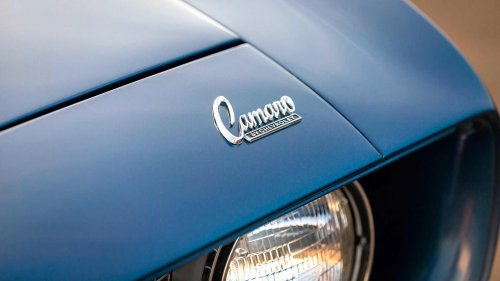
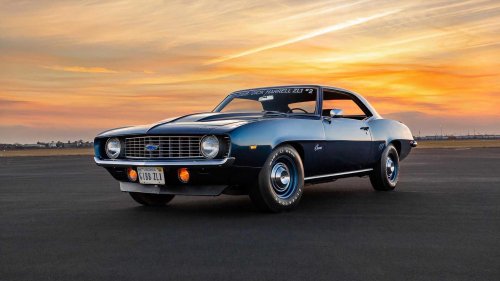
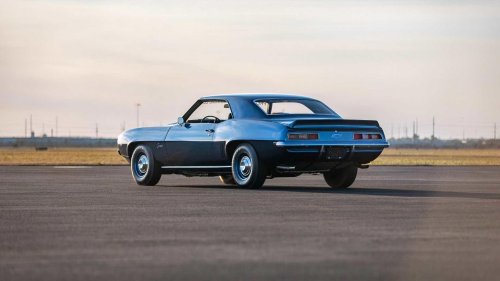
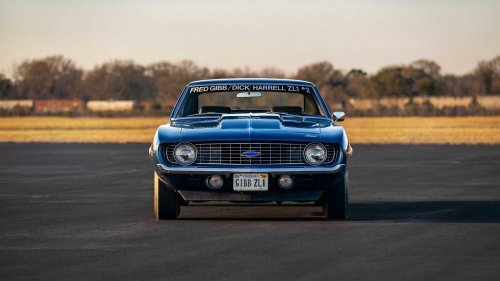
Some cars are rare because they were expensive. Others are rare because not enough were made, as no one bought them. This one is rare because it never reached the dealerships at all. It was built in very few numbers, and the brand pulled the rug from under it faster than it could reach 60 mph.While it may seem like it's available abundantly, these replicas simply pay tribute to a sports car that the manufacturer built, but canceled it immediately. This rare sports car from the 60s was meant for the road and battle the best on the racetrack. Today, the examples that slipped through the cracks are parked in museums, desired by collectors, but we may see them show up at an auction for sale. The 1963 Chevrolet Corvette Grand Sport Is Ridiculously Rare Via: Bring a Trailer The 1963 Chevrolet Corvette Grand Sport is ridiculously rare because it was conceived as a factory-backed weapon that General Motors officially pretended didn’t exist. At the center of it all was Zora Arkus-Duntov, who believed the standard C2-generation Corvette was fundamentally capable but fatally flawed for international racing. It was powerful, but too heavy to compete seriously against the likes of Shelby American Cobras and Ferrari’s purpose-built GT cars. The Grand Sport was his solution: strip the Corvette down, shrink its mass dramatically, stiffen the chassis, and turn it into a legitimate FIA GT contender.The car was engineered specifically with FIA GT Championship regulations in mind. To race in the GT class, Chevrolet needed to homologate the car, which meant building a minimum number of road-legal examples. The plan called for 125 units, enough to satisfy FIA rules while allowing Chevrolet to challenge Ferrari on its own turf. These were not show cars or prototypes meant to be crushed later. They were intended to be legal, registrable, and sold (that was Duntov's intention).Via: Bring a Trailer Following the Automobile Manufacturers Association’s 1957 racing ban, enacted after the fatal crash at the 1955 24 Hours of Le Mans, Chevrolet couldn't openly back any motorsports programs. Even so, Duntov and his engineering team quietly worked around the restriction, offering backdoor support to private Corvette owners who continued to race on their own. However, only five 1963 Corvette Grand Sport were completed before everything collapsed. Duntov built the program in secret, hoping it would result in victory at Sebring and Le Mans.In early 1963, General Motors doubled down on its internal racing ban, ordering all factory-supported competition programs shut down. When GM executives discovered the secret Grand Sport project, they canceled it immediately. The remaining cars were never built, and the existing five were quietly sidelined. They were later sold to private teams to race later, but without factory backing or official recognition.That combination of a clear racing purpose, a canceled homologation run, and a corporate shutdown makes the Grand Sport uniquely rare. With only five examples to exist, it represents a moment when Chevrolet was ready to go all-in against the world’s best, then was forced to pull the parking brake. Engine Specifications And Performance Via: Bring a TrailerThe 1963 Chevrolet Corvette Grand Sport was engineered with one obsession in mind: weight reduction. Compared to a standard C2 Corvette, it shed roughly 800 pounds thanks to ultra-thin fiberglass body panels, an aluminum space-frame-style chassis, magnesium components, and pared-down interiors. Curb weight landed around 1,900 pounds, shocking for an American V8 sports car of the era.Power came from small-block V8s, most commonly a 377 cubic inch unit derived from the 327, fitted with aluminum heads and racing internals. Output ranged from about 485 horsepower to well over 550 horsepower in full race trim, depending on configuration. With that power-to-weight ratio, the Grand Sport was intended to exceed 180 mph and dominate long-distance GT racing. Why The Corvette Grand Sport Almost Never Appears At Auction Via: Bring a Trailer The 1963 Corvette Grand Sport almost never appears at auction for one simple reason: only five authentic cars exist. All five examples were purpose-built race cars that were never sold publicly in the first place, and every surviving example is already accounted for today. When owners have something this historically important, selling it is rarely about money. It’s about legacy.That’s why actual public auction appearances are almost nonexistent. The only recorded attempt at auction came in 2009, when a 1963 Chevrolet Corvette Grand Sport, chassis no. 002, crossed the block at RM’s Automobiles of Arizona in Phoenix. Even with a reported high bid of $4.9 million, the car failed to sell. Since then, authentic Grand Sports have largely traded privately, if at all. Decades can pass without one openly changing hands.Because originals are effectively locked away, demand has spilled over into replicas, which is where most enthusiasts actually get access to the Grand Sport experience. '63 Corvette Grand Sport Replica Sales Are Through The Roof Via: Bring A Trailer While the original five Grand Sports never show up publicly, the classifieds seem to be littered with replicas, recreations, and tributes float around freely for sale. While they attempt to remain true to the documentation of the originals to varying degrees, don't for a single moment they can be acquired for cheap.Replica values have surged as collectors accept that originals are untouchable. The highest recorded replica sale hit $176,000 in 2023, followed closely by a $175,000 sale in January 2026. A well-known replica formerly owned by actor Tim Allen sold for $97,000 in 2024. Looking at recorded sales over time, the average lands at roughly $108,000 for a make-believe replica of a sports car that was never supposed to exist. Several examples comfortably clear $110,000, while the lowest known sale still brought $69,000. That gap says everything about demand for a car most people will never see, let alone buy. All Five Original Grand Sports Still Exist Today Via: Bring a TrailerAll five original Corvette Grand Sports still exist today, which is remarkable given how hard they were raced once Chevrolet pulled the plug. After GM canceled the program, the cars didn’t retire quietly. Instead, they were handed over to private owners and semi-official efforts that fully understood what they had. Teams like Mecom Racing Team and Roger Penske Racing campaigned the cars in period competition, often against better-funded factory rivals.Their breakout moment came at the 1963 Nassau Speed Week, where the Grand Sports outright defeated Cobras and Ferraris, validating everything Zora Arkus-Duntov had predicted. Later, at the 1966 12 Hours of Sebring at Sebring International Raceway, Team Penske entered a Grand Sport as a prototype alongside a Stingray GT, both backed by Sunoco. The Grand Sport, driven by Dick Thompson and Dick Guldstrand, proved competitive even years after its forced retirement. Where They Are Today All five of these race cars were used in competition, and importantly, survived, which was unusual, making them treasured icons of Corvette history. Today, each of the five chassis are accounted for.Chassis 001 belongs to Cincinnati collector Harry Yeaggy. Chassis 002 resides at the Simeone Foundation Automotive Museum, preserved in original, unrestored form. Chassis 003 is owned by collector Larry Bowman. Chassis 004 was displayed by the Revs Institute as part of the Miles Collier Collections. Chassis 005 remains with former Corvette engineer Bill Tower. The Corvette Grand Sport Legacy Chevrolet The Corvette Grand Sport name didn’t die in 1963. Chevrolet brought it back decades later as a badge, first on the C4, then more convincingly on the C6 and C7. In modern form, Grand Sport has meant wide bodies, track-focused suspension, and a sweet spot between the base Corvette and Z06. But none carry the weight and motorsport heritage of the original five. While these were trim packages of the normal Corvette, the original 5 Grand Sports were race cars, built to beat Ferrari and shelved by corporate order. Other Rare Corvettes That Still Trade At Auction Rm Sotheby's The Corvette Grand Sport sits at the top of the rarity pyramid, but it isn’t alone. Other ultra-rare Corvettes prove how deep Chevrolet’s performance bench really runs. Take the 1969 Corvette ZL1, the rarest factory Corvette ever made. Only two were built, both essentially loophole cars created to sneak an all-aluminum, race-bred V8 into a production Corvette. When one of those two surfaced at a recent RM Sotheby's auction, it hammered for an astonishing $3.14 million, underlining just how valuable factory-built outliers have become.Mecum Auctions Then there’s the Corvette L88. Produced in far greater numbers of 216 units over three years, it still occupies rare air thanks to its brutal, no-compromise race setup. According to classic.com, L88 Corvettes carry an average value of $251,333, a figure driven by documented history and originality. The Muncie M22 Rock Crusher manual transmission was the rarest in the 60s, and the L88 was one of the cars that used it. Those examples of the L88 even draw higher bids than most Corvettes at auction.While the ZL1 is rarer than the Grand Sport, the two examples have sold at auction, but any of the five Grand Sports going under the hammer is ridiculously rare. Together, these cars show why the most extreme Corvettes aren’t just collectible, they’re blue-chip assets.Sources: General Motors, Simeone Foundation Automotive Museum, Team Penske, RM Sotheby's, Bring a Trailer, Petersen Automotive Museum



















 +79 others























!['What the [Expletive] Is That?:' Customer Complains Car is 'Shaking Like Crazy.' Then His Mechanic Takes a Closer Look At The Tire](https://cdn.topcarnews.net/thumb/id/aHR0cHM6Ly9jZG4ubW90b3IxLmNvbS9p-bWFnZXMvbWdsLzQwRTk0cS9zMS9tYXpk-YS1taWF0YS1vbi1zdHVkZGVkLXdpbnRl-ci10aXJlcy10ZXN0LmpwZw/79e14514a276098b50ad4c871b42cc60.jpg?t=20261010&post_id=3458)
!['What the [Expletive] Is That?:' Customer Complains Car is 'Shaking Like Crazy.' Then His Mechanic Takes a Closer Look At The Tire](https://cdn.topcarnews.net/thumb/id/aHR0cHM6Ly9jZG4ubW90b3IxLmNvbS9p-bWFnZXMvbWdsL01rWVFNNC9zMS9pbWdf-ODY0Mi5qcGc/6f1ec4b4318a8b257cc3e8a877ffe35f.jpg?t=20261010&post_id=3458)
!['What the [Expletive] Is That?:' Customer Complains Car is 'Shaking Like Crazy.' Then His Mechanic Takes a Closer Look At The Tire](https://cdn.topcarnews.net/thumb/id/aHR0cHM6Ly9jZG4ubW90b3IxLmNvbS9p-bWFnZXMvbWdsL2xFM3dsVy9zMS9pbWdf-ODY0OC1jb3B5LmpwZw/347bc674f00c1700fd29d2c57e842287.jpg?t=20261010&post_id=3458)
!['What the [Expletive] Is That?:' Customer Complains Car is 'Shaking Like Crazy.' Then His Mechanic Takes a Closer Look At The Tire](https://cdn.topcarnews.net/thumb/id/aHR0cHM6Ly9jZG4ubW90b3IxLmNvbS9p-bWFnZXMvbWdsL2JnMTJHdi9zMS9tYXpk-YS1taWF0YS1vbi1zdHVkZGVkLXdpbnRl-ci10aXJlcy10ZXN0LTAxLmpwZw/93bb67d2c8cc97fba8d2ff15175061ca.jpg?t=20261010&post_id=3458)
!['What the [Expletive] Is That?:' Customer Complains Car is 'Shaking Like Crazy.' Then His Mechanic Takes a Closer Look At The Tire](https://cdn.topcarnews.net/thumb/id/aHR0cHM6Ly9jZG4ubW90b3IxLmNvbS9p-bWFnZXMvbWdsL3BiM3E5by9zMS9tYXpk-YS1taWF0YS1vbi1zdHVkZGVkLXdpbnRl-ci10aXJlcy10ZXN0LTAyLmpwZw/99624eda68d3f45fcbd7939f0443e37f.jpg?t=20261010&post_id=3458)
!['What the [Expletive] Is That?:' Customer Complains Car is 'Shaking Like Crazy.' Then His Mechanic Takes a Closer Look At The Tire](https://cdn.topcarnews.net/thumb/id/aHR0cHM6Ly9jZG4ubW90b3IxLmNvbS9p-bWFnZXMvbWdsL1hCNlBYVi9zMS9tYXpk-YS1taWF0YS1vbi1zdHVkZGVkLXdpbnRl-ci10aXJlcy10ZXN0LTAzLmpwZw/544d73fd805018640d3a35252e9dbb76.jpg?t=20261010&post_id=3458)