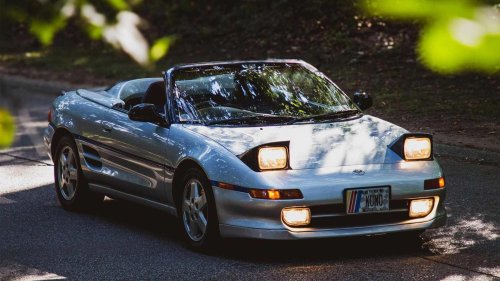
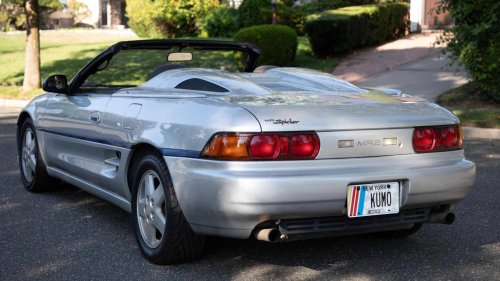
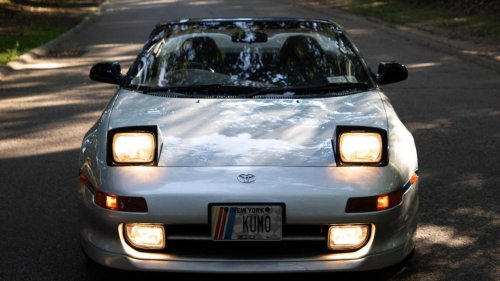
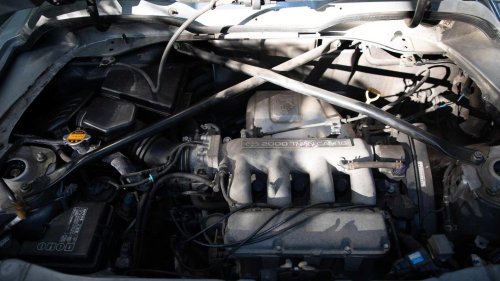
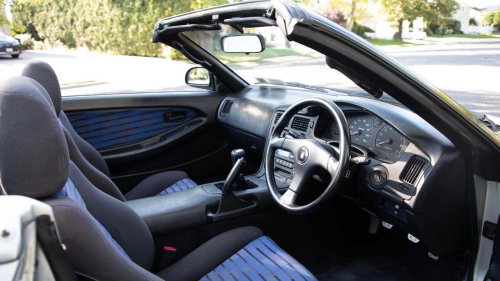
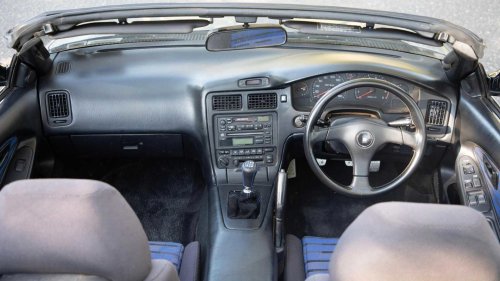
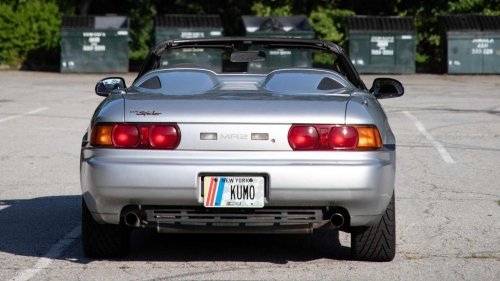
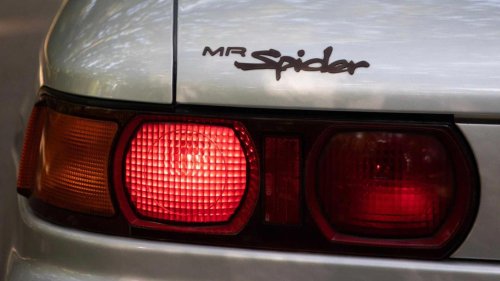



















Toyota's know-how when it comes to building well-sorted cars is up there with the best of them. Back during the 1980s, when small sports cars were gaining popularity at lightning speed, Toyota introduced the MR2. It was the first mid-engined, rear-wheel-drive sports car introduced to the US from Japan, and it quickly gained fame for both its great handling and a cutesy look. Not to mention, a pair of pop-up headlights upped its cool factor, too.Thousands of MR2s were produced over the course of the nameplate's production, with a grand total coming in at just under 300,000. The second-gen MR2 was the most popular. However, one of the least common MR2 iterations also came from the second generation: the Spider. Less than 100 were ever produced, and they were only for the Japanese market. The folks behind the transformation weren't part of the MR2's original production process, although their influence was felt heavily in Toyota motorsports. The Rarest Production Convertible MR2 Cars & Bids The second-gen MR2, also referred to as the SW20, first hit the market in late 1989 as a 1990 model. However, it wouldn't be until 1996 that the world would be introduced to the MR2 Spider (not to be confused with the later MR2 Spyder).The changing scope of the sports car market during the 1990s had Toyota thinking it needed to branch out a little bit. Convertible sports cars were popular at the time, and while the MR2 offered removable roof panels as an option, it was not available as a true convertible. To test the waters without retooling an entire production line, Toyota reached out to its arm, Toyota Technocraft (TTC). TTC took a handful of MR2s straight off the assembly line and went to work removing the roof and converting them into convertibles. How TTC Did It & Why Cars & BidsConverting a car into a convertible isn't as simple as taking a reciprocating saw to its roof and calling it a day. In reality, numerous changes need to be made to the vehicle's bones to make it happen. When it came to TTC's convertible MR2, the company needed to shore up the car's structural rigidity once the roof was gone. This was done by strengthening the chassis with extra welds and adding heavy reinforcement brackets and beams. Because of this, the MR2 Spider's overall curb weight likely increased with the extra bolstering.Cars & Bids Something Toyota was keen on when it came to having TTC take care of the conversion was the partial avoidance of liability. Because this was an exercise in testing the waters, Toyota didn't want to take full responsibility for possible issues that could crop up with a convertible MR2. The blame for issues such as poor handling, fit-and-finish problems, and convertible-top failures could be placed on TTC. Of course, TTC is part of Toyota proper, which left the Japanese brand without a direct tie to the MR2 Spider, despite the MR2 Spider being an officially sponsored project.Another key reason behind the MR2 Spider's creation was the upcoming third-gen MR2. During the mid-1990s, Toyota was still in the early stages of developing the model, and, as with any new project, ideas were constantly thrown around. Creating a small batch of fully convertible MR2s was a great way to test the proverbial waters. If the few folks who bought one loved it, Toyota would be more apt to fully commit to a droptop third-gen MR2 variation when the time came. The MR2 Spider's Bones Cars & BidsWhile the second-gen MR2 normally offered both a naturally aspirated and a turbocharged 2.0-liter inline-four, the Spider came equipped only with the former. The engine itself was Toyota's transverse-mounted 3S-GE mill, which belonged to the brand's "S" engine family. It was built with help from Yamaha and came with an aluminum cylinder head, while the rest of the motor was made of cast iron. One of the hallmarks of the 3S-GE was its forged crankshaft and specially designed oil passages that supply oil directly to the crank's main bearings, as well as to the connecting rods and piston heads.Backing up the sturdy little engine is either a four-speed automatic or a five-speed manual transmission, the latter of which is an extremely rare sight on the MR2 Spider. Of course, rear-wheel drive is the sole drivetrain configuration. The MR2 Spider's suspension was largely the same as the standard model, featuring a MacPherson strut setup at the front and a multi-link setup at the rear. Features Cars & BidsInside, the SW20 MR2 Spider was, largely, the same as you'd expect in a standard MR2. There are a pair of sport bucket seats with a thick center console that runs between the chairs. Power windows, locks, and mirrors are also standard fare. A full complement of instruments is found within its gauge cluster, including a tachometer, fuel gauge, and water temperature gauge. As for creature comforts, air conditioning was also standard.Cars & Bids Outside, the MR2 Spider was, of course, much different than the standard model. Its trunk deck was completely different, with a pair of raised nacelles just behind the seats. The engine cover was also slightly changed to accommodate the space where the convertible top needed to fold. Topping off the changes was an "MR Spider" badge on the rear end, with "Spider" in the same font as on the fourth-gen Toyota Supra's badging. How The Limited-Run SW20 Spider Helped The MR2 Cars & BidsAll told, anywhere between 88 and 91 examples of the SW20 MR2 Spider were built, with a few reports differing slightly. Exact, original pricing for the rare model is also seemingly impossible to find. However, we do know that most examples served at least some time as dealership display pieces, meant to generate excitement around the SW20 MR2, which, by 1996, was already seven years old in the Japanese market.While Toyota has never directly stated that the SW20 MR2 Spider led to the introduction of the convertible third-gen MR2, we can confidently say that the little experiment worked. Toyota never fully planned to commit to a convertible SW20 model. Still, the small, limited-production run of the MR2 Spider spearheaded by TTC seemed to show Toyota that demand for a rear-mid-engined convertible sports car was there and ready to be tamed. How Much You'll Pay For One Cars & BidsThat is, if you can get your hands on one. SW20 Spiders are extremely rare, meaning finding one for sale is equally rare. However, one did pop up for sale on Cars & Bids in September 2025. The listing was bid up to $17,000, but did not sell. Another example from September 2023 can be found on Cars & Bids, as well, with a sale price of $30,250. So, while it's possible to find one, you'll be paying quite a pretty penny for it. If you do spring for one, you'll end up owning one of the rarest MR2 iterations ever created, and you can even get a nice tan, to boot.