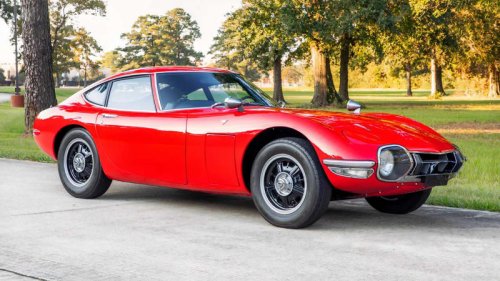
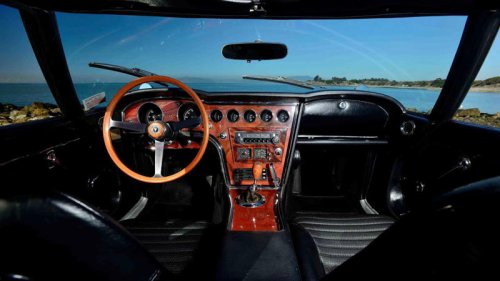
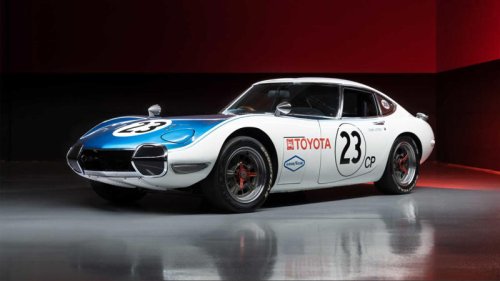
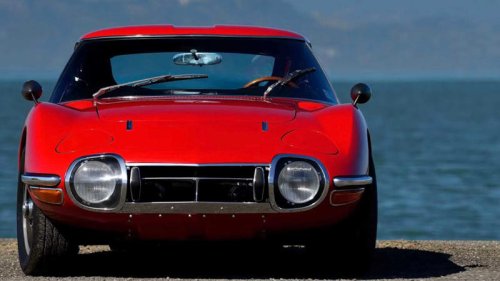
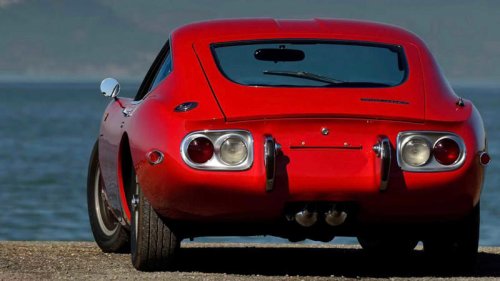
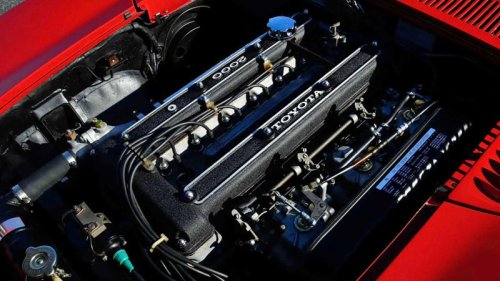



















In 1967, the world had a firmly established idea of what a great sports car looked like. It came from Maranello, or Stuttgart, or Coventry, or occasionally from Bowling Green, Kentucky. It did not come from Japan. The Japanese automotive industry had spent most of the previous decade fighting for basic credibility in export markets, and the idea that a Japanese manufacturer might produce something that could share a showroom with a Jaguar E-Type, let alone challenge it technically, was not a conversation most enthusiasts were willing to have seriously.Toyota decided to have it anyway. The car it built was assembled by hand in batches of eight per month, in a factory better known for motorcycles. Its dashboard was crafted from the same rosewood used in concert grand pianos, finished by the same craftsmen. It ran a twin-cam inline-six developed with help from a company that had never built a car engine before. And when it was done, it was so far ahead of what anyone expected from Japan that the world still wasn't sure how to react. There were only 351 of them. Most people in the collector car world will spend their entire lives without seeing one. The World Didn't Believe Japan Could Build This Concorso d’Eleganza Varignana 1705 By 1965, Toyota's most prestigious offering was the Crown, a comfortable sedan aimed squarely at the professional class. Porsche had the 911. Jaguar had the E-Type. Ferrari had the 275 GTB. Toyota had a car your dentist drove to work. The gap between Toyota's image and the world of proper sports cars was not merely large. It looked permanent.What changed things was not a moment of corporate ambition. It was a small, elite team working under a project code name of 280A, led by chief engineer Jiro Kono and designer Satoru Nozaki, who had decided that Toyota needed to prove something. The brief was specific: build a grand touring car capable of competing with the best of Europe, confirm its credentials on a race track, and show the world that Japan could engineer at the highest level. The budget was tight, the timeline was aggressive, and the target was audacious. None of that stopped them. What the team produced would become the most important sports car Japan has ever built.The project began in 1963. Yamaha, which had been developing a sports car concept that Nissan had previously rejected, brought that design to Toyota and the partnership was formed. The first prototype was completed in August 1965, just 11 months after development began in earnest, and unveiled at the Tokyo Motor Show two months later. It stopped the show. Nobody had seen anything like it from a Japanese manufacturer. Nobody expected to again. The Toyota 2000GT: 351 Cars. One Chance To Change Everything via Bring A Trailer The Toyota 2000GT entered production in May 1967 and ran until August 1970. In that time, Yamaha's factory in Iwata, Shizuoka assembled exactly 351 cars at a rate of eight per month, sometimes fewer. Of those, just 54 were allocated to North America. Toyota had originally planned to build 1,000 cars per year. The market, still unwilling to accept Japan as a source of serious performance machinery, did not cooperate. The car was priced at $7,150 in the US, which put it above a Porsche 911S at $6,790 and well above a Jaguar E-Type at $5,539. Buyers who might have stretched to those European alternatives were not stretching further for a Toyota, regardless of what the car could actually do.That decision looks catastrophic in retrospect. Current valuations place a Concours example at $1.2 million, making the 2000GT the most valuable Japanese sports car in the collector market and the only Japanese car to have held a consistent place in the seven-figure club. A car that buyers passed over for a Porsche in 1967 now costs four times what that Porsche is worth today. The Craftsmen Behind The Car Via: Mecum Auctions The 2000GT was not assembled on a production line. Each car was built by hand, with Yamaha contributing not just its engineering capability but its craft traditions. The dashboard was finished in rosewood or walnut veneer, produced in the same Yamaha workshops that made grand piano components. The result was an interior that period reviewers described as suited to a luxurious grand touring car, with a quality of material finish that no Japanese production car had previously attempted.Under the body, the engineering was equally considered. The 2000GT was the first Japanese production car to feature four-wheel disc brakes, a fully independent double-wishbone suspension at all four corners, and magnesium alloy wheels. The 2.0-liter twin-cam inline-six breathed through three Mikuni-Solex twin-choke carburetors and produced 150 hp at 6,600 rpm from a free-revving engine that Yamaha had developed from a Toyota Crown block, fitting it with an entirely new aluminum twin-cam head. A five-speed manual was standard. The body, just 45.7 inches at its highest point, was lower than any comparable European sports car of the era and made from aluminum panels over a steel backbone chassis clearly influenced by the Lotus Elan's architecture. Bond, Shelby, And The Cars That Got Away Hagerty Two 2000GTs are in a category entirely their own. When Bond producer Albert "Cubby" Broccoli selected the 2000GT for "You Only Live Twice" in 1967, the standard coupe presented an immediate problem: Sean Connery, at 6'2", could not fit inside it. Toyota's solution was to build two one-off open-top versions in just two weeks, with removable acrylic windshields and tonneau covers behind the seats to suggest a folding roof. These two cars remain the only factory convertible variants of the 2000GT ever produced. One is now at the Petersen Automotive Museum in Los Angeles. The whereabouts of the other remain unclear, last reported in Japan after years in Hawaii.Carroll Shelby's involvement added another chapter. Toyota provided three pre-production 2000GTs for SCCA competition in 1968, the only season the car raced in the US. Two competed, one served as a spare, and the results were strong enough that Lee Iacocca reportedly pressured Shelby to stop campaigning a Japanese car against American machinery. The most historically significant of the three, serial number MF10-10001, the very first 2000GT ever built, sold at auction in 2022 for $2.5 million, making it the most valuable Japanese car ever sold at public auction. How the 2000GT Performed Against Its 1967 Rivals Via: Mecum AuctionsThe performance table puts the 2000GT's numbers in honest context. Against the 1967 Chevrolet Corvette it was comprehensively outgunned. Against the E-Type it conceded ground in power and outright pace. But the Porsche 911S comparison is the instructive one: near-identical power output, near-identical top speed, and a 0-60 time within a second of the German car, from a first-generation effort by a manufacturer that had never built anything like it before. Period testers confirmed the point. Reviewers from both the US and the UK praised the 2000GT's neutral chassis balance, noting that neither excessive understeer nor oversteer troubled the car, and that its low build and wide track produced stability without sacrificing ride quality.The 2000GT also set the record straight on paper before reviewers ever drove it. In October 1966, before the car entered production, Toyota took two near-standard prototypes to the Yatabe High Speed Test Track and ran them for 72 hours straight. The result was three FIA world records and 13 international records in the 1500-2000cc class, including a 128.67 mph average lap on the banked circuit. Porsche took that result seriously enough to prepare a 911R specifically to reclaim the records. The fact that Porsche felt compelled to respond is its own kind of validation. What One Is Worth Today and Why the Price Keeps Climbing Via: Mecum AuctionsThe valuation trajectory of the 2000GT is one of the collector car world's cleaner case studies in delayed recognition. In 2000, a well-presented example with high mileage broke the $100,000 mark for the first time. By 2006, a Christie's auction in France produced a result of $225,000, close to double the previous benchmark and the signal that the market had started to understand what it was looking at. By 2012, one sold for $627,000. By 2013, the million dollar threshold had been crossed, and the car had become the collector market's only Japanese member of that club. Today, current market data places a Concours example at $1.2 million, with exceptional provenance examples trading above that ceiling.Several factors continue to push values upward. Supply is structurally constrained: only 351 were built, and fewer survive in drivable condition. Left-hand-drive examples, of which only 84 to 109 were produced depending on which production records are referenced, command a meaningful premium over right-hand-drive cars because they are the specification most accessible to American and European buyers. Cars with documented US delivery history are rarer still. And the convertibles exist in a category entirely beyond valuation comparison: neither of the two Bond cars has been offered for public sale in recent history. Toyota's Own Commitment to the Cars That Survive Via: Mecum Auctions What separates the 2000GT from most ultra-rare sports cars of its era is the level of manufacturer support still available. Toyota's GR Heritage Parts program has begun reproducing original components from factory sources and making them available to registered owners. This is not a token gesture. For a car built in numbers this small, the availability of correct factory parts directly affects long-term drivability and, by extension, value. It also signals something about how Toyota regards the 2000GT within its own history: not as a curio, but as the foundation of everything that came after.The collector who wants one faces a difficult search. Auction appearances are rare, documented provenance is non-negotiable at this price level, and the window between a car coming to market and changing hands is short. Tribute cars exist. Pre-purchase inspection by a specialist with specific 2000GT experience is essential, not optional. The cars that do appear in good condition and with solid history sell quickly, and at prices that reflect exactly how few of them remain. Most collectors will never see one in person. The ones who own them know precisely what they have.Sources: Hagerty, Yamaha Motor, Toyota Automobile Museum, CNN Business, Evo, SuperCars.net, Mecum.