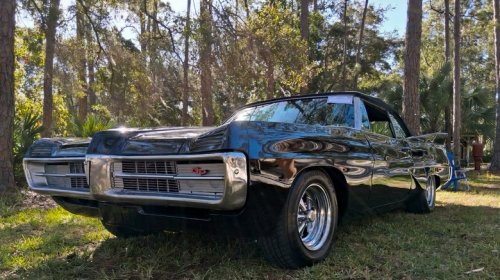
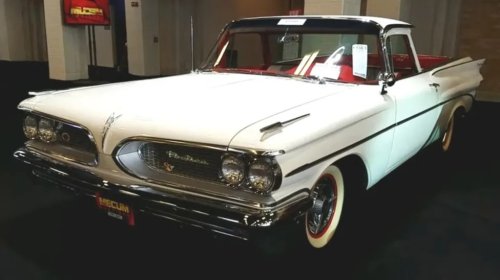
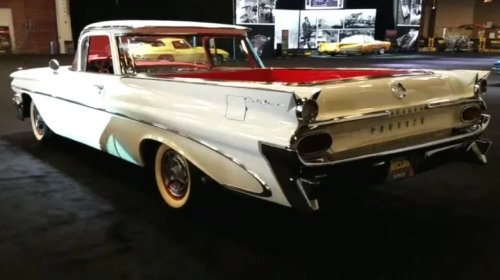
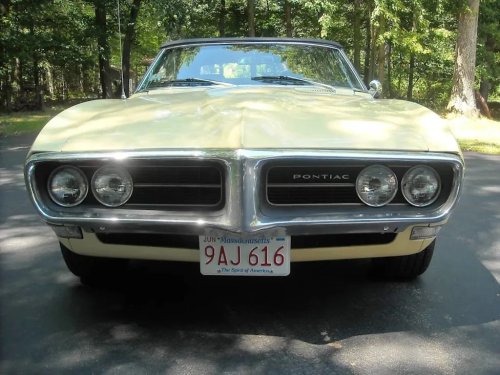
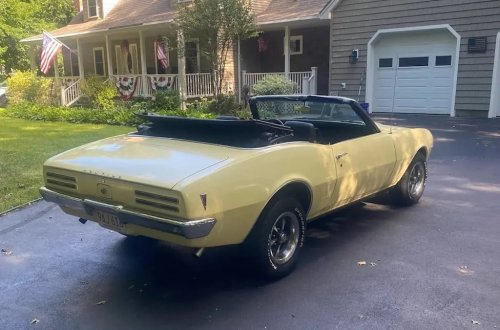
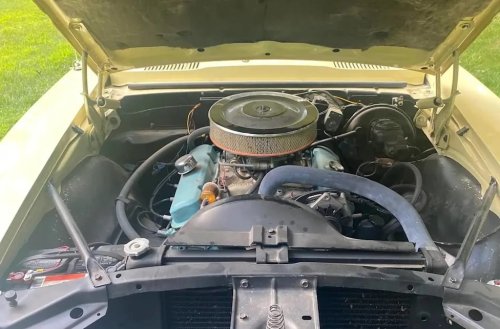
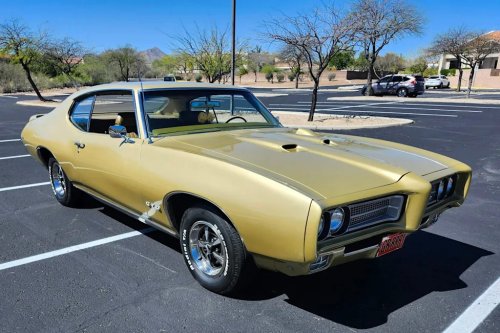
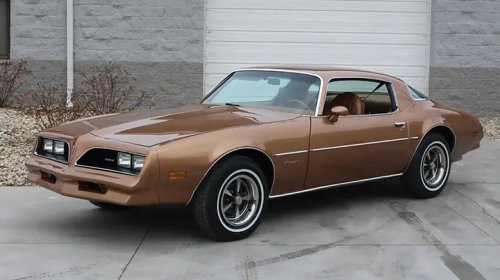
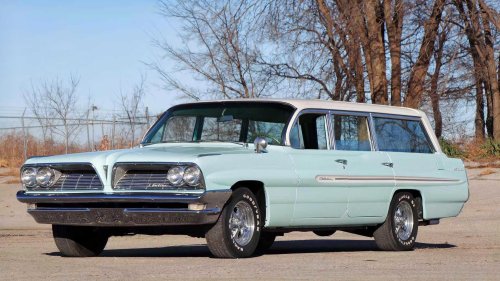
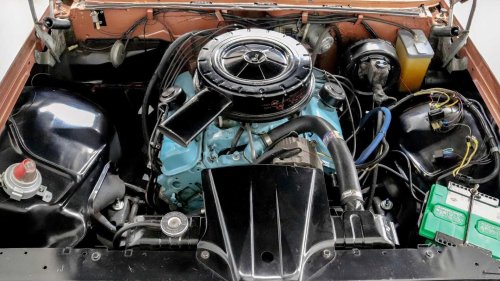
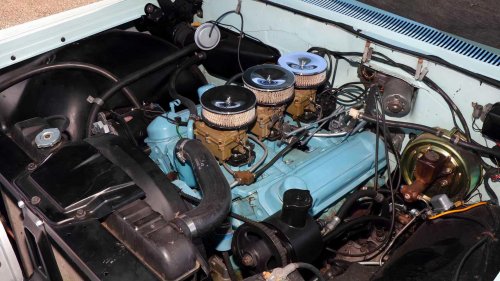
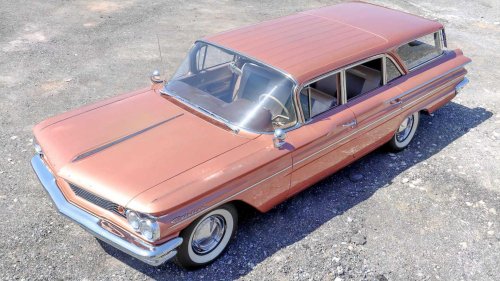
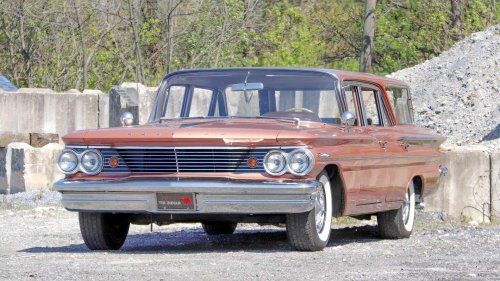
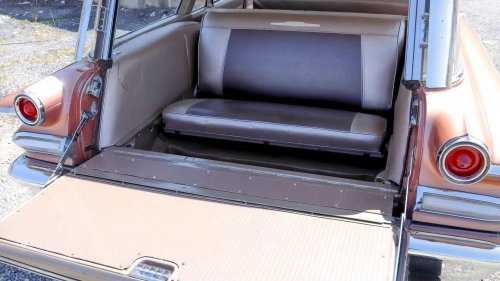
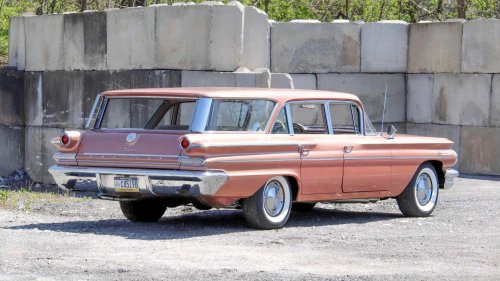
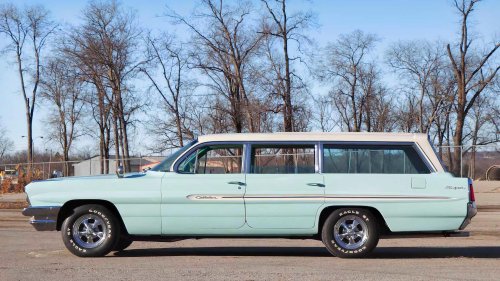
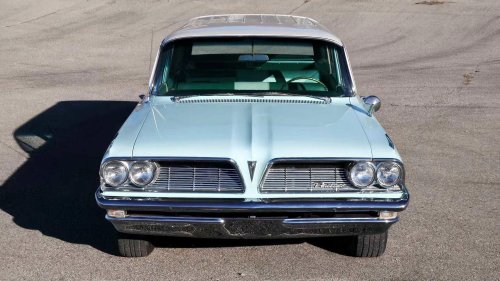
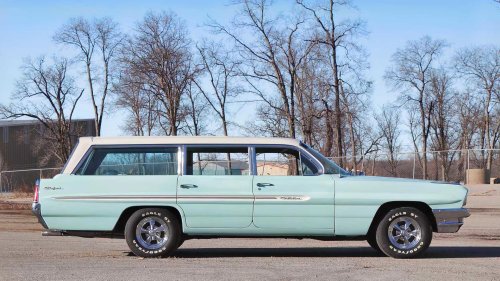
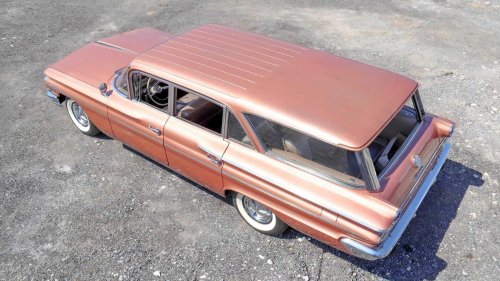
Before safety and environmental regulatory organizations cracked down on the American auto industry in the early '70s, engineers had the free rein they needed to create some wild machines. Ideas that should have been killed off in focus groups were allowed to become reality, and engineers were experimenting faster than marketing departments could keep up. This is how we got the golden age of muscle cars and pony cars. However, while sporty cars benefited the most from this freedom, not every outrageous powertrain of the era lived under a long hood that was built to dominate.See, back then, engine sharing was far more common than it is today, and sometimes the most powerful engines ended up in the order sheets of family cars that didn't even need them. As one of the most exciting American manufacturers of the '60s, Pontiac loved stuffing big V8 engines into virtually every model that could allow it to maintain its performance image, and this is how an unassuming full-size wagon quietly received serious performance hardware that made it one of the most fascinating factory performance oddities in Detroit history. Pontiac Catalina Safari: When "Family Car" Stopped Meaning "Slow" Via Mecum AuctionsThe Catalina name had appeared on earlier Pontiacs, but in 1959 it became a full model series that replaced the Chieftain line as Pontiac's value-focused full-size offering. Riding on GM's B-body platform, the Catalina was a massive car with a wheelbase of up to 122 inches and was available in multiple body styles, including a wagon. Like other Pontiac wagons of the era, the Catalina wagon was known as the Safari and provided space for up to nine passengers, making it the ultimate family hauler and grocery getter of the day.The Safari was a key part of the formula that made the Catalina one of the most successful Pontiac models throughout the '60s, and part of its success was down to the fact that it was always equipped with some ofthe largest and most powerful Pontiac V8 engines. Even though its proportions and family-hauling intent didn't show it, the Catalina could be optioned with enough V8 power to not only haul its massive weight but also make it a threat in stoplight-to-stoplight situations. The Catalina Safari Was A Powerhouse Via Bring A TrailerThe Catalina Safari debuted in 1959 as part of the revised Pontiac lineup, and from the get-go, one could tell that it meant business. The only engine available in the 1959 Catalina Safari was a 389 cubic-inch "Trophy" V8, which was the largest Pontiac V8 engine at the time. However, to cast a wider net, several different configurations of the engine were available depending on carburetion, compression, and transmission pairings.Buyers who valued fuel efficiency could get a 215-hp version of the 389 with a two-barrel carburetor and lower compression (8.6:1). On the opposite side of the spectrum, buyers who wanted a tire-shredder could order a higher-compression "Tri-Power" version of the 389, rated at about 345 hp and 425 lb-ft of torque.The Catalina Safari got more power as the '60s went by, starting in 1963, when a 421 cubic-inch became available and offered up to 370 hp in the Tri-Power "High Output" versions. Pontiac's NASCAR-derived 421 Super Duty V8 was also available in 1962 in extremely limited numbers, aimed at competition, often involving specialized installation practices tied to racing rules of the era. Factory-documented SD 421 wagons appear to be exceptionally uncommon, and most SD cars were built as competition-focused Catalinas.Via Mecum AuctionsSafari power figures peaked in the late '60s with the 428 cubic-inch "HO" V8, which generated 390 hp and 465 lb-ft of torque. The last hurrah came in 1970 when Pontiac equipped the Catalina Safari with a gargantuan 455 cubic-inch V8 producing a slightly lower 370 hp and a massive 500 lb-ft, but its power was short-lived as a compression ratio change dropped its power to 335 hp in 1971. The Culture That Made The Catalina Safari Wagon Seem Normal Via Bring A TrailerThe early '60s can be compared to the Wild West as far as the American auto industry is concerned. With family cars sharing platforms with smaller performance-oriented models and the engine-sharing culture in full swing, Detroit's ordering systems were remarkably wild, and sometimes they allowed buyers to equip wagons like the Catalina Safari with similar power and heavy-duty equipment typically found in the fastest muscle cars.The "Win on Sunday, Sell on Monday" mantra also promoted drag racing culture, leading families to want the same mighty V8 engines found in race-winning sedans for their daily Safari wagon. And since gas was dirt cheap at the time, why not?This "why not" approach led to the creation of the muscle wagon segment which spawned some of the most insane sleeper cars of the '60s. While some of these high-performance engines and features were only sold via special orders to those "in the know," sometimes they were fully advertised to the public and openly available on order sheets for gearheads crazy enough to tick those boxes. The Catalina Safari Was The Ultimate Family Hauler Of The 1960s Via Bring A TrailerThe post-war baby boom created a huge demand for family vehicles in the '50s and '60s, prompting Pontiac to respond with several family-oriented models and trims. The Catalina was among the best full-size cars when it became a standalone model in 1959, loved for offering a more premium feel than a Chevy without the massive price tag of a Cadillac.The Safari trim gave the Catalina even more space for larger families, with a seating capacity for up to nine passengers. Despite its weight, it was fast enough to provide effortless passing power, making it perfect for short grocery runs and long road trips on the new Interstate Highway System. A Blend Of Practicality, Power, And A Touch Of Luxury Via Bring A Trailer As a family-targeted trim, the Catalina Safari wagon was all about practicality. The wagon could be optioned with a third rear-facing bench seat that allowed it to ferry up to nine passengers, and with the second and third rows folded, the Safari offered nearly 100 cubic feet of cargo space. Some cars also had the two-way tailgate, which made it easier to access the cargo area and third bench seat.Practicality wasn't enough for Pontiac, so they added power into the mix — more than any Catalina Safari buyer needed, if we're being honest. This monstrosity had serious V8 power that gave it superior passing capacity on the highway, even when towing heavy loads. The icing on the cake was the long list of available luxury features that could equip the Catalina Safari with many of the upscale features found inside, including air conditioning, full carpeting, Morrokide upholstery, power accessories, and more. It Helped Improve Pontiac's Position In The Sales Charts Via Bring A TrailerThe Catalina's blend of power, practicality, and upscale features created an irresistible package that the market loved. For much of the '60s, the Catalina was the best-selling full-size model in the U.S., only beaten by the Ford Galaxie 500 and Chevy Impala. The Catalina was so popular that it helped Pontiac clinch the 1965 Motor Trend Car of the Year award alongside other full-size Pontiacs.The Catalina's success also helped Pontiac maintain its position as the third best-selling car brand in the U.S. for much of the '60s, right behind Chevy and Ford. While the overall value it offered played a role, a large part of its success was down to its power figures and the fact that it maintained Pontiac's performance image despite its size. The Catalina Safari Was Too Powerful For Its Own Good Via Mecum AuctionsAt its peak in the late '60s, the Catalina Safari had a 428 cubic-inch HO V8 cranking out 390 hp and 465 lb-ft of torque. While the wagon was built on a heavy-duty chassis designed for utility, it was not always fully equipped to handle the most extreme performance versions of its engines, even though some buyers considered the power necessary to haul the 4,000+ pound land yacht.The combination of high-output engines and 1960s technology created several significant safety risks. For starters, the high curb weight and massive rear overhang made it susceptible to swinging, and the "Wide-Track" design didn't help much during high-speed maneuvers. The Safari also came standard with four-wheel drum brakes that were prone to brake fade during repeated hard use. Standard bias-ply tires of the era also lacked the grip and heat resistance required for the high-speed capabilities of the 300+ hp engines. With these dangers in mind, it's no surprise that not many Catalina Safaris were equipped with the top engine options. Pontiac Catalina Safari Collectibility Today Via Mecum AuctionsThe '60s are commonly remembered as the "golden era" of American muscle cars, and icons like the Pontiac GTO, Ford Mustang, Plymouth Hemi 'Cuda, and other rare and powerful muscle cars from the era often fetch millions at auctions. However, while the sporty coupes and convertibles bask in endless acclaim, muscle wagons like the Catalina Safari have been overlooked for ages, with values lagging far behind even when they share platforms and engines in some cases. The tide is changing, though.As collector tastes evolve, muscle wagons are gaining more popularity among enthusiasts who love factory oddities with great stories. A quick glance at the Hagerty Valuation Tool shows that prices of the most powerful 1960s Catalina Safaris have grown by double-digit percentage figures over the last year, but it remains an affordable collector car, with Hagerty values hovering around $20,000 to $30,000 for units in good condition and close to $50,000 for one in concours condition. These figures track when you check recent Catalina Safari auction results on Bring a Trailer and Mecum Auctions, including a perfectly restored 1960 Safari that sold for a whopping $66,000 at Mecum Harrisburg 2025. Powerful Catalina Safari Versions Are Rare Via Mecum AuctionsOrder sheets may have allowed buyers to equip their wagons with unnecessarily powerful V8s, but understandably, not many buyers checked those boxes. Wagons were rarely equipped with the top engines, and in some cases, those that left the factory with such engines were used as donors for GTOs, Firebirds, and other smaller cars.Catalina Safaris are already rare as is, but units equipped with the top engine configurations are akin to mythical creatures. We only found one instance where a Catalina Safari on sale had the best engine configuration available, which adds to its allure as a potential budget collector car. What To Look For When Buying One Via Bring A TrailerIf you want to stand out at the next car meet (and probably occupy two parking spaces), a V8-powered Catalina Safari can definitely get the job done, especially if you can find one with the most powerful engine configuration. If you're lucky enough to find one on sale, it's important to confirm things like engine codes, correct carburetion, and matching documentation to confirm that it was indeed born a V8 car, and not converted later (with the configuration you prefer, of course).If everything lines up, you get a rolling reminder of when Detroit's mechanical excess was allowed to thrive without worrying about road safety and MPG statistics. In a world where cars are increasingly losing their identities, novelties like the Catalina Safari will always stand out, reminding enthusiasts of a forgotten chapter of the American auto industry.Sources: Mecum Auctions, Bring A Trailer, Hagerty Valuation Tool
















 +1 others