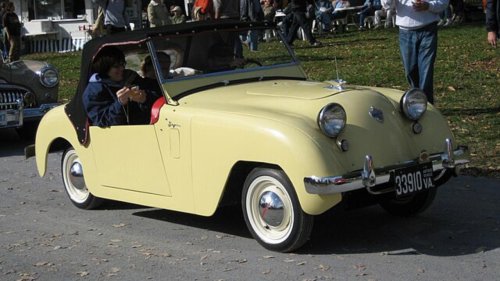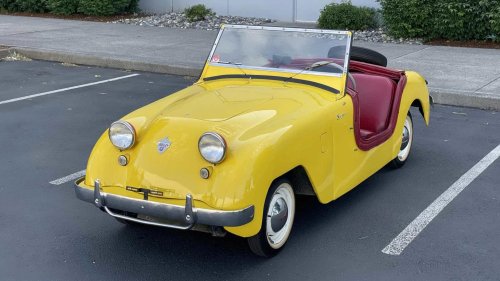
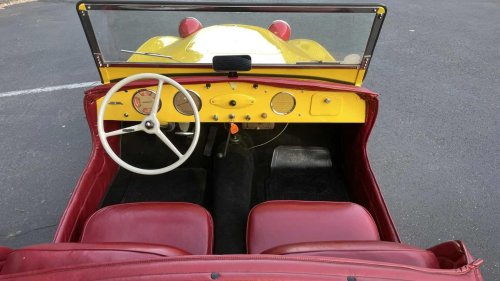
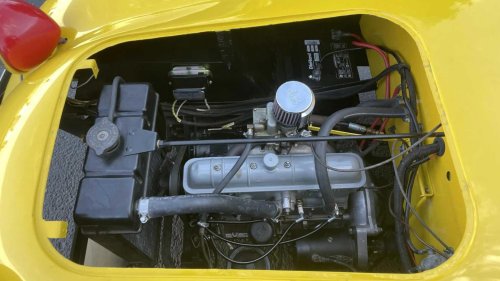
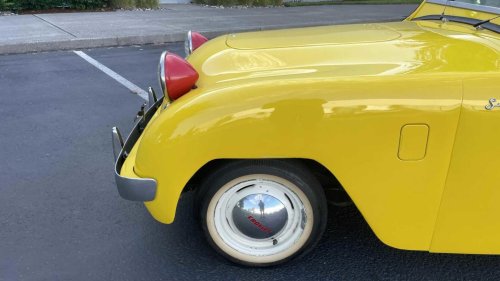
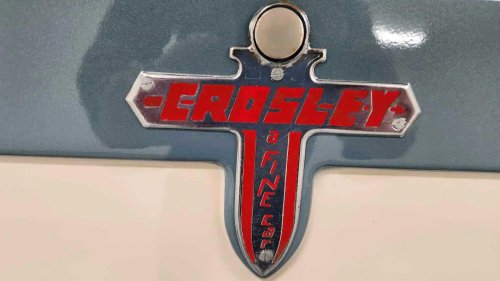



















Jump LinksCrosley Hotshot Key PointsWhen we hear of post-war sports cars in the US, most people typically refer to models such as the Chevrolet Corvette and, to a lesser extent, the more luxurious Ford Thunderbird. Both iconic post-war sports cars came about during the mid-1950s, and offered Americans the sort of performance that hadn't even been dreamed of on the mass market before. They also offered a sense of personal freedom that was hard to beat at the time.Before the iconic Corvette and Thunderbird, though, there was slow little post-war "sports car" with a much less thought-of name. It was called the Crosley Hotshot, and it arrived onto the post-war car scene in 1949 as a tiny two-seater sports car with more to prove than it had to offer. However, what it lacked in power and beauty it made up for in sheer American spirit and a willingness to get out there and have some fun, no matter how silly - or cute - you might look in it.We've picked the Crosley Hotshot for this article because of its largely unknown nature and the fact that it represents one of the first sports cars built in post-war America. A Name To Live Up To: The Hotshot Bring A Trailer Crosley Hotshot Key Points Introduced in 1949 Crosley's first purpose-built sports car Boasted an engine measuring only 44 CID Used an overhead-cam car engine design Was the first American car with caliper-style disc brakes Axed following the 1952 model year By the time Crosley's factories were back up to full production after World War II, the Cincinnati, Ohio-based company found itself only producing cars for the absolute ground level of the automotive market. In other words, it made very cheap, basic cars. Crosley didn't fancy this image very much, so it hatched a plan to create a purpose-built sports car to entice a new sort of buyer to its showrooms. The answer was the Crosley Hotshot.In its debut form, the Hotshot didn't even feature doors, but rather a hop-over cutout in the side of the body to climb over. The Hotshot's purpose wasn't to dazzle with an artistic design, but rather it was meant to perform well if driven with a little bit of spirit. Many of its interior and exterior components were removable in order to reduce weight and increase its handling prowess, such as the windshield and the rag-top roof. Once everything removable was done away with, the Hotshot weighed just under 1,000 pounds.Bring A TrailerCrosley introduced a "Super" version of the Hotshot in 1950, which added luxuries such as actual doors and a foldable rag-top roof that could be stored in its trunk, rather than the original's non-stowable roof. The Super's interior was also revamped and featured red plastic and leatherette-style seating surfaces, also finished in red. The Crosley Super, or Super Sports as it was referred to after 1950, continued the Hotshot lineup until the nameplate's axing in 1952. What The Crosley Had To Offer Bring A TrailerAt the Hotshot's heart lay an engine that could probably be best described as a mouse on a wheel. It only displaced 0.7 liters, or 44 cubic inches, and boasted four cylinders arranged in an inline configuration. Interestingly, it was constructed of sheet metal, not cast iron. It was an in-house-built unit, and was positioned behind the Hotshot's front axle for better weight distribution (probably). Interestingly, having its engine placed where it was meant the Hotshot is considered front-mid-engined, much like a Ferrari 812 Superfast or Nissan FM-based cars such as the Nissan 370Z and Z.In order to transform the Hotshot's 26.5 horsepower into usable forward motion, the Hotshot employed the use of a three-speed manual transmission with a shifter mounted on the floor rather than on the steering column. Its suspension setup consisted of both coil and leaf springs, and its chassis was an all-new design for Crosley, being lower and longer than its other model offerings. Weirdly, the Hotshot also sported caliper-style disc brakes on all four corners, becoming the first American car with this feature. The Hotshot Was Meant For A Certain Group Bring A TrailerBecause the Hotshot came about just a few years after World War II ended, Crosley was looking for a way to capture some of the new market. Soldiers, who had returned home from war and were now settled into their civilian lives, were looking for ways to spend some of their hard-earned cash. So, Crosley figured that a sports car would entice some of these ex-GIs and allow them to experience some fun whilst out on the road.However, the Hotshot wasn't exactly manly. Nor was it very good-looking, or practical in any way. Another factor pushing the Hotshot to the curb was the introduction of the Oldsmobile Rocket V8, America's first high-compression V8 offered in the Oldsmobile 88, and also introduced in 1949. The new, powerful Olds eight-pot was much more enticing and stole the show, especially considering it was wrapped inside a luxurious, well-made Oldsmobile rather than the basic, bare-bones, and doorless Crosley Hotshot. Sadly for Crosley, the beauty queen Olds 88, with a heart of Detroit iron, beat out the frumpy Hotshot by a, well, long shot. Crosley As A Whole Bring A TrailerWhile it may seem British to some, Crosley was actually a wholly American company. Founded in 1939, Crosley was the brainchild of a man called Powel Crosley Jr., who envisioned a car company that created small, affordable cars for the mass market. The prices of Crosley models were kept low due to most of them sharing the same chassis and other components, with the only differing aspects being things like the body shells and trim pieces.During World War II, Crosley halted all civilian automobile production and instead focused on experimental vehicles for the US military. Once the War was over, Crosley returned to civilian automobile manufacturing and ended up pioneering a few concepts that are still in use today, such as the previously mentioned disc brakes, the use of the term "Sports Utility" and, of course, America's first-ever post-war sports car, the little Hotshot.However, by the early 1950s, Crosley was in trouble. Other legacy American automakers were becoming very popular, and making cars that were quite a bit better than the Crosleys in terms of equipment and build quality. On top of that, the Detroit Big 3 were able to keep their prices lower due to streamlined production and design, rendering buying a Crosley unnecessary, unless you had a penchant for the quirky. So, on July 3rd, 1952, Crosley went belly-up, never to be resurrected.Sources: ClassicCarCatalog.com