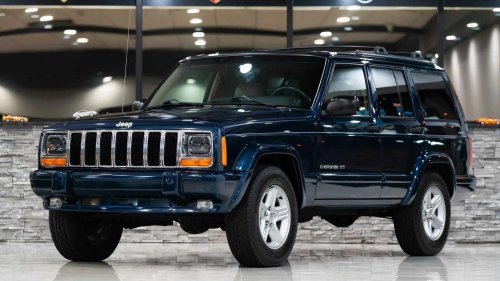
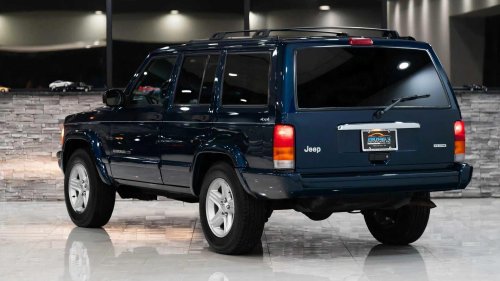
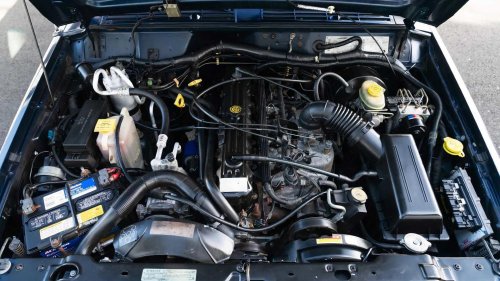
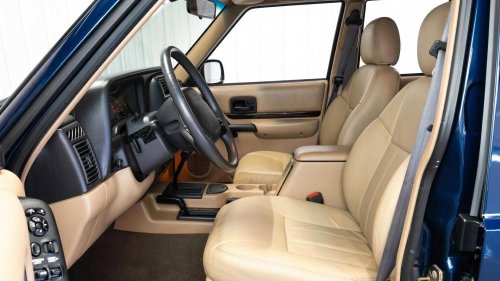
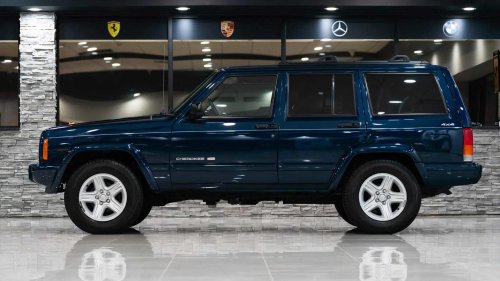
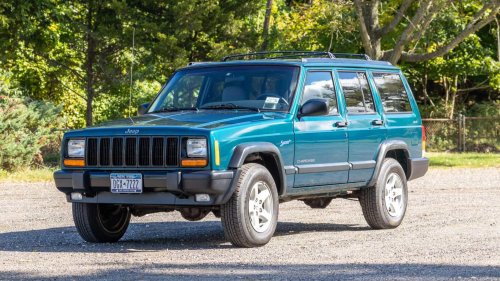

















There are fundamental (but not exclusive) differences between performance cars in America and Europe. Whereas the US loves muscle cars, pickups, and SUVs with giant V8s, tiny mpg figures, and the footprint of a small bungalow, it is quite the opposite across the pond. Europe is the home of the hot hatch, a class of sporty car that is based on the cheapest, thriftiest shopping model you can find, with tiny engines spinning like washing machines under the hood.The Volkswagen Golf GTI helped to kick off the hot hatch love affair in the '70s, and by the second generation in the mid '80s, the small Wolfsburg performance car ruled the streets of inner city Europe. But was it the same in the USA? Not quite. The MK2 Golf was launched in America in 1985, but it faced unlikely competition from a long-standing homegrown brand. This wasn't a hot hatch either; it was a full-fledged SUV, but it had all the ingredients that fast hatchbacks would embrace in the '90s and 2000s. While it may not have looked as sporty as a Golf GTI, this dinky truck could outrun not just the standard Golf GTI, but also the range-topping 16-valve version. This was all carried out with the security of four-wheel-drive, pared to the practicality of a hatchback.Had the USA beaten the Europeans at their own hot hatch game? In some ways, it did, although it used a very different recipe to do it. The Jeep XJ Was An Unlikely Performance Car Hero BringatrailerJeep had made its name on the battlefields of World War II, not in the retail combat of automotive showrooms. Having started off as the hugely-capable Willys-Overland, the Jeep brand grew into the civilian market, starting off with the CJ (for Civilian Jeep), before developing the Jeep Wagoneer (SJ), which helped to create the whole luxury SUV segment.In the '80s, Jeep was looking to replace the popular Cherokee, which had been introduced as a sportier, two-door take on the Wagoneer in 1974. The boxy, chiseled XJ Cherokee arrived in 1983, with a wide-reaching appeal. The XJ Was An SUV That Pretended To Be A Hot Hatch Bringatrailer We may take it for granted these days, but the idea of a cross between an off-roader and a sporty car was something very new in the mid '80s. But Jeep was keen for the new XJ to be popular with people who mostly just wanted to drive to work, rather than across a plowed field. In an effort to make the next Cherokee as car-like as possible without losing its off-road chops, there was even the option of a five-speed manual (as well as a three-speed auto) at launch, mated to either an AMC-designed 2.5-liter inline-four or a General Motors-sourced 2.8-liter V6. The trouble is, neither of these engines offered much grunt, so that was next on Jeep's to-do list.For the 1987 model year, the Cherokee changed gear. Jeep decided to introduce a new Power-Tech 4.0-liter inline-six that had been created from AMC's 4.2-liter inline-four, hailing it as 'the most powerful engine in Cherokee's class'. This being the late '80s, no one was expecting the kind of supercar-humbling SUVs we see today, but it was still pretty potent. The 4.0-liter inline-6 initially pumped out 174 horsepower and a useful 220 lb-ft of torque. The Jeep 4.0-Liter Changed Everything BringatrailerIt is worth considering that VW's top-end Golf of the time, the GTI 16v, had 139 horsepower, which was seen as pretty formidable for a Euro hot hatch. The Jeep's powerplant uses a sequential multi-point fuel injection system and a fast-burning combustion chamber to maximize power. There was also the option of a five-speed manual gearbox, plus the possibility of different trims such as the Limited and Wagoneer.The Jeep XJ was a game-changer, bringing the brand to the masses and showing that there was a market for this kind of new dynamic SUV. By 2001 (yes, it lasted that long), the XJ Cherokee received the 4.0-liter PowerTech inline six as standard in all trim levels, seeing the 2.5-liter inline four disappear from the line-up. By 1991, the 4.0-liter was making 190 horsepower at 4,600 rpm and 225 foot-pounds of torque at 3,000 rpm. The Jeep XJ 4.0-liter Had Been Designed To Feel Like A Car Bringatrailer Helping the XJ to pioneer the fast SUV theme was the fact that it had ditched the body-on-frame design in favor of a strong yet lightweight unibody construction that made it more akin to a standard car. The XJ is not a huge vehicle either, with a length of around 165.3 inches, which, coincidentally, is almost identical to the length of the MK5 Volkswagen Golf. The coil-sprung solid front axle gave plenty of travel on the rough stuff, but also allowed the Jeep to stay composed when driving quicker on asphalt.A lot of the XJ's sporty on-road manners were down to AMC’s Renault-trained engineering boss, François Castaing, says Hagerty, who had come from working on race cars for the 24 Hours of Le Mans. There is also a “quadra-link” front set-up, which means the live front axle has four leading control arms, limiting movement when braking or accelerating hard. Here's How Quick The Jeep 4.0-Liter Is — And How It Stacks Up Against The Competition Bringatrailer It's worth remembering that the 4.0-liter Jeep Cherokee wasn't just more powerful than a four-cylinder Golf GTI in the '80s. The 1992 Jeeps already had 190 horsepower, which was a decent amount more than the 174 horsepower from VW's new 2.8-liter VR6 engine in its hottest Golf. The 1987 version of the hot XJ could hit 60 mph in 8.4 seconds (according to Car and Driver), which was faster than the GTI 16v (Car and Driver test) by a hair (0.1 seconds), as well as naturally quicker than the standard GTI. The More Powerful 4.0-Liter Cherokee Was Naturally Even Quicker For the more powerful Jeep 4.0-liter, that was down to 8.3 seconds, although some sources suggest it was even a bit quicker at 7.8 seconds. Not bad for an off-roader, and very respectable compared to some of the faster hot hatches of the time. The later six-pot all-wheel-drive Golf R32 reaches 60 mph in around 6.6 seconds, using a 3.2-liter V6 and power to all four wheels. Interestingly, the XJ bowed out in the USA in 2001 after a long run, but Chinese versions of the vehicle were built until 2014. Buying A 4.0-Liter Jeep Cherokee Today Bring a Trailer Jeep XJs may be cult classics, but they sure are cheap. Models from 1988, which includes all engine line-ups, have an average price of just $12,251, according to Classic.com. Even the more desirable two-door models of the 4.0-liter don't go for a lot of money, with this great-looking 2001 Jeep Cherokee Sport (with just 76,000 miles on the clock) going for $9,800 in 2025.Scanning the classifieds, there are quite a few going for less than that, with some barely breaking the $5,000 mark. Obviously, with any used car, you need to be careful, but with the right purchase, you could have a quirky all-American take on a six-cylinder hot hatch for throwaway money.Sources: Classic.com, Bring a Trailer, Jeep.