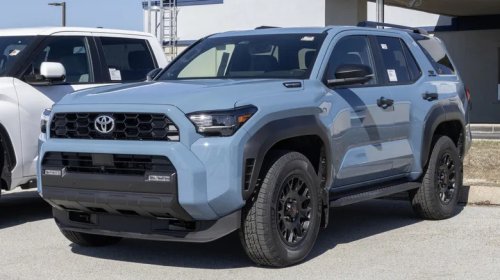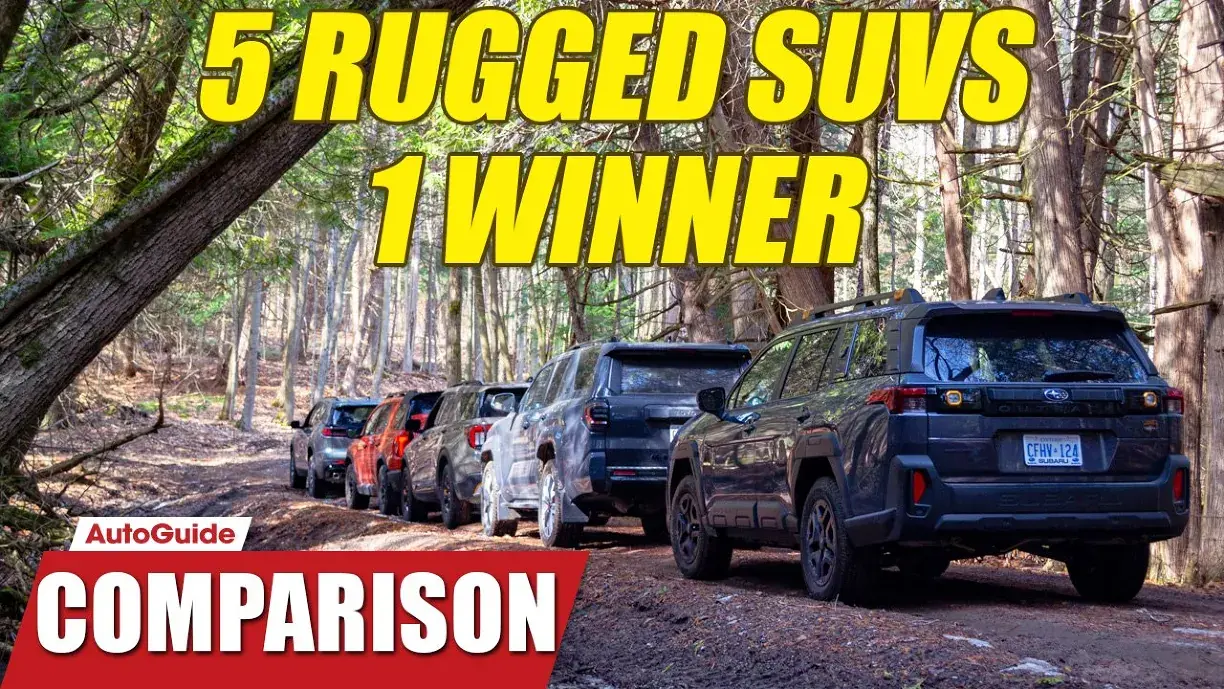



















Co-Written by Kyle Patrick rugged mid size suv mega comparison Welcome to our latest mega comparison brought to you by WeatherTech. Rugged is the new cool. That's the case at least when it comes to crossovers and SUVs. It seems every major automaker is launching some form of rugged, off-road ready sub-brand. Names like Tremor, TrailSport, Wilderness, and AT4 are just a few examples. Initially reserved for more purpose built offroad ready SUVs, the ruggedization of anything within the SUV/Crossover world is well underway. Anything form a Honda CR-V or Toyota RAV4 all the up to a Chevrolet Traverse or Volkswagen Atlas can come with knobbier tires and extra dirt-ready bits. But what about those in the middle? The SUVs that aren't in the uber-popular segment where the Subaru Forester and Hyundai Tucson play, nor in the big-boy world along with the Mazda CX-90 and Kia Telluride. Yes, it's the hard to define mid-size SUV class. Late last year we sampled some near premium mid-size SUVs and found a wide array of options. This year, we're revisiting this hard to define segment, looking at those offerings that are as at home in the mud as local shopping center's parking lot. Representing the traditional two-row SUV world is the Honda Passport TrailSport and the Subaru Outback Wilderness. Another two row entry in our comparison is the Toyota 4Runner, which is a true body-on-frame SUV. To keep with the dual personality theme, we opted for a more road-focused trim of the 4Runner, the TRD Sport. Rounding out our test are two larger choices, both with three rows of seats but still all the necessary off-road hardware. They are the GMC Acadia AT4 and Ford Explorer Tremor. With our group now complete, we head out for a week's worth of testing on highways, city streets, and moderate off-road trails. These are our findings. 5th - Toyota 4Runner TRD Sport 2026 Toyota 4Runner TRD SPort: All the Details 2026 Toyota 4Runner TRD SPort: All the Details View Gallery 31 photos Credit: Kyle Patrick Every other vehicle here is primarily an on-road SUV with an off-road edge. The Toyota 4Runner on the other hand is an off-road SUV somewhat tamed for better on road manners. As odd as that may seem, the TRD Sport is the most street-orientated trim in the 4Runner lineup. But that doesn't mean it's soft. This is still the only body on frame SUV here with a true 4X4 drivetrain including a two-speed transfer case. Off road modes? This SUV doesn't need any stinkin' off-road modes. It has 4-Hi and 4-Lo, more than enough to crawl through anything the others in this test can overcome. Our tester does have a bit of an edge though as it's wearing winter tires instead of the usual all-season tires, which would be the least off-road aggressive in the test. As is stands, the 4Runner breezed through our off-roads tests, only scraping its front chin spoiler on the larger of obstacles. Otherwise, none of our moderate off-road tests were a challenge. Off-Road Wolf in Sheep's Clothing Photo: Kyle Patrick Photo: Kyle Patrick Everything else about the 4Runner though is still off-road-biased. It's a wide vehicle with the second most ground clearance, only beaten by the Subaru. Remove the mud flaps and front splitter though and we figure it would be better than the Outback. A trade-off of that dirt capability is that the vehicle rides rough. It jitters over broken pavement and crashes over larger bumps in the road. That's just the side effect for having the durability of a solid rear axle. That axle, plus the fact some trims of 4Runner can have a third row of seats means it also has the worst seats behind the driver in test. They are cramped and there's a bulge sticking down from the roof where the retractable sunroof goes. Missing Equipment, But Stores a Lot rugged mid size suv mega comparison In the front, the driver sits high up, behind a tall hood line that's exaggerated by an intake that doesn't really do anything other than add to the style. Inside we like the chunky switch gear, but not much else. The interior is easily the cheapest looking and feeling. Even the prominent, and very blue streak can't overcome that. Our tester also has the least amount of equipment, but it's only the second least expensive. It's not far off pricewise from the Passport, but lacks a power seat, power liftgate, upgraded infotainment screen, ventilated seats, heated back seats, and a lot more. On the plus side, the 4Runner has the second largest cargo area and it looks bad ass. It's easily the most off-road looking, even with the front lip spoiler. It received the highest exterior style score as it continues to feature those classic 4Runner proportions. Surprisingly, it handles better than expected for the vehicle's truck roots. Don't get me wrong, it's the second worst handler here, but not by as much as we expected. Punchy Power Photo: Kyle Patrick Photo: Kyle Patrick The 2026 4Runner is available with two engine choices. To keep costs down, ours has the entry-level, non-hybrid turbocharged four-cylinder. It develops 278 hp, which is the second least in our test, but has 317 lb-ft of torque, which is the second most. Couple to an eight-speed automatic transmission, the 4Runner is fairly swift, as are all the entries here. The engine pulls well at all speeds, delivering more linear power than others. It also has a cool, faint turbo whistle, reminiscent of an old-school diesel. Surprisingly, even with its truck bits and lack of hybrid hardware, the 4Runner is rated mid-pack in terms of fuel efficiency in our test. It can also tow upwards of 6,000 pounds. The Verdict Photo: Kyle Patrick Photo: Kyle Patrick The Toyota 4Runner continues to be the bridge, or the link between hardcore off-roaders like the Jeep Wrangler and Ford Bronco, and softer dirt-loving vehicles like those found in this test. The problem is, it's compromised when not in the rough stuff. The ride, driving dynamics, and even interior space all trail the competition. And, despite a competitive price tag, it lacks many features found in our other testers. Sure, the 4Runner could be better equipped, but then the price would shoot north significantly. As it stands, the 4Runner is our choice if consistently driving in moderate off-road conditions. But if it's more of an occasional trip into the woods, the others here might be better suited for the other 98% of the time you're driving them. 4th - GMC Acadia AT4 2026 GMC Acadia AT4: All the Details 2026 GMC Acadia AT4: All the Details View Gallery 30 photos Credit: Kyle Patrick This is the big boy of our comparison. Longer than anything else by a good bit, it dwarfs the Subaru Outback and offers the most space out of an option here. If the Toyota 4Runner is an off-roader trying to double for family duties, this is the family vehicle with an off-road edge. With the AT4 package, it's easily the best looking Acadia, with the chunky all-terrain tires, skid plates, and exposed tow hooks. But, compared to the others here, it's still a bit generic and bland, which might not be a bad thing if we're comparing it to the Outback. Beside size, the Acadia is also the heaviest vehicle here and the most powerful. Under the hood is a 2.5-liter turbocharged four-cylinder making 328 hp and 326 lb-ft of torque. It's hooked up to a 10-speed automatic transmission and an Active Torque Control AWD system only available on the AT4. During our testing, the Acadia was the second quickest in our merge test. That stated, the transmission is slower to kickdown and unleash the power. This is also a peaky powerplant, with a lot of the real world usable power residing in the higher rpm. Drivetrain Trickery Photo: Kyle Patrick Photo: Kyle Patrick One thing we've complained about in the past when it comes to this engine is the noise inside the cabin. In the 2026 Acadia AT4, it wasn't much of an issue at all. It's still a wee bit growly at times, but nothing like the last time we tested it. Surprisingly, despite having the largest physical shape, most weight, and biggest amount of power, this SUV still manages mid-pack fuel economy figures. Aside from the 4Runner, the Acadia is the only vehicle here than can be manually set to only drive two wheels, the front two in the GMC's case. With the press of a button, it flips into all-wheel drive mode, which splits power front to rear at different ratios depending on road conditions and which drive mode is selected. Even when the all-wheel drive mode is engaged, it's still quite easy to spin the front wheels under hard acceleration when cornering. Large and Lumbering Photo: Kyle Patrick Photo: Kyle Patrick On the road, the Acadia drives as large as it is. There's a massive hood to look over, and everything feels heavy. The steering effort, the transmission's deliberate gear changes, the suspension responses…it all feels like it's going a fraction slower than in reality. We ranked this as the worst handler in our comparison, even below the truck-based 4Runner. Off-road the same theme continues. The Acadia AT4 had no problem conquering any of our off-road challenges, but we felt like it required more effort in doing so compared to the others. A bit more steering effort, more throttle application, a little more modulation in crawling over the taller logs and rocks. Comfy Cruiser rugged mid size suv mega comparison On the plus side, the interior is possibly the quietest in test and it has the best ride comfort. The driver's seat can be adjusted multiple ways offering average comfort. There's enough headroom to wear a full bowler hat, and the middle row offers the same generous amount of space and comfort. The interior is the nicest of the group here, but none of these are what we'd call class leaders. In the GMC, it's a bit busy with numerous different textures, materials, and designs across the dashboard and doors. We really like the Acadia's infotainment software and the dual control climate switches on the bottom. Of course, I need to make a special shoutout to my favorite technology, GM's handsfree Super Cruise. The Verdict Photo: Kyle Patrick Photo: Kyle Patrick Overall, the 2026 GMC Acadia AT4 is one of the better equipped, family ready vehicles here. It also has a lot of the off-road hardware to venture off the beaten path, although it does boast the lowest ground clearance. That's a minor footnote though as the Acadia suffers from a few other issues, most notably its real achilleas heel, the price. As tested, the vehicle seen here has the highest price tag in both Canada and the United States. It's not much pricier than the Explorer, but priced way above the most affordable option, the Outback. If size is the highest determining factor though, this is the biggest vehicle, just be ready to pay the biggest price. 3rd – Honda Passport TrailSport 2026 Honda Passport Trailsport: All the Details 2026 Honda Passport Trailsport: All the Details View Gallery 29 photos Credit: Kyle Patrick Honda is on a path of rediscovery. Before the CR-V became a sales juggernaut, the Passport was the brand's original SUV. A rebadged Isuzu Rodeo, it was simple, rugged, and body-on-frame. When it brought the badge back in 2019 the new Passport was now unsurprisingly a unibody affair, a truncated Pilot for those seeking adventure. Now it's new all over again, and the promise is more of that rough-and-tumble feel found in vehicles like the 4Runner, married to the sort of on-road manners buyers expect from the big H. Style Photo: Kyle Patrick Photo: Kyle Patrick Mike will no doubt tell you how the Outback isn't that bad in person. Now that my eyes have stopped bleeding I'm open to considering it. I can say the Honda is easily the coolest-looking utility here, and not just because it's the only one in a proper color-and no, I'm not counting the springtime thaw sludge that the Explorer is bathed in. The Passport is boxy and bluff, the sort of squared-off shape any kid will draw when asked what an SUV is. The low shoulder line is practical too, providing excellent visibility. Don't forget the contrasting back roof section, which Honda says is to resemble a backpack. Aw, adorable. Honda also has learned what Kia's known for years: amber DRLs are in fact cooler. The Passport isn't quite so adventurous inside. It's a fine place to spend time, with the current Honda cabin design language adopting a few appropriately rugged touch points. We just wish there were more splashes of that hero orange throughout. It's well-equipped mind you: the heated and ventilated seats are effective, and Honda's digital instrument cluster is one of the best with solid customization and a clean design. Old-School Driving, Polished 2026 Ford F-450 Dually: All the Details rugged mid size suv mega comparison This is the only vehicle here with a naturally-aspirated V6. Fans of no-fuss, simple powertrains will appreciate it, and 285 hp puts it firmly mid-pack. The other side of the coin is a relatively meagre 262 lb-ft of torque, and it doesn't even come on-stream until a heady 5,000 rpm. Even with the smart shift programming of the 10-speed automatic ‘box, the Passport requires a heavy foot to get the most out of this powertrain. With one of the heftiest curb weights of the test, it ends up as one of the slowest in our real-world acceleration test, while narrowly avoiding being the least fuel-efficient too. Ouch. This is a big box and largely, the Passport drives like one. It's almost impressive how Honda has imbued it with that sense of slight hesitation and the busier ride of a body-on-frame vehicle. The Passport is a calmer daily driver than the 4Runner, smoothing out bumps that would keep the Toyota's wheel (and driver) buzzing. There's even reasonable feel from the wheel. The Passport never feels less than deliberate, that chunky curb weight informing all of its movements. On the highway it is utterly planted, and quieter than you might expect given that shape. Like the rest of the pack it handled our test trail with ease: the Passport might not have the most ride height but it has the best approach and departure angles and that can be crucial in certain situations. Big Ol' Box Photo: Kyle Patrick Photo: Kyle Patrick As we keep saying, the Passport is cavernous. It's the largest of the two-row players here, and it feels it. This is a great example of paper versus practical: the stats suggest the Subaru has more headroom but my hair is only brushing one of the vehicle's visors. Space in the second row is ample: the spec sheets might say the Outback has more headroom but reality suggests otherwise. The shape makes the Passport hugely practical, with one of the largest storage holds in the two-row game. With 44 cubic feet (1,246 L) behind the second row it has a huge advantage over the Subaru. That gap shrinks significantly in seats-down form, with the Honda scoring 83.8 cu ft (2,373 L) against the Scooby's 80.5 cu ft (2,280 L). Honda's tech suite is firmly middle-of-the-pack. The infotainment screen is large and relatively easy to use with its Google Built-In features, though it lacks the ultimate functionality of the American competition. Bonus points for effective off-road cameras being accessible at any speed via a stalk-mounted button, too. The Verdict Photo: Kyle Patrick Photo: Kyle Patrick Don't take the Passport's third-place finish as a knock against it. If anything, it highlights the Honda's place in the rugged-model landscape. The lines between unibody and body-on-frame continue to blur, and the Passport exists in a middle ground between the truck-like 4Runner and the car-on-stilts Outback. Those wanting adventure-ready looks with good manners on the tarmac will find a lot to like in the Passport. Its character brought the Honda this far, but the thirsty powertrain stopped it from nabbing silver. 2nd – Ford Explorer Tremor 2026 Ford Explorer Tremor: All the Details 2026 Ford Explorer Tremor: All the Details View Gallery 30 photos Credit: Kyle Patrick This might seem hard to believe, but the Explorer Tremor was the wildcard of this comparison. Sure, we're all familiar with the Blue Oval's three-row SUV (and how spotting it in the rearview always induces at least a moment of anxiety), but the Tremor is a new trim this year. It takes Ford's Raptor-lite recipe and applies it to the brand's best-selling SUV, mixing in a little more of the off-road ability the Explorer originally had. Diet Dino Photo: Kyle Patrick Photo: Kyle Patrick In many ways, the Tremor is a reframing of the previous Explorer Timberline. With the new T badge, it picks up multiple traits found on its siblings, many of which are dipped in the Electric Spice accent color. An additional, dazzling light bar for off-road use? Check. A raised suspension? Check. Unique wheels wrapped in all-terrain rubber, with one spicy pocket to let you know where the valve stems are? Check-and clever. The Explorer cabin felt and looked like a rental car special when this generation first launched for 2020. Ford listened to complaints and has seriously upped the game as part of last year's facelift. While it's quite dark inside, we both enjoy the various material and patterns within the Tremor; it's not quite as fancy as the GMC but is more consistent in its quality. There's also a lot of useful storage space. Pony Car Spirit Photo: Kyle Patrick Photo: Kyle Patrick Unlike the Timberline, the Tremor gives Explorer buyers a choice of engine. This tester has the standard 2.3-liter EcoBoost, while the muscular 3.0-liter V6 provides an ample 400 horsepower. When we've sampled the two powertrains back-to-back, of course we've preferred the V6. But against its similarly-powered competition, the four-cylinder proves very effective. If it's good enough to power the Mustang, it's plenty for an Explorer. For starters the smaller EcoBoost helped push the Explorer to be the quickest here in our real-world highway acceleration test. Normally it sounding the best in this quintet wouldn't matter much-these are larger family SUVs, after all-but these are adventure-focused trims and thus we're inclined to allow a little more emotion into the equation. The trade-off is a prodigious thirst: in our test loop the Explorer eclipsed even the 4Runner, stopping just shy of 20 mpg (12.2 L/100 km). Photo: Kyle Patrick Photo: Kyle Patrick We've dinged Ford's 10-speed auto ‘box before for being easily confused, but the facelift's new shift logic has straightened that out, too. The engine isn't the only aspect of the Explorer to give off Mustang vibes, though the rest are understandably subtler. This is the only unibody competitor here with a distinct rear-drive-biased design, and it makes for a surprisingly eager and satisfying drive on-road, even with the A/T tires. Around town and on the highway, the Tremor handily dispatches bumps and dips without fuss and has good sound isolation. On the trail, the Explorer is confident and capable, though there's no denying its size becomes that much more noticeable. We'd still rather be weaving it between the trees than the GMC, mind you. Friendly and Approachable rugged mid size suv mega comparison The Explorer's ubiquity works in its favor here: Ford has spent decades honing the package into a model of usability. There's storage everywhere, and while its on-paper specs don't give it many outright wins in terms of space, every spot in the house feels appropriate. Yes, the third row is tight-but other than the massive C-pillar causing claustrophobia, it should be perfectly cromulent for an adult on short trips. The Explorer easily has the most comfortable and supportive front seats of the test, and its second-row captain's chairs just beat those of the GMC. Ford's latest Sync system is a blessing, easy to use and ultra-snappy in its responses. It loses points for the lack of physical climate controls, even though at least that module is always on-screen. While not functional, we all like the flashy animations when flitting between the many drive modes in the Explorer-and yes, there is a noticeable difference when on the trail. Of course we can't ignore BlueCruise, which now features automated lane changes. The hands-free highway drive assist is generally great if still not quite as polished as Super Cruise. On the highway up to the trail, there was only one situation where I felt uncomfortable enough with the Explorer leaning towards an off-ramp that I intervened. Verdict Photo: Kyle Patrick Photo: Kyle Patrick Like I said at the beginning, the Explorer was the surprise of the group. We had a rough idea where the other SUVs would land before the test started but didn't know where Ford's offering would end up. In the Tremor we found an easy-to-like SUV that drivers can enjoy without passengers suffering for it, with plenty of useful and intuitive tech that helps it blend into family life. If you need the third row, this is the easy pick of this pack-but in the end, its price and thirst just held the Explorer Tremor back from the top spot. 1st - Subaru Outback Wilderness 2026 Subaru Outback Wilderness: All the Details 2026 Subaru Outback Wilderness: All the Details View Gallery 29 photos Credit: Kyle Patrick The Subaru Outback is the SUV of extremes. It has the lowest price, lowest curb weight, least amount of power, smallest tow capacity, the best fuel economy, the highest ground clearance, and the smallest wheels and tires. In the end, it also gained the greatest number of points to win this comparison. Let's dig into why. Low Power, Big Speed Photo: Kyle Patrick Photo: Kyle Patrick Under the hood is Subaru's 2.4-liter turbo flat-four-cylinder engine that makes 260 hp and 277 lb-ft of torque. Low as those numbers may seem, weight is a heck of a thing. The Outback Wilderness is the only vehicle here under 4,000 pounds. Everything else is between 4,500 and 4,800 pounds. The smallest amount of horsepower doesn't matter when there is 600-900 less pounds of SUV to haul around. Add in a continuously variable automatic transmission and Subaru's symmetrical all-wheel drive system, and the Outback Wilderness feels the quickest and almost any speed, even if actual acceleration numbers had it a hair behind the quickest of the bunch. Another benefit of the light weight is the best in test fuel economy figures. No, It's Still a Tall Wagon Photo: Kyle Patrick Photo: Kyle Patrick Despite sitting highest off ground with 9.2-inches of ground clearance, this is easily the best handler of the group. Yet another benefit of its light weight and of course the car-based roots. Even if it looks like a SUV now, it still has nearly the same tall wagon underpinnings the previous Outback had. It's so nimble, and so easy to dart in and out of traffic unlike the ponderous Acadia or 4Runner. Despite wearing the smallest wheels with the tiniest, skinniest tires, there's a generous amount of mechanical grip when cornering, a byproduct of the least aggressive off-road-bias all-terrain tires. That might lead to poor off-road performance, right? Well, not really. Although it did post the second lowest score in dirt road driving, it was marginally behind the Passport and Explorer, and that generous ground clearance had it rubbing its undercarriage in the mud less often. Much like the 4Runner, the Outback has the mechanical and technological goods when hitting the trails, it just requires a driver aware of how to maximize their potential. The Explorer and Passport in contrast do it for you. Comfort Consideration Photo: Kyle Patrick Photo: Kyle Patrick Back on the pavement, the Outback only trails the Acadia in terms of ride comfort. That long travel suspension does a great job smoothing out bumps, but it doesn't quite isolate occupants like the GMC. It also doesn't wallow side-to-side over broken pavement despite its tall stance, a trait the Passport is susceptible too. Road noise however is mid-pack in this test as is engine noise. Inside, the Outback feels the tightest up front up because it is. That said, a comfortable seating position is possible to find in these squishy Startex seats. The hood line is low, helping to add to some of the best overall sightlines in our comparison. Despite having a lot roofline and high ground clearance, the rear seat of the Outback ties the Acadia for the most headroom and is mid-pack in terms of legroom. Although Kyle finds the seat cushion low, I do not, and when the scores were tallied up, it is one of the best rear seat areas for adults. Another thing the Outback scored high on was the infotainment system, not necessarily because it is great, but aside from the Acadia's, it lacks the flaws many of the others here suffer from. The Verdict Photo: Kyle Patrick Photo: Kyle Patrick Now on to the one part of the Outback that could make everything I just talked about irrelevant – the looks. I personally am indifferent to the Outback Wilderness. I don't like the look, but I don't it either. It's odd, but to me, it's just there. Others aren't nearly as neutral or kind. I don't blame them as it looks so out of place amongst this rugged set we have on hand. It could be enough to be a total deal breaker for some potential buyers. It almost cost the Outback the win here, as it barely kept ahead of the Explorer. A big reason for the Outback's win is the price. As tested, with a good bit of standard equipment, the Outback Wilderness is the lowest priced vehicle here by thousands in USA. Even with the missing optional package that includes Nappa leather seats and other features, it would still undercut everything in our comparison. In Canada, the 2026 Outback Wilderness is a screaming deal, $11,000 cheaper than the next most affordable as tested price, the 4Runner, and $18,500 less expensive than the Acadia. Not only is the Outback one of the best vehicles here (looks withstanding), but that price makes it such a bargain over everything else, and our winner in this comparison shootout. 2026 Toyota Corolla Cross SE: All the Details