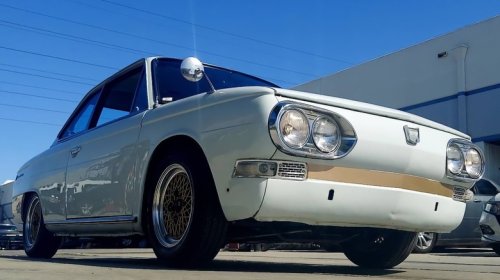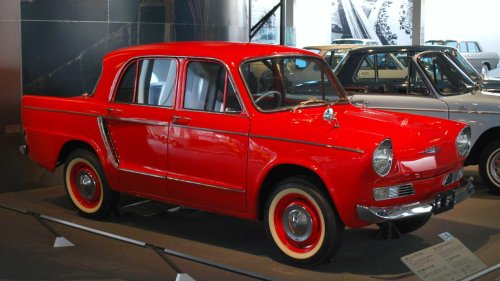
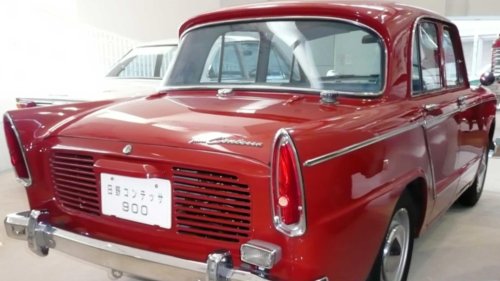
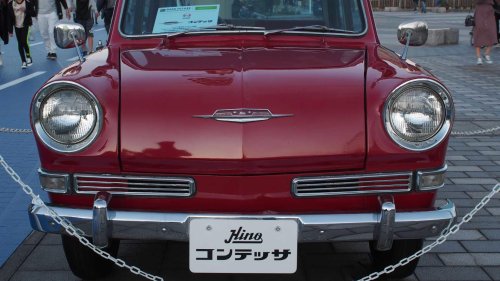
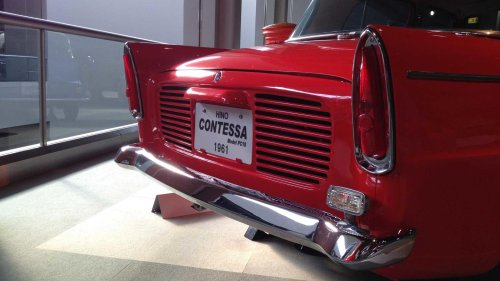
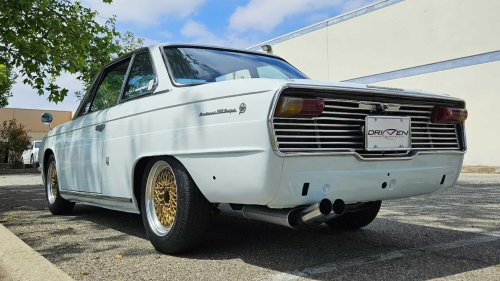
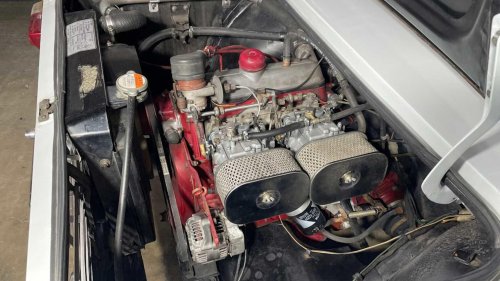
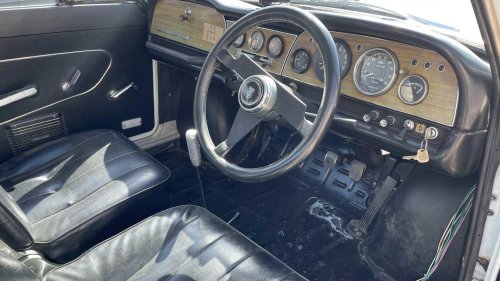
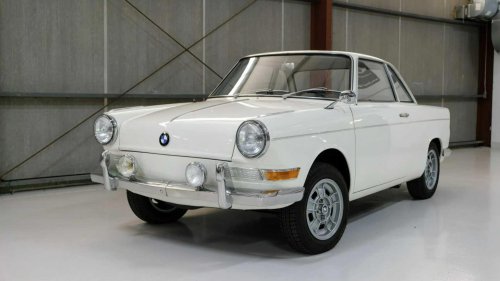
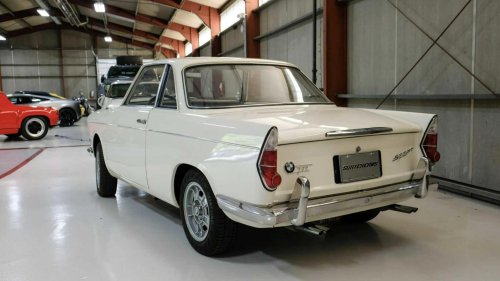
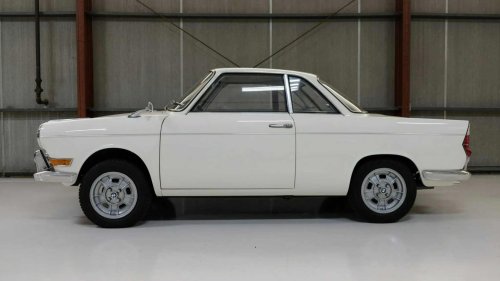



















During the late 1950s and early 1960s, Japan's automotive market began to boom. The post-war economy had entered full swing, and loads of Japanese citizens were gunning for their very own car. To meet this new demand, brands like Toyota, Honda, and Subaru began producing small, cheap cars made to help transport the masses. These small models were also built to last, and utilize as few parts as possible for the purpose of making DIY repairs easy.While a few Japanese brands were producing their own, homegrown models, other, smaller marques struck up deals with other automakers to import or rebadge cars for their own purposes. One such example of this came from a Japanese company called Hino, which built a model called the Contessa. Its name stands for "countess" in Italian, as its tiny body was designed in the country. However, underneath the skin, the Hino carried guts courtesy of Renault, a French automaker. A Japanese Brand, Italian Styling, and French Bones Wikimedia Commons: Mytho88 In the 1960s, Hino was known as a large, respectable company within Japan. However, its influence outside its home country was, and still is, limited. Mostly, Hino was known for producing large trucks, as that was its original objective upon its founding in 1942. It wouldn't be until 1961, though, that Hino would produce its first home-grown passenger car called the Contessa. Prior to the Contessa's introduction, the automaker had previously built a Renault model for the Japanese market.Being Hino's first clean-sheet automobile design, it was decided that some help was required for the project. With nothing but heavy-duty truck styling experience under its belt, Hinko decided to contract an Italian designer by the name of Giovanni Michelotti, who had worked on other, famous design projects like the Ferrari 250 and the Maserati A6G. While a bit less glamorous than the usual Ferrari or Maserati, Michelotti set to work penning the tiny, cheap Hino regardless.Wikimedia Commons: Ypy31 For the Contessa's bones, Hino decided against going with the Italians. Instead, the French were contracted for help. However, at the time, Hino had a long-standing relationship with Renault, a French automaker, as it had produced the Renault 4CV under license. The French carmaker allowed Hino to utilize the 4CV's platform for its own use, although the chassis was, by 1961, outdated, as Renault had replaced it with the 8 model. First Generation (1961–1964) Wikimedia Commons: Kestrel The first-gen Hino Contessa, also called the "PC Series", was largely based on the previous Hino-built Renault 4CV when it came to its underpinnings. A tiny, 0.9-liter inline-four-cylinder engine was installed at the rear of the car. Interestingly, the engine was mounted longitudinally, or in a back-to-front configuration, despite the Contessa boasting a rear-wheel-drive drivetrain. In addition, its radiator was mounted at the back of the engine.For early first-gen Contessas, Hino supplied a three-speed manual transmission that utilized a steering column-mounted shifter. However, reportedly due to harsh criticism regarding this setup and its tendency to be sloppy, a four-speed floor-mounted manual transmission was offered as an option in later models. The Contessa's rear axle was supported by something called a swing axle, a simple independent suspension setup that uses CV shafts attached to the wheels that pivot on the Contessa's transaxle.Inside, there was just enough space for five passengers, a slight improvement over the previous Hino Renault 4CV, which could, allegedly, only fit four passengers comfortably. Its styling was reminiscent of American car design seen during the mid to late 1950s, as it sported things like a pair of tail fins. Along the first-gen Contessa's flanks sat a pair of air intakes for the rear-mounted engines, which were situated just behind the rear door openings.Wikipedia Commons: Iwao A special edition called the Contessa Sprint was offered, as well, which featured different body work and a tuned version of the 0.9-liter engine. Power output for the Sprint iteration was rated at 44 horsepower, and a top speed of 87 mph was reported. Second Generation (1964–1967) Bring A TrailerThe second-gen "PD Series" Contessa debuted right as the first-gen bowed out. Instead of the psedo-1950s American styling, the new Contessa boasted much sleeker, 1960s-era looks. Its twin headlight pods on either side of its front end resembled those found on cars like the Renault 8, the model with which the PD Series Contessa shares much of its mechanical make-up. The PD Series grew in both length and width to match the growing number of Japanese car buyers who were interested in larger, roomier vehicles. In 1965, a two-door coupe version was introduced.In total, four variations of the second-gen Contessa were produced, ranging from the 100, 200, 300, and 400 models. Both right and left-hand drive models were built, as well. Alongside the numbered versions sat two distinct trim levels, Standard and DeLuxe. Standard models were as bare-bones as possible, and even had black inserts installed in place of its inner pair of headlights.In addition, Standard-trimmed models received painted bumpers, rather than the chrome ones seen on the DeLuxe models. A small export market followed the PD Series Contessa, with models being sold new in Australia, the Netherlands, and Switzerland.Bring A Trailer In place of the 0.9-liter inline-four found within the old PC Series model, Hino used a larger, 1.3-liter four-pot supplied by Renault. This new engine was, reportedly, stronger in construction, as it featured a five main bearing block. The Contessa coupe came standard with a more powerful version of the 1.3-liter engine, which boasted a twin-carburetor setup and a revised cylinder head which ramped up its compression ratio slightly.Bring A TrailerBring A Trailer Near the end of the PD Series Contessa's production, Hino had entered into a partnership with Toyota. Because of this, Contessas began receiving a litany of Toyota-built components. However, the gigantic Japanese brand decided to discontinue the production of the Contessa at the end of 1967, despite there being many leftover shells and associated parts. The remaining, incomplete models were eventually finished at a reduced rate by late 1969. Another Giovanni Michelotti-Designed People's Car Bring A TrailerJust two years prior to the introduction of the Hino Contessa, another Michelotti-penned small car hit the market on the other side of the world. Its name: the BMW 700, a last-ditch attempt by the Bavarian automaker to right the proverbial ship.In 1956, BMW released a bespoke grand tourer called the 507. Due to numerous setbacks throughout its development, its base price was raised from $5,000 in 1955 to about $10,500, or roughly $117,736 in today's money, meaning it was quickly priced out of reach of most folks. In addition, designing and developing the 507 reportedly meant – even at its $10,500 price tag – BMW lost money on each model it sold, and there were few that actually made it into the hands of buyers.Bring A Trailer By the 507's axing in 1959, BMW was in dire straits. A well-timed injection of capital, courtesy of business magnate Herbert Quandt, saved the company from the brink, but only just. From that point on, BMW vowed to focus its efforts on a small, cheap car for the masses that was extremely inexpensive to produce.Bring A Trailer Enter the 700, offered in both coupe and sedan body styles. BMW's chief distributor for Austria commissioned Michelotti to design the 700 around the existing BMW 600 chassis. After a couple of sketches were sent over, a final design was agreed upon, and production commenced. Upon the 700's release, its base price was just $1,648 in 1961, the equivalent of roughly $17,800 in today's money.By the end of the 700's run in 1965, about 188,000 were reportedly sold. With sales numbers like those, the tiny, cheap 700 managed to save BMW from disaster, ensuring it would stick around after the 507 debacle after all.