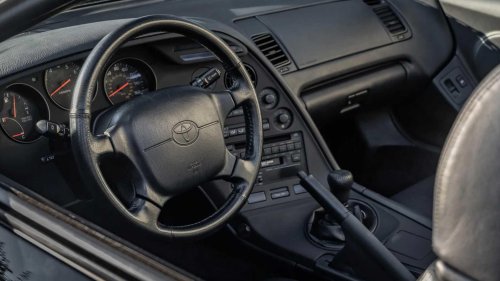
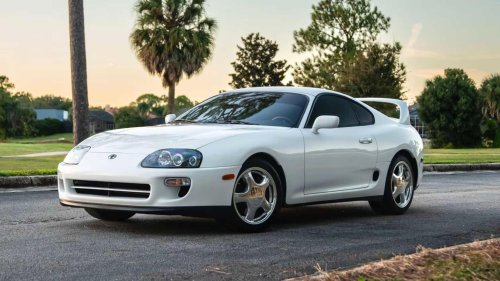
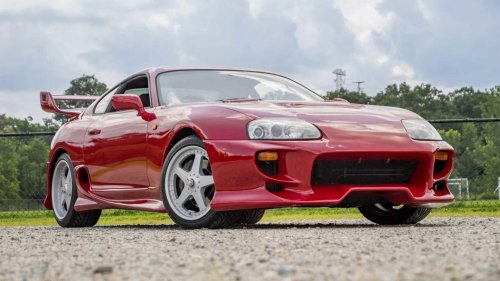
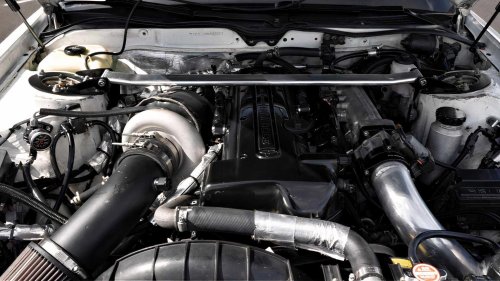
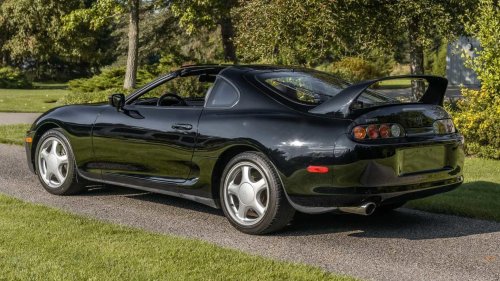
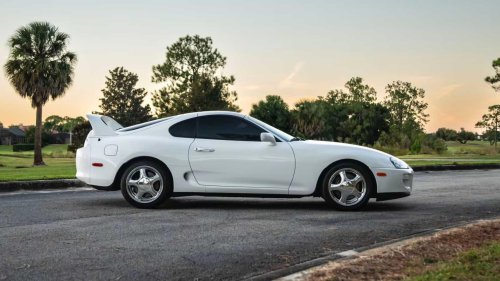
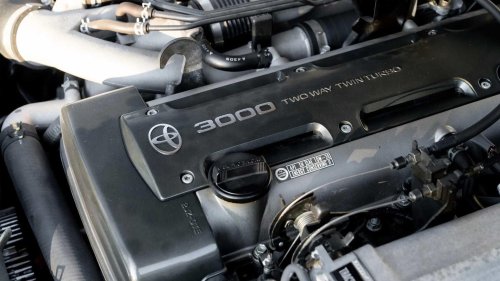
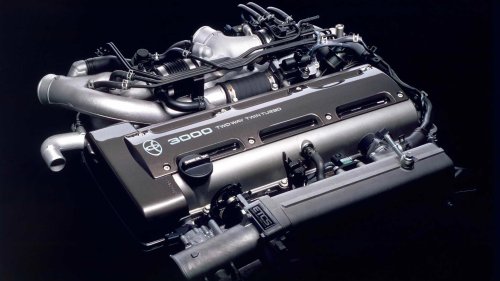
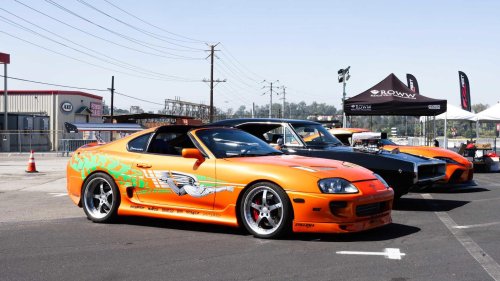
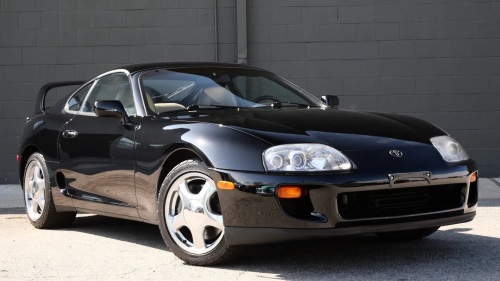
In the early 1990s, the European performance car world was doing exactly what it had always done: building big, expensive, naturally aspirated V8s and expecting the rest of the world to be impressed. Porsche was pushing its 928 GTS through its final years with a 5.4-liter V8. BMW was preparing to drop a 5.0-liter V8 into the E39 M5. Mercedes had AMG building fire-breathing V8 sedans in Affalterbach. By displacement alone, Europe looked untouchable.Then Toyota quietly put something under the hood of a sports coupe that would humiliate the lot of them. Not just in outright performance, but in engineering depth, tunability, and sheer staying power. And the wild part? It did it with fewer cylinders, less displacement, and a price tag that made the German establishment look absurd.The engine in question isn't a V8. It's not even close to one in layout. But what it does with three liters of inline-six architecture is the reason it's still being built up, swapped in, and talked about more than three decades after it first arrived. When More Cylinders Didn't Mean More Engineering Bring a Trailer To understand why this engine mattered, you have to understand what European V8s of the era were actually doing. The Porsche 928 GTS, the final and peak version of Porsche's grand tourer, made 345 hp from a 5.4-liter V8. It hit 60 mph in around 5.4 seconds. For 1992, that was genuinely fast. But it took 5.4 liters to get there, and the 928 was heading out of production by 1995.The E39 BMW M5, arriving in 1999, was the era's benchmark. A hand-built, rev-happy 5.0-liter V8 making 394 hp and 369 lb-ft of torque, it hit 60 mph in 4.8 seconds. Exceptional by any measure. But it was also a naturally aspirated unit with a ceiling baked into the architecture. Tune it and you're fighting the physical limits of what the design can give. It was a perfectly calibrated unit with no room to grow. Toyota took a completely different approach. Meet The 2JZ-GTE: The Engine That Changed The Rules MecumThe Toyota 2JZ-GTE is a 3.0-liter twin-turbocharged inline-six, introduced in 1991 and fitted to the MKIV Toyota Supra from 1993 onward. On paper, the export-spec figures of 320 hp at 5,600 rpm and 315 lb-ft of torque sound competitive, but not world-beating. What makes those numbers even more misleading is the political context in which the 2JZ-GTE was born.In the late 1980s, Japanese automakers entered into an informal “gentleman’s agreement” to cap advertised horsepower at 276 hp in an effort to discourage escalating performance wars and appease government safety concerns. It wasn’t legally enforced, but it was widely honored on paper. In reality, it made Japanese brands more competitive than ever and entangled them in a secret horsepower war to build cars that were both underrated and able to be easily tuned for more power.Consequently, the 2JZ-GTE was officially rated at 276 hp in Japan, yet independent dyno tests routinely showed stock cars producing 300-320 hp at the crank. Toyota wasn’t understating the engine’s potential. They were disguising it. Even before tuners touched boost pressure, the 2JZ was already stronger than its published numbers suggested, and Europe had no idea. On paper, the E39 M5 still made more power, while the Porsche 928GTS nearly matched it. So where does the story really start? It starts with what Toyota built into the bottom end.Bring a Trailer The 2JZ-GTE uses a cast-iron block with a closed-deck design, meaning the cylinder bores are fully surrounded by the block structure, dramatically increasing rigidity under pressure. The crankshaft is forged steel. Connecting rods are hot-forged. The pistons feature oil-spray nozzles to manage heat at high boost. The head gasket is a three-layer steel unit. Toyota didn't build this engine to make 320 hp. Toyota built this engine to survive far beyond that, and left the door wide open for whoever came next.The sequential twin-turbo setup runs two identically sized turbos: a smaller unit that spools quickly at low rpm for immediate response, with the second joining above 4,000 rpm for high-end charge. The result is broad, linear torque delivery across the rev range, something a naturally aspirated V8 of similar output physically cannot replicate without significantly more displacement. The Tuning Ceiling That Embarrassed Everyone Officially Gassed, YouTube Here is where the 2JZ-GTE goes from impressive to legendary, and where the European V8s of the era start to look genuinely limited by comparison. With proper supporting modifications, including uprated fueling, an aftermarket ECU, and a single large turbo in place of the sequential setup, a stock 2JZ-GTE bottom end can reliably handle 600-700 hp. The factory internals. Not a built motor. Not forged pistons and upgraded rods. The same block Toyota put in a road car in 1993.Go further with forged internals, ARP head studs, and a purpose-built turbo setup, and you're looking at 1,000 hp from the same basic architecture. Drag builds have gone well beyond that. The 2JZ was never designed to be a mass-market engine with a hard ceiling. Toyota over-engineered it to a degree that the aftermarket community has spent 30 years trying to find the actual limit, and largely hasn't. For context, the BMW S62 V8 in the E39 M5 tops out at roughly 500-550 hp in heavily modified form before you're fighting the architecture. Why The Inline-Six Layout Gave Toyota the Edge Via: Bring A Trailer Part of what makes the 2JZ-GTE's engineering story so compelling is that the inline-six configuration itself is structurally better suited to forced induction than a V layout. An inline-six is inherently balanced, with primary and secondary forces cancelling out without the need for balance shafts. That reduces internal vibration, lowers stress on bearings at high boost, and contributes directly to longevity under sustained hard use.A V8 splits its firing events across two banks, which creates packaging compromises and more complex intake and exhaust routing. When you're building for high boost, that complexity is a disadvantage. The 2JZ's straight-line architecture meant simpler, more efficient turbo plumbing and a more predictable powerband under boost.Toyota also made a key decision with the square bore and stroke dimensions of 86 mm x 86 mm, giving the engine flexibility across the rev range. Short-stroke engines rev freely but lose low-end torque. Long-stroke engines pull hard down low but run out of steam. A square design sits in the middle: usable from idle, willing to rev, and responsive to boost across the entire range.The VVT-i system added from 1997 onward advanced intake cam timing up to 30 degrees, broadening the torque curve further and adding efficiency at lower loads. In combination with the twin-turbo setup, this gave the 2JZ-GTE a usability in everyday driving that its power figures alone don't fully convey. What A MKIV Supra Costs In 2026 MecumThe MKIV Supra's value has climbed sharply over the past decade, and it shows no sign of reversing. What was a $30,000-$50,000 performance car in the 1990s is now firmly in collector territory, and the 2JZ-GTE is a big reason why.According to Hagerty's valuation tool, a 1994 MKIV Supra Turbo in good condition is currently valued at $100,000, with concours examples reaching $284,000. The good condition figure has risen sharply in recent years, reflecting how few unmolested, unmodified examples remain. Recent auction results reinforce this: Classic.com reports an average sale price of $95,678 across all MKIV 4th-gen Supra sales, while low-mileage examples sold at auction in 2024 have cleared $130,000.The manual transmission turbo coupe (as opposed to the targa Sport Roof variant) commands a premium, as does any car with a verifiable single-owner history, original paint, and a stock 2JZ-GTE. Modified cars can still fetch strong money if the work is high quality and documented, but they generally sit below comparable unmodified examples at auction. The Legacy: Why This Engine Still Matters Bring a Trailer The 2JZ-GTE stopped production in 2005. The MKIV Supra went out of production in 2002. Neither of those facts has slowed the engine down even slightly. In 2026, the 2JZ is still one of the most sought-after swap candidates in performance car building, dropping into everything from Nissan 240SXs to BMW E46s to dedicated drag cars chasing six-second quarter miles.This directly reflects what Toyota built: an engine so over-engineered for its factory output that it has continued to perform at the cutting edge of modified car performance for over three decades. No European V8 of the same era comes close to matching that legacy in the tuning world, and very few engines from any manufacturer can make the same claim. It didn't need eight cylinders. It didn't need five liters. It just needed Toyota to build it properly, and they did.Sources: Stuttcars, Autoevolution, MVP Motorsports, Hagerty, Classic.com, Car & Driver.