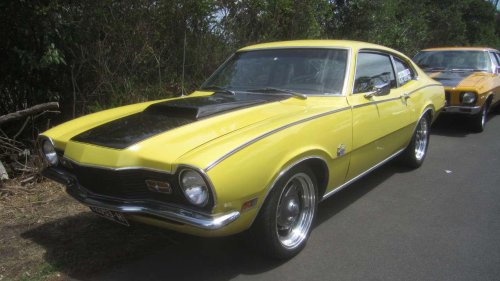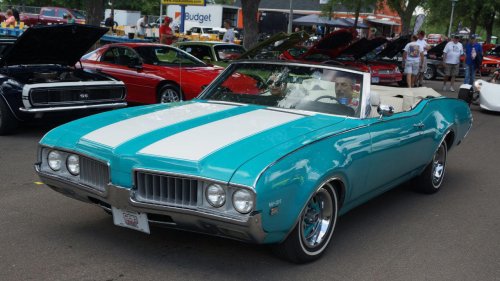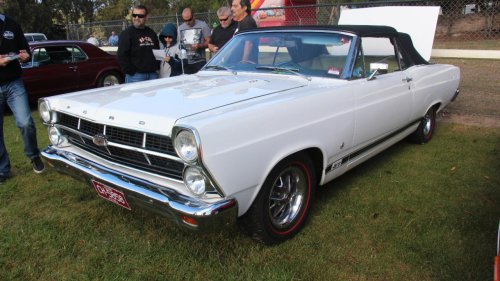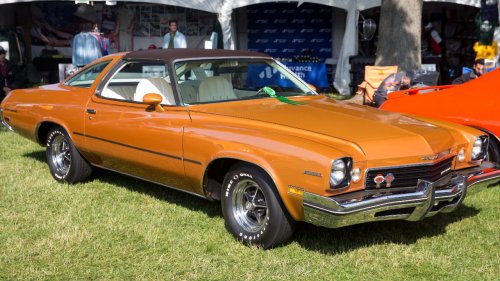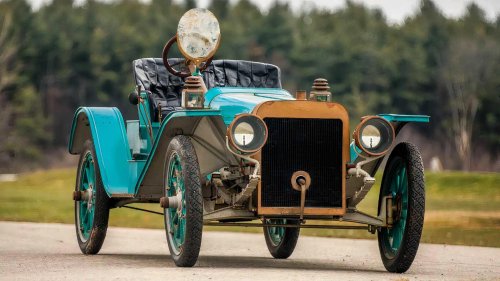
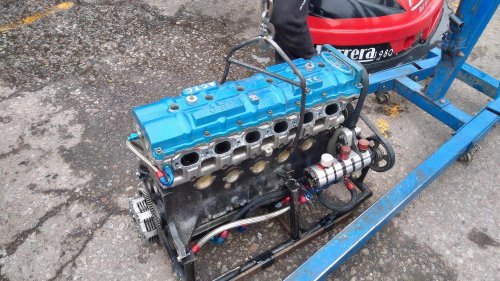
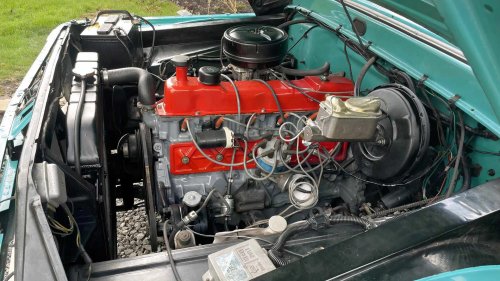
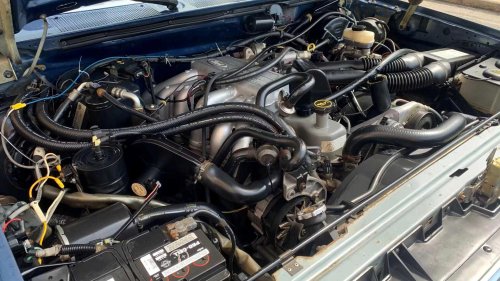
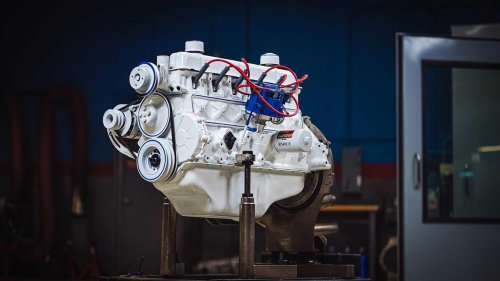



















What makes an American engine notable? Is it all in the cubic displacement, the number of cylinders, and that’s it? You'd think that, given the way people talk about V8s and '60s muscle cars. But narratives are often just that, and they don’t paint the full picture of engines that could reasonably power a muscle car. Just look at Ford. Even if the major sales drivers were V8s, the most dependable engine of the bunch certainly wasn’t. It could even be a drag engine in a pinch. The Straight-Six: FoMoCo’s Reliable Parlor Trick RM Sotheby'sSix cylinders in a straight line. It's a form factor nearly as old as mass-produced automobiles themselves, but they didn't come into their own until much later. In a time before eight cylinders was the gold standard for a refined and powerful internal combustion engine, this simpler arrangement was well-suited for heavy-duty applications like trucks and passenger cars. In the case of Henry Ford, his first straight-six wound up under the hood of something unlike thelegendary working-man's icon Model T, the Model K.The Model K was what passed for a Lincoln before the brand even existed. It was almost double the weight of the Model T, and needed every bit of its 40 horsepower to lug its weight around. Ford's next straight-six would have to wait until 1941. By then, Ford’s iconic and endlessly tuneable Flathead architecture was taking America by storm. With a docile nature and under stressed engine block, the 226-cubic inch Flathead straight-six followed the legendary Flathead V8 into production that year.This six-pot was a mainstay in Ford’s full-size car and truck lineup. Over two subsequent generations, the engine increased in cubic displacement, moved to overhead valves, and borrowed components from the larger V8 Y-Block. By 1968, the motor had swollen to a healthy 4.1 liters or 250ci. It was nearly as big as the V8s Ford was putting in their cars and trucks at the time. Better still, they were half the weight. Truck Six: A Heavy Duty Hauling Engine With a Hidden Secret Just a Man/Wikimedia CommonsBreaking off from its previous line of straight-six engines, Ford started production on a new generation of engines purposed tuned for heavy-duty industrial platforms. At its Cleveland Engine plant in Brook Park, Ohio, an engine so overbuilt that it could run as a generator for years on end with basic maintenance began production in 1965. Its smallest variant was still a not unsubstantial 3.9 liters or 240ci.To help give this new I-6 the strength it needed to haul day in and day out for years, the new block utilized nearly bulletproof timing gears instead of a chain or belt. In a move similar to what diesel truck engines made around the same time, this addition allowed for simple oil changes to keep the engine happy for mile after sweaty mile. For aFord F-Series light truck primed to take over America by storm, an engine with that kind of grunt made for a perfect pairing.The Econoline van also became a household name under the dutiful care of the 240 straight-six. Meanwhile, the earliest Broncos used them to great effect as a hard counter to the Jeep, the K5 Blazer, and Land Rover. Even larger passenger cars like the Galaxie and the LTD used the 240 straight-six to great effect, usually as a base motor. With good low-end torque, the motor served all kinds. But it wasn’t the ultimate of the breed, not by a long shot. Ford 300 Straight-Six: A Truck Motor With Latent Muscle Potential Bring a TrailerWho’d have thought stroking the 240’s engine block to 4.9 liters or 300ci would make the difference between a serviceable light truck motor and an impromptu muscle car engine? Hitting the scene alongside the 240, the 300 was very nearly as big asthe much-beloved and endlessly adaptable 302-cubic-inch (5.0-liter) V8under the hoods of everything from Mustangs to vans and trucks. It even beat it to market by a good few years, offering shockingly similar levels of performance.Well, the nitty-gritty details were actually more complicated. Where the 302 was a horsepower heavyweight, the truck-like-300 straight-six was a torque monster. In a fashion attributed mostly to modern turbo diesels and EVs these days, a typical ‘60s Ford 300 straight-six with a one-barrel carburetor made peak torque almost immediately. Meaning, of course, if you were to place two Ford Rancheros or F-100s side-by-side, one with a 302 V8 with a two-barrel carb and one with a 300 I6, the straight-six would likely get off the line faster. Ford 302 V8 vs 300 Inline 6 It might even beat the V8 in an 1/8th-mile race, all while lasting hundreds of thousands of miles before wearing out without doing much beyond oil and spark plug changes. So legendary was its reliability, that the Ford 300 found steady work in industrial applications like generator and irrigation pump service. In the same breath as the Toyota 1HZ diesel or the Buick 3800 V6, the Ford 300 was an all-time great long-term hauler. The Secret’s in the Intake Manifold, But it Doesn't Stop There MecuThe Ford 300 I6 was born into an interesting period in American automotive history at the tail end of the muscle car era. It was a time when gross horsepower readings, read on a dyno stand with open headers, was replaced by net horsepower, in the vehicle wired up as normal. This sapped advertised power figures considerably, and the 300 was no exception.An early '70s light-duty F-Series truck made in the neighborhood of 120 hp in exchange for instant torque. But the secret converting it into a screaming muscle engine came in the way the top-end of the motor was designed. Thanks to separate intake and exhaust manifolds, swapping out the intake side for something with a higher flow-rate was entirely possible and downright viable.Variants equipped for heavy-duty truck use featured forged rods and a forged crankshaft to help pull their loads up steep gradients at high RPMs. Effectively, these HD 300s were purpose-built for turbo upgrades right underneath everyone’s noses. It’d never be as popular as a 302, but what the 300 could offer with the right hardware installed was nothing short of astonishing. An Unforeseen Performance Beast in the Right Hands PowerNation/YouTubeAs easy as it is to bolt performance parts onto a 302 or a 351 V8, there’s a surprising amount of aftermarket support available for its straight-six cousin. Long-tube headers, beefier intake manifolds, and conversion kits for four-barrel carburetors, orfull-on electronic fuel injection like car far newer than it is, are all available from the same vendors that service V8s.On occasion, parts designed primarily for the 302 V8—like distributors, carburetors, alternators, and ignition hardware—have been ported over to the 300 I6 with minimal fuss and a few custom brackets. Elsewhere, purpose-built hardware like Offenhauser intake manifolds and Isky Flat Tappet cams help turn a low-strung truck engine into a real muscle car motor.Without forced induction, such upgrades can make an engine that once barely pulled 100 horsepower into something that makes three times that, plus even more in torque. With purpose-built turbocharger kits from places like reputable vendors, this once humble engine can make in excess of 500 horsepower and enough torque to move planets. The Power Nation crew showed its performance potential to the world when they got their hands on a high-end, purpose-built turbo kit for this motor. When all was said and done, their mighty 300 was cranking out 522 horsepower and 597 lb-ft of torque.What's great for hot rodders looking for an unorthodox mill is that Ford didn’t stop selling the 300 straight-six in the US until 1996, a scarcely believable 30-plus year run. That means there’s more of them out there than you might think, just waiting for a slew of upgrades.Sources: Power Nation, Ford