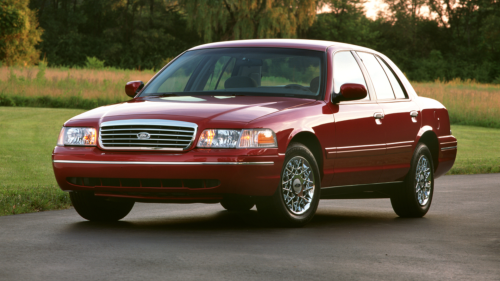
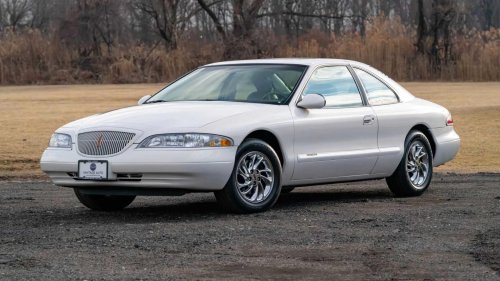
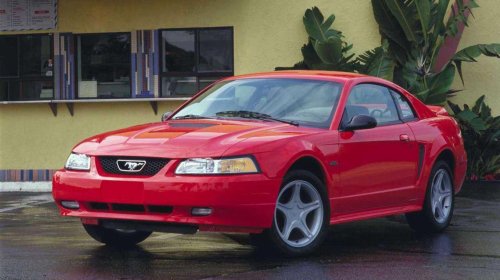
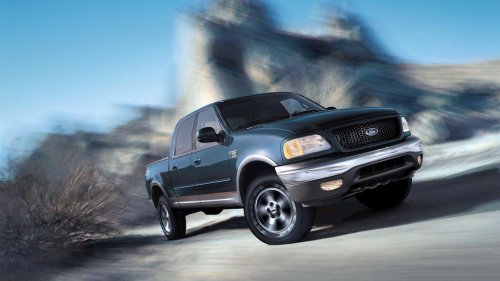
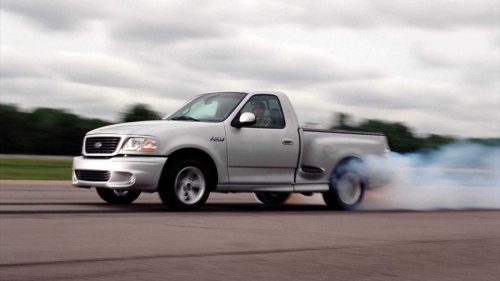
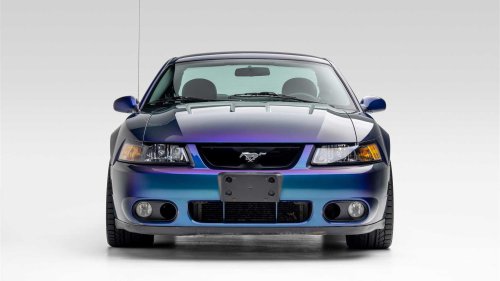
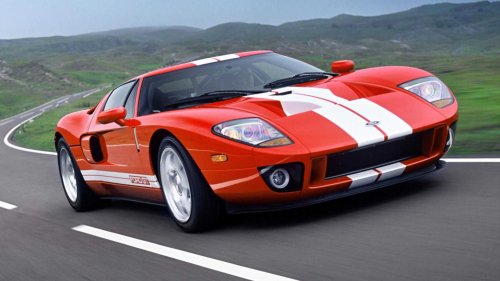
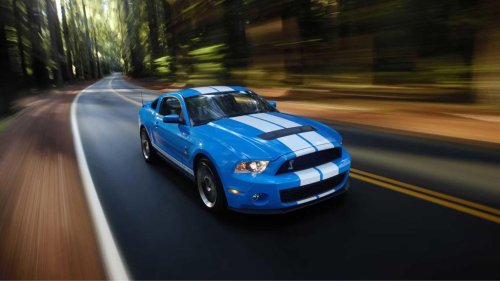
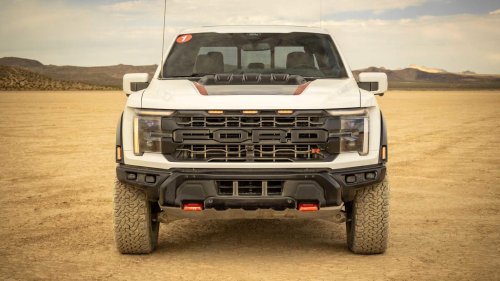
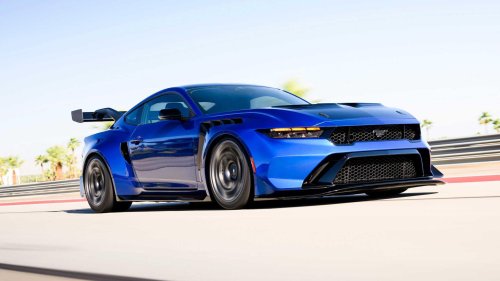
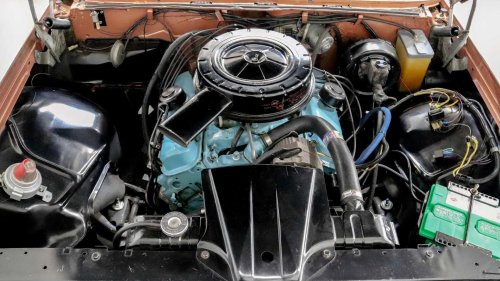
The Ford modular V8 family first hit the road in the early nineties, replacing the dated Windsor engines with a flexible new powerplant series that would power models, including the Ford Mustang and the Lincoln Mark VIII, in addition to exotic Shelby and Raptor variations and plenty more. It's unclear if anyone knew this at the time, but principles laid down by Ford's modern V8 family would help it mature into a line of workhorse engines, evolve to carry entire product lines on its back, and go on to achieve various high-performance "firsts" that would lay the groundwork to power some of the most extreme Blue Oval machinery on the road. It's also the V8 engine that's won more awards than any other.As a break from traditional pushrod engines, the new overhead-cam 4.6-liter V8 engine first appeared in the 1991 Lincoln Town Car. The Triton branding appeared in 1997 to bring this engine family to the truck and utility lineups with even higher displacements that would cement the modular family as a commercial success. The engine wasn't about winning dyno competitions, it was about earning trust. Early high-performance versions of Ford's modular V8 used sophisticated quad-cam cylinder heads for advanced breathing, and even paved the way for a modern supercharged V8 power war that would rage until present day. Below, we're looking at the wide range of models powered by this flexible performer, and the modern iterations that followed, further evolving the principles set out by the original modular V8, back in 1991. 1991 Lincoln Town Car / Ford Crown Victoria The Initial Single-Cam Solution For Reliable Durability 2003 Ford Crown Victoria front 3/4The first copies of Ford's 4.6-liter modular V8 engine rolled out to the Lincoln Town Car in 1991 and the Ford Crown Victoria in 1992. This particular version of the engine was the simplest. It used a single overhead camshaft for each bank operating two valves per cylinder. The power output wasn't enormous, but torque output was solid. Replacing the dated 5.0-liter Windsor V8 before it, the new modular 4.6-liter V8 proved that Ford's latest overhead-cam architecture could be smooth, quiet, durable, and easily mass produced for fleet use, for instance, in police vehicles. The early modular V8 engines from this era earned a solid reputation for reliability with proper maintenance, and set the template for further advances. 1993 Lincoln Mark VIII A Quad-Cam Variation That's Built To Breathe 1998 Lincoln Mark VIII LSC White Front Angled ViewWith the high-durability, low-cost modular engine launched in the Crown Victoria and Town Car, engineers set off to create a higher-output variation that was built to breathe, rev, and perform. The Lincoln Mark VII was supposed to push Lincoln into a new era, utlizing cutting-edge styling and powertrain engineering. In the early 1990s, global competitors in the luxury space were rapidly advancing the naturally-aspirated V8 engine, squeezing out more power per liter. Lincoln's new grand touring coupe would join the battle with the latest version of the modular V8. This time, a 4.6-liter unit constructed entirely of aluminum and built in a quad-cam (dual overhead camshafts for each bank of cylinders), 32-valve layout that spun up 280 horsepower and 285 lb-ft of torque. The modular V8 had now shown off its tremendous flexibility for the first time, and was one of the most sophistictaed American engines of the day. The cylinder head and air flow work put into this early quad-cam modular unit would lay the foundation of high-performance Ford V8 engines for decades to follow. 1996 Ford Mustang GT Mass Market Performance Thrills After A Few Tweaks 2000 Ford Mustang GT Coupe - front 3/4 angle In 1995, the Mustang GT came powered by its last 5.0-liter V8 engine for decades, as the new 4.6-liter modular unit moved into the engine room. From 1996, the new SOHC variation found duty under the Mustang GT's hood, complete with 215 horsepower and 285 lb-ft of torque. At this point in history, the modular V8 from the Mustang GT was outgunned by larger engines from competitors and didn't deliver the performance that some Mustang fans expected. Still, the early modular V8s in the Mustang GT were reliable and cheap to build, and the architecture itself was gaining traction.By 1999, Ford updated the SOHC 4.6-liter V8 for Mustang GT use with a higher-flowing cylinder heads, a new intake manifold, more aggressive camshafts, and an increased compression ratio. This woke the formerly sleepy Mustang GT engine up with a power boost to 260 hp, again proving the benefits of continuous evolution. The Mustang GT would run a 4.6-liter modular V8 all the way through 2010, before the next-generation modular Coyote variation arrived in 2011 to resurrect the famous "5.0" badge. 1997 Ford F-150 The Modular V8 Gets Scaled Up For The First Time 2000 Ford F-150 - front 3/4 angleFor 1997, the modular V8 family would be upsized for the first time. Until this point, all other variations of the engine had come in a 4.6-liter displacement. The latest "Triton" variation of the powerplant family would adopt a longer stroke to bump displacement to 5.4 liters. An iron engine block was selected for maximum toughness, as this would be the volume engine in the F-150 and other hard-working Fords for years to come.The 5.4-liter Triton engine put the modular V8 on the map as the backbone of Ford's truck, SUV, and commercial vehicle lineup for decades. Later variations switched from the SOHC, two-valve setup to a three-valve layout with variable cam timing. This initial truck-tune took the modular V8 framework and laid the groundwork for a new breed of extreme-performance engines to follow. 1999–2004 Ford F-150 SVT Lightning The 5.4-liter Gets Its First Blower 2004 Ford F-150 SVT Lightning Front 3/4 View burnout launchEngineers saw further opportunities with the 5.4-liter V8's introduction in 1997, so they experimented. By 1999, a supercharged, high-performance version of the powerplant was readied for launch in a limited run of high-performing F-150 SVT Lightning pickups. The SOHC V8 configuration was upgraded with a supercharger and supporting modifications to produce 360 hp and 440 lb-ft of torque. By this point, the modular V8 could be had in two displacements, multiple cylinder head configurations, and with a cylinder block cast of either high-strength iron or lightweight aluminum. 2003–2004 Ford Mustang SVT Cobra The Highest Output 4.6 Liter V8 2004 Ford Mustang SVT Cobra CoupeWith the groundwork completed some years earlier in the F-150 Lightning, Ford's engineers had learned a lot about supercharging the modern V8 engine, and the 4.6-liter V8 was next up to receive a boost. In 2003, the resulting Mustang SVT Cobra hit the scene with a quad-cam, 32-valve, iron-block configuration of the 4.6-liter engine that would become the first of many modern supercharged Mustang variations to follow. 2005–2006 Ford GT Taking On The World's Fastest Cars 2005 Ford GT front quarterRemember the supercharged 5.4-liter V8 from the F-150 Lightning a little further up your page? Turns out Ford was far from done tinkering with it. When the Ford GT supercar arrived, a mid-mounted, 550-horsepower version of the big supercharged V8 was on propulsion duty, complete with an aluminum block, quad-cam heads, and motorsports-level durability and validation built right in. For this application, the highly specialized version of the 5.4-liter V8 proved just how far Ford engineers could push the high-displacement engine. 2007–2014 Ford Shelby GT500 Shelby's Mustangs Pushed Generations Of The Modular V8 To Their Production Limits 2010-2014 Ford Mustang Shelby GT500 Front 3/4 Driving blueWhen the Shelby GT500 arrived for 2007, it took the 5.4-liter supercharged V8 to the mainstream market once again. Unlike the Ford GT, this engine configuration used an iron block and didn't turn in quite as much power. Although it did push the Mustang into 500-horsepower territory for the first time, while reinforcing Ford's commitment to leadership in supercharged V8 engines. Later versions got a 5.8-liter variation of the supercharged V8, and switched from an iron to an aluminum block in the process as the modular V8 continued to adapt, evolve, and proliferate. 2023–Present Ford F-150 Raptor The Modular V8 Enters The 700-Horsepower Club 2024 Ford F-150 Raptor R White Front in DesertWhen the F-150 Raptor R arrived in 2023, it showed just how far the original DOHC aluminum-block architecture had evolved. The 5.2-liter supercharged 'Predator' engine used here was the most powerful ever fitted to a Ford pickup. From its roots in the Lincoln Mark VII and later evolution through the Ford GT, Shelby GT500, and Mustang Cobra R, the modern Predator configuration of the modular V8 was now delivering no less than 700 horsepower. 2025 Ford Mustang GTD The Technological Culmination Of The Modular V8 2025-ford-mustang-gtd-track-10At this writing, the Mustang GTD is the most extreme take on Ford's modern-day modular V8 principle. Designed to give Mustang GT3-class performance, this 815-horsepower variation is backed by an arsenal of exclusive, motorsports-derived engineering tweaks, including a rear-mounted transmission and pushrod suspension system. This is the most powerful road-legal V8 Ford has ever built, and currently caps the brand's range of V8 engines as the ultimate evolution of Ford's modular lineage.Sources: Ford