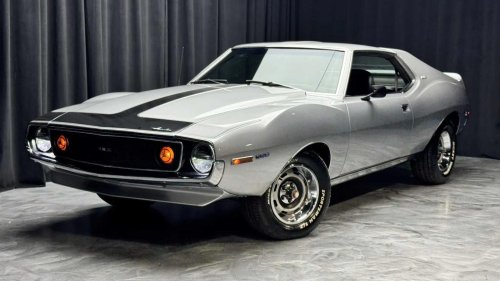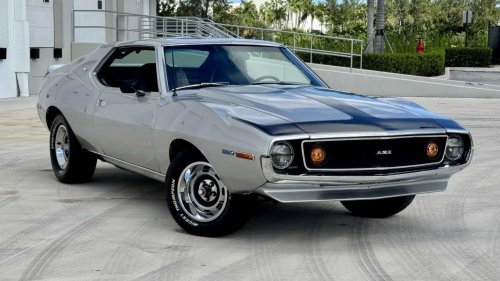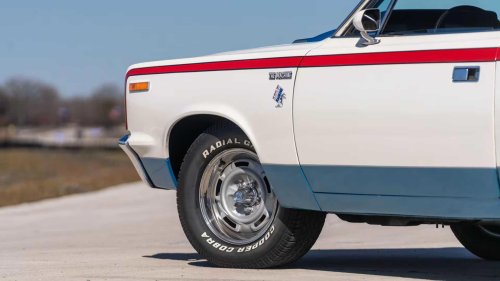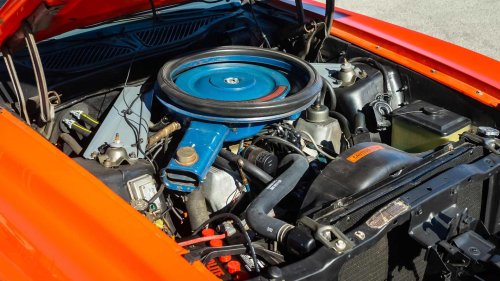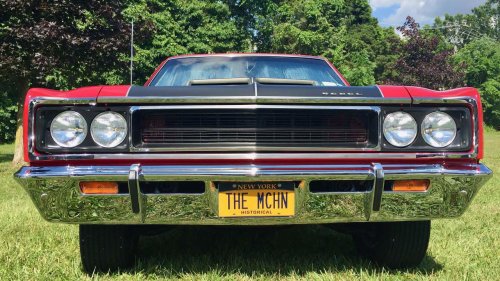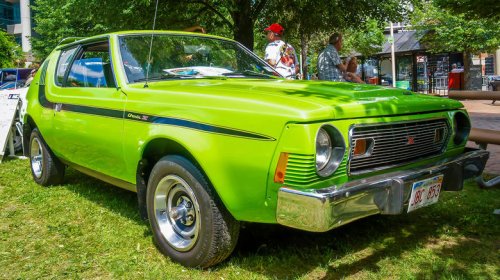
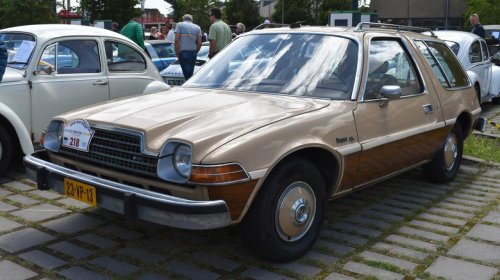
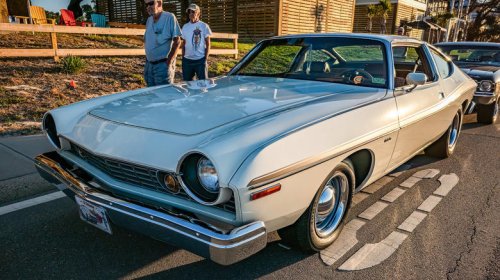
















AMC GremlinThe AMC Gremlin has one of the funniest histories of any car. It's named after the mythical creatures best known for causing aircraft malfunctions in the Royal Air Force. AMC introduced it to the public on April Fool's Day, and the first sketch of the car was done on a Northwest Orient Airlines barf bag. The car was essentially a sawed-off AMC Hornet made to compete in the compact car segment. AMC hadn't been much known for performance to that point, so the base engines on the Hornet were fairly mundane and focused more on efficiency. That is, of course, until it stuffed an AMC 304 V8 into it. AMC began the practice in 1972 and stopped in 1977, one year before the Gremlin's untimely demise in the U.S. The car wasn't the fastest, running a quarter mile in a hair over 16 seconds while going to 60 MPH in a little under eight seconds. So, despite having V8 power, AMC still focused on making the Gremlin an economy car. It arguably best known for being dirt cheap in its day, and its quirky design had its 15 minutes of fame in the 1970s. The Gremlin would become the subject of jokes from comedians and sketch comedy TV shows for years, but it has seen a resurgence in recent times as a legitimate collector's car. It'll never be known as a muscle car despite its spec sheet, but it was definitely something different in the 1970s when everyone else was doing mostly the same stuff.AMC PacerThe AMC Pacer is a lot like the AMC Gremlin. It was made by AMC as a commuter car and competed in the compact car segment. It came in a variety of configurations, including a hatchback, a base wagon, a limited-edition wagon, and the Pacer X. It was a late addition to AMC's lineup and first debuted in 1975. The line didn't last long, and it was discontinued in 1980. Sales of the car were reportedly terrible, and it was a chunky-feeling car that people didn't like. That didn't stop it from having a guest role in the movie "Wayne's World" as the Mirthmobile. You may remember it as the car that played host to the headbanging to Bohemian Rhapsody. Various configurations of the Pacer came with the AMC 304 V8, including the 1979-80 version of the AMC Pacer Limited Wagon and Hatchback, the 1977-80 AMC Pacer DL Wagon, and the 1975-80 AMC Pacer DL Hatchback. We won't bore you with the excessively slow zero to 60 MPH numbers, but suffice it to say that emissions regulations made it so the Pacer had the weakest of the 304 V8 at 125 horsepower. Its official quarter mile time is "eventually," and at no point was this car ever considered a performance vehicle despite its V8 engine. In its final year, AMC produce a little over 2,000 cars. The design was polarizing to say the least, but the car did have its fans. It's also immediately recognizable, and it's a frequent contender for one of the worst cars ever built. Some people dig that, though.AMC MatadorThe AMC Matador has the distinction of being AMC's biggest vehicle in the 1970s, usurping the prior title holder, which was the Ambassador. It started in 1971 and was a midsize car through 1973. A 1974 refresh saw it increase to a full-size car and would remain that way until AMC stopped making it in 1978. At its core, the Matador was a redesigned Rebel, so while it had a brand-new nameplate, it wasn't technically a brand-new car. It also happened to be the car that AMC used for NASCAR racing in the 1970s. It was humorously referred to as "The Flying Brick." AMC did it up nice for the NASCAR races, but the Matador was much tamer in the hands of consumers. It used the AMC 304 V8 engine every year that the car was available from 1971 to 1978. However, it did not receive the most powerful variant of the engine. Early models of the Matador sported a 304 V8 that made around 150 horsepower. By the end, the 1978 Matador with the 304 V8 lost approximately 25 horsepower. Given its size, unless you opted for the larger engine options available at the time, this was actually one of the slowest cars AMC made in the 1970s. The Matador had an interesting life, though. It starred in the James Bond film "Man with the Golden Gun" where it was driven by main villain Francisco Scaramanga. At the climax of a car chase, Bond would flip the AMC Hornet he was driving, and it's one of the earliest examples of computers being used to help design movie stunts.AMC AmbassadorThe AMC Ambassador is one of the longest-running nameplates in AMC's history. AMC made the car from 1954 until 1974 across eight generations. The 20 years that AMC built this car made it one the longest running nameplates in the automotive industry. Like the Concord, the Ambassador came in a few different variants over the course of its life, including a coupe, a sedan, and a wagon. It also stood as AMC's luxury pick, offering folks more chrome and flash than the similarly sized Matador. Eventually, AMC folded the Ambassador and kept the Matador, leaving the Matador as AMC's biggest car. The Ambassador and the AMC 304 V8 only existed at the same time for five years, from 1970 through 1974. As it turns out, the car had the engine all of those years. Despite having a beefy V8 onboard, the Ambassador is among the slowest cars from AMC during that era. It made it to 60 MPH from a stop in about 11 seconds and completed a quarter mile in a very leisurely 17.5 seconds. However, the Ambassador wasn't concerned with speed as it was more built for family hauling. It was a nice-looking car, but it didn't compete well with other large family haulers of the era. Buyers back then were more interested in the wider cars offered by competitors and while the Ambassador had good dimensions for a full-size car, other cars simply did it better. As such, AMC only sold about 40,000 to 60,000 units per year in the 1970s, with sales gradually dropping each year the car was out.AMC SpiritThe AMC Spirit is the final AMC-branded car we were able to find that ran an AMC 304 V8 at some point in its lifespan. It is best known for replacing the Gremlin in AMC's lineup to better compete with what was going on in the late 1970s as automakers transitioned to smaller, more fuel-efficient cars. AMC came out with the car in 1979 and only built it until 1983. Among the various versions was the AMC AMX Spirit, which was a specialty version of that car that was named after the AMC AMX that the automaker built in the late 1960s. That is the version of the car we'll be talking about today since it used the AMC 304 V8 in 1979. It was one of a few engine options available at that point and AMC was trying to get the most out of the V8, which had been sucked dry by emissions standards at that point. The 304 in the AMC AMX Spirit made 125 horsepower and cruised to 60 MPH in about 10 seconds with that engine. The quarter mile time is similarly not impressive. By 1980, AMC had phased the engine out of the Spirit and dropped the AMX part of the name as well, going forward with just the AMC Spirit. The bigger news for the Spirit was that it was considered much better looking than the Gremlin that it replaced. It featured a more coherent look overall and even started integrating the hard angles that would become popular in 1980s cars. It would go on to be a collector car for some people, albeit a very slow one. Jeep J10 And J20 TrucksAMC was arguably best known for being the owner of Jeep before Chrysler took them over in the late 1980s. As such, there are some Jeeps that came with the AMC 304 V8. Among them is the Jeep J10 and J20 series pickup trucks. These trucks were among the first produced under the AMC banner after the company bought Jeep in 1970. These Jeeps were fairly good workhorses for their day, sporting up to 8,000 GVWR and looking surprisingly modern for their time. Jeep and AMC would continue make the J-series trucks until Chrysler's acquisition in 1987. Despite being available throughout the 1970s, the Jeep J10 and J20 only had the AMC 304 V8 for a couple of years in 1971 and 1972. It was available as an optional engine on all trim levels of the J10 and J20 except for the highest GVWR-rated models, which used a 360 cubic inch V8 that output a little more power for those higher weight ratings. Both types of trucks shared an architecture with the Wagoneer and Cherokee. Interestingly, the Cherokee never had the AMC 304 V8, despite sharing much of its architecture with the J-series trucks and Wagoneer, which did. While we do refer to these trucks as the J10 and J20 series, they were not called that when they were produced. Jeep had different naming conventions for their trucks back then and it ranged from the J-2500 to the J-4800. However, these trucks would become the J10 and J20 after a rebranding in 1974, so we'll keep it simple and call them by those names instead.