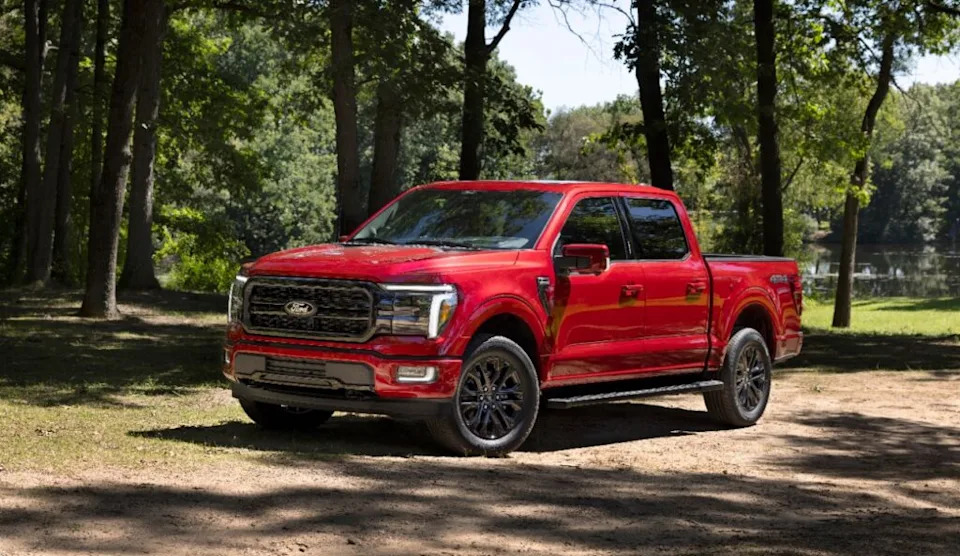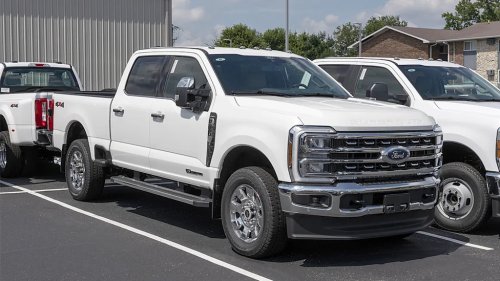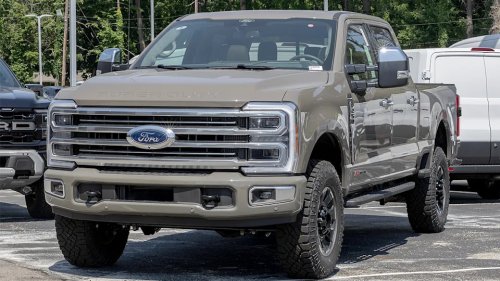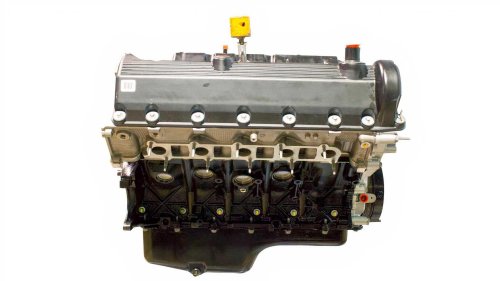
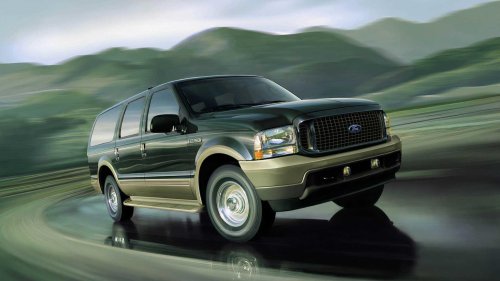
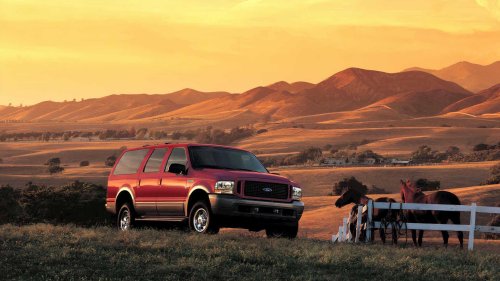
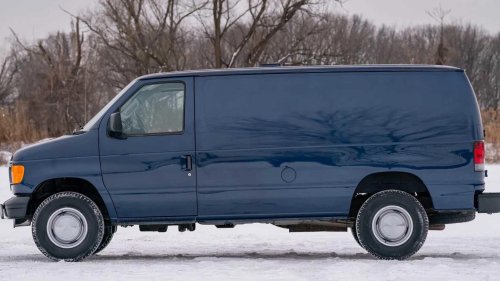
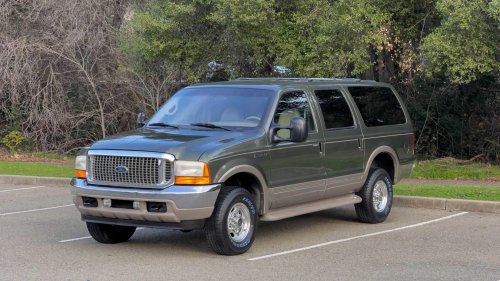
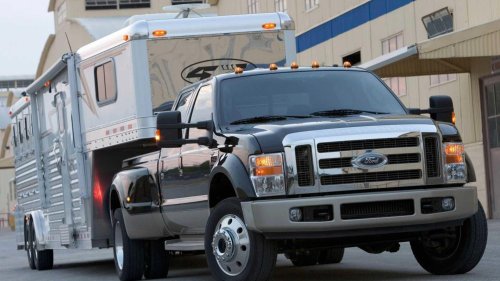
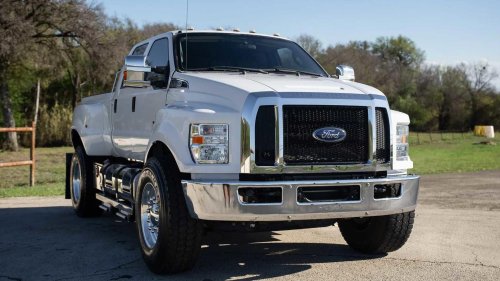
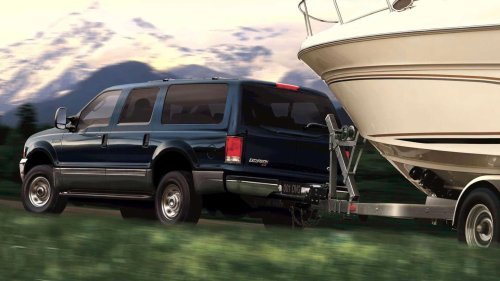



















If we're talking V10s, we're usually talking supercars and city buses, right? Packing 10 cylinders into a pickup truck or an SUV feels like overkill. And yet, that's exactly what Ford did from 1997 to 2019 with the 6.8-liter V10 Modular powerplant. This engine found its way into commercial applications, dedicated work trucks, motorhomes, Super Duty pickups, and, our favorite, a massive three-row SUV: the Ford Excursion.With gas prices being what they are, we're not sure we can recommend buying a V10 as your daily driver, but the 6.8 remains one of the best powerplants Ford ever built for chassis cabs and delivery vans. 640 Pounds Of Cast-Iron Power FordThe original version of this engine, available during the late 1990s and early 2000s, had two valves per cylinder. In 2005, the three-valve variant was introduced. The two-valve engine stuck around in the E-350 and E-450, while the three-valve engine powered the rest of the lineup until both versions were retired after 2019.Ford's modular engines used both aluminum and cast-iron blocks. The V10 was cast iron with cast aluminum alloy heads. The vibration in this behemoth was tamed via a balance shaft gear driven by the left camshaft. Watch Out For Spark Plug Issues In Early V10s FordOne of the most well-known problems affecting the V10 concerns the spark plug threads. Plugs only went five inches deep in early V10s, and they could be held in place with just four threads. The head was made of aluminum, and the plugs were made of steel, so if the threads didn't get stripped, the plugs were liable to get welded into place.According to CarComplaints, the 2000 Ford Excursion has 15 complaints on file for "spark plug discharge from head-threads gone," with a typical repair cost of $570 at an average mileage of 145,900. It says the fix is to "remove motor, disassemble, replace threads with inserts," which sounds like a big pain in the neck.These spark plug issues were resolved by 2009, but later V10 buyers weren't spared the exhaust manifold problems, which saw the bolts rust and break, leading to even worse fuel economy. The V10s also suffer from cracked Positive Crankshaft Ventilation hoses, another problem that can result in lower mileage as the plastic hose becomes brittle with age.Our advice would be to first look for a later V10, something from 2009 at the earliest, if that's an option. Secondly, do some preventive maintenance. Replace those hoses and bolts before they crack and rust. The V10 Found Its Way Into A Handful Of Mainstream Vehicles Ford If you want to drive a city bus as your personal vehicle, believe it or not, that's perfectly legal, as long as you're licensed to drive something that big. We're betting you want something a little more reasonable, though, which means you're probably looking for one of the following vehicles. 2005-2019 E-Series Vans Bring a TrailerThe E-350 and E-450 vans sold from 2005 to 2019 were available with a two-valve V10. However, the V10 engine was only available in the E-Series as a chassis cab and cutaway after 2015. These vans are hard to find with V10s, as most E-Series sold in these years would be packing a Modular-family V8. A 2010 E-450 can list for anywhere from $10,000 to $24,995 and up, depending on mileage and condition. 2000-2005 Ford Excursion Bring a TrailerThe Ford Excursion, based on the F-Series platform, was available with a range of V8s, including a modular Triton, and a pair of Power Stroke turbodiesels. The 6.8 V10 is obviously the star of the show, delivering 310 hp through a four or five-speed automatic transmission. We don't have enough data to provide a trending price for the Excursion, but we did find the following V10 models for sale in our marketplace. A 295,146-mile 2001 XLT is selling for $5,995 in Ohio. A 118,781-mile 2000 XLT is selling for $12,495 in Ohio. A 195,310-mile 2000 XLT is selling for $8,995 in North Carolina. A 143,472-mile 2005 XLS is selling for $6,950 in Georgia. A 177,062-mile 2002 XLT is selling for $17,950 in California. A 131,940-mile 2001 XLT is selling for $17,980 in Montana. A 190,209-mile 2001 XLT is selling for $15,990 in Nevada. A 149,132-mile 2000 XLT is selling for $9,645 in Arizona. A really cool, and completely impractical 2002 stretch limo with 140,021 miles on the odometer is selling for $7,000 in Nebraska. The Ford Excursion is the most sensible V10 option if you're after a daily driver, but we use the word "sensible" very flexibly here. The SUV averages around 10.5 miles per gallon combined. This means you could be burning at least a whole gallon for every single grocery trip. 1997-2004 Ford F53 Motorhome A Ford Motorhome (a full-size motorhome, not a Transit Trail Camper) might be the mainstream vehicle that makes the most sense with a V10 under the hood. Yeah, it's a gas-guzzler, but you're probably only taking it out a few times a year. Ford packed the V10 into its F-Series-based motorhomes from 1997 to 2004. Pricing for older motorhomes varies widely. A well-kept model can easily top $50,000, while a fixer-upper might be had for under $15,000. 2005-2010 Ford Super Duty FordThe 2005-2010 Ford Super Duty was available with a three-valve V10. These trucks can be found for about half their initial MSRP, more than 15 years later, but finding one with a V10 is easier said than done. Most Super Duty buyers will opt for a V8 or a turbodiesel over a ten-cylinder. 2012-2019 Ford F-650 And F-750 Super Duty Bring a TrailerAmong the final models offered with a V10 as a factory-equipped engine were the 2012-2019 big-boy Super Duties, the F-650, and the F-750. The F-750 could tow up to 37,000 lbs, and we have to assume that, if you're driving something like this, you probably move houses for a living. Well-kept F-650s and F-750s regularly sell for more than $30,000. The V10 Powered A Lot Of Professional-Grade Vehicles, Too If we're not counting the F-750 as a "professionals only" truck, what does that really leave us with? Well, buses, for one. The modular V10 was packed into the Blue Bird Vision, a school bus capable of seating up to 83 passengers. In this big yellow monster, the V10 produced 362 hp and 457 lb-ft from 2011 to 2021 and was equipped to run on both gasoline and propane. The V10 has also been hybridized for 305 hp in the New Flyer Low Floor city bus.The engine was also made available in F-450 and F-550 chassis cabs, which were typically sold to fleets and for customization from 2005 to 2019, producing 288 hp and 424 lb-ft of torque. There were also the F53 and F59 stripped-chassis trucks, which are not so much finished vehicles as bare skeletons you can build into RVs, buses, work trucks, cranes, or whatever else you need. Is A V10-Powered Ford Worth Buying In 2026? Ford No.Okay, if you need something for work that can haul a small mountain around town, we can see the upsides in driving a V10. A 10-cylinder Super Duty can pull several times its own weight, and they're selling for considerably less than you'd be spending on a new Super Duty. If your truck is making you money, then yeah, it's going to pay for all that extra gas it guzzles, sooner or later.But, it's hard to imagine anyone wanting to buy a Ford Excursion or drive a V10 Super Duty as their grocery-getterWhen gas is over four bucks a gallon, we dig the Excursion for being the real-life version of the Canyonero from that Simpsons episode, which is one of our favorite screen cars. Still, the Simpsons writers intended that SUV that "seats 35" as a joke, not as a viable means of transportation.