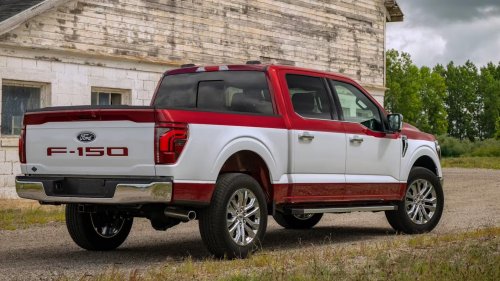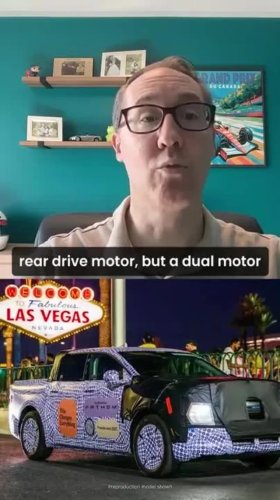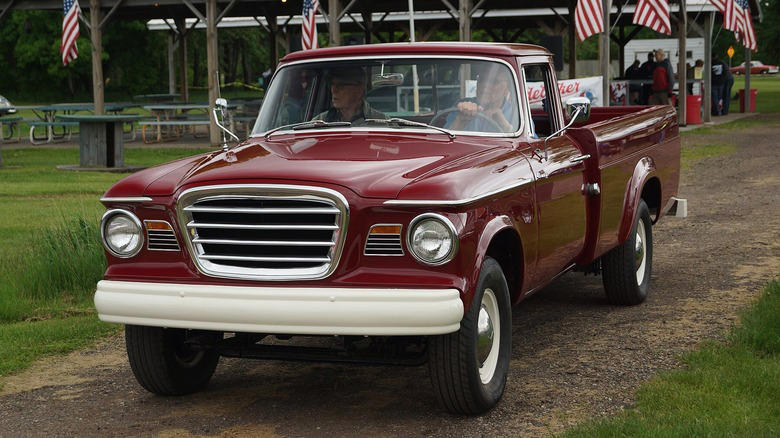
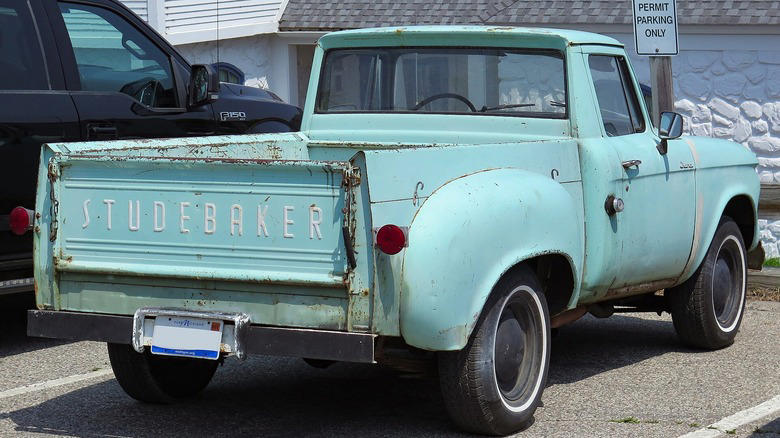



















Greg Gjerdingen/Wikimedia Commons The right truck at the wrong time? We'll find out for sure once it goes on sale, but the 2027 Ram 1500 Rumble Bee — packing a supercharged 6.2-liter Hemi worth 777 horsepower — has already been successful at generating buzz for the Stellantis truck brand. It's called up memories of past high-powered street trucks as well. A case in point is the legendary 1999 Ford SVT F-150 Lightning that — for context — was described by Car and Driver as a "muscle-bound monster" with only 360 supercharged horses in the stable. Yet we can push the birth of the supercharged pickup back even further than that if we include the 1963 Studebaker Champ. Studebaker's pickup, like the company itself, was in a tough spot entering the 1960s. It faced ever-increasing competition from the Big Three, which led to some interesting compromises and experiments. The Champ would be an example of both. For instance, when it was time for Studebaker to redesign the truck for 1960, the company was so short on cash that it simply updated the Champ's appearance with body parts from its Lark sedan. Studebaker then tried the same sort of trick under the Champ's hood. The company had already begun making a name for itself by supercharging its cars during the previous decade, and in 1963, it finally brought that technology to its pickup truck. But in a case of bad timing even the 2027 Rumble Bee (probably) won't have to deal with, Studebaker closed up its U.S. operations in December of the same year, and the final Studebaker ever built came off the production line in 1966. Checking out the Champ in detail Elise240SX/Wikimedia Commons To be clear, Studebaker only built two supercharged Champs, and neither were sold to the public. One was used by the same Studebaker division responsible for engineering the superchargers themselves, and the other is believed to have ended up at an Indianapolis Studebaker dealership. Both were half-ton trucks with Twin-Traction rear diffs — albeit with different gear ratios — with the former riding on a 112-inch wheelbase with a short box and the latter on a 122-inch setup with a long box. Options beyond the Avanti Jet Thrust 289 Engine with supercharger were slim, but the one retained by Studebaker did get a radio. As for their motivation, the trucks followed the pattern laid down in the late 1950s with Studebaker's performance-oriented Golden Hawk line. The formula included a 289-cubic-inch V8 and a McCulloch supercharger that combined for 275 horses and 333 pound-feet of torque in the cars. Now, the exact output of the powerplants in the supercharged trucks, which had upgraded blowers, isn't readily available. However, it is worth noting that the Ford F-100 at the time topped out with 160 horsepower and 277 pound-feet of torque from its naturally aspirated 292-cubic-inch V8. (Remember, Ford wouldn't introduce the F-150 until 1975.) And while the Champ would be knocked out with the rest of the Studebaker lineup in 1966, it left a long-lasting legacy that goes beyond supercharging, too: the 1960 Champ was the first pickup to offer a sliding rear window.