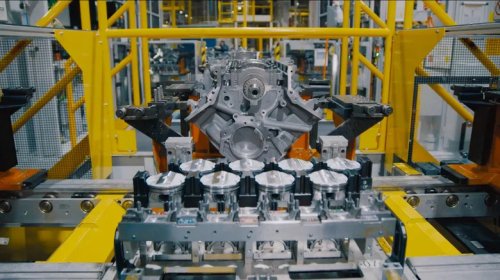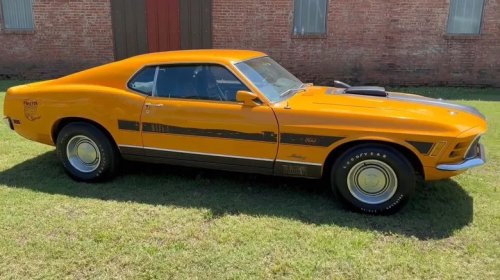

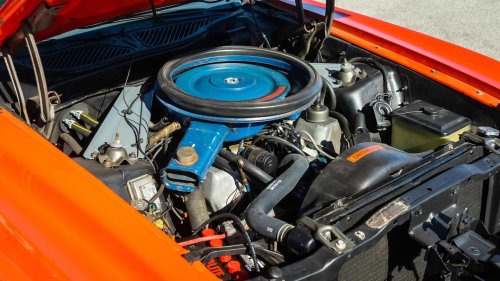



















When the '70s arrived, the decade should have suited the muscle car genre perfectly. Gone were the hippy vibes and painted Volkswagens, replaced by a time filled with glam rock, disco, and punk. The muscle car was all those things: a wild, slightly reckless expression of automotive free will. But, as we all know, the '70s couldn't have been worse for the party animal muscle car segment.The oil crisis and emissions regulations put a stop to the carefree power wars of muscle car manufacturers, replacing these bicep brutes with far less brawny models. But before the muscle car era could die out, a few car companies brought out some last hurrah models with truly spectacular engines. Ford's Mustang may have become larger and bulkier in the early '70s, but it had some potent mills to haul it around. Some of the small blocks only lasted a year before they had to be altered to fit in with the changing times, making them the rarest of this decade. But there is a catch – read on to find out more. The Boss 351 Is The Rarest Ford Small Block V8 Of The '70s Mecum Rather confusingly, Ford had two small-block 351 engines in 1970. The company introduced a small block 351 in 1969, made in Ford’s Windsor, Ontario, engine plant. Naturally, this was called the 351 Windsor and was a longer-stroke version of the 302, and available with two- or four-barrel carburetors – it is a reliable and usable V8 engine. But Ford was also working on another small block 351, to be known as the Cleveland. It was built at Ford Engine Plant Number 2 in, you guessed it, Cleveland. The 351C Was A New Engine For Ford's Muscle Cars This engine, with the internal code '335', may have sounded similar, but it is completely different. The block is wider and lower, with cylinder heads that were taken from the Boss 302, with a few modifications. The 351C utilizes a 2.04-inch intake and 1.65-inch exhaust valves, and the four-barrel version has 2.19/1.71-inch valves. The 351W was an extension of the 289/302, but the 351C was all new and presumably the mill that Ford believed would take the Mustang into the '70s with a bang.Ford had been quickly updating its engine lineup in the preceding years, introducing exciting options such as the wedge-head 429 Cobra Jet for 1970, swept along by the hype around muscle cars. Ford had apparently called the new 351 a "$100-million engine," says Hot Rod magazine, and created a "510,000-square-foot addition to the company's Cleveland Engine Plant #2" just to manufacture it. What Seemed Like A New Horizon For The Muscle Car Was Actually A Last Hurrah Mecum But there were clouds ahead for the muscle car era. Rising fuel costs were taking the market elsewhere, with some buyers moving to the new Japanese imports that looked a bit like Mustangs but cost much less to own. Nevertheless, Ford introduced the 351C to the Mustang in 1970 in two different flavors. There was the 250-horsepower H-code with a two-barrel carburetor, and the 300-horsepower M-code, which has a four-barrel carburetor. This engine was pretty popular, finding its way into around 23,500 1970 Mustangs, says Hagerty.For 1971, Ford wanted to introduce a new high-performance version of the Mustang, having decided to drop the Boss 302 and the Boss 429. This car would fill the gap between the two and keep both sets of customers happy, hopefully. The 302 Boss was officially rated at 290 horsepower and the 429 Boss at 375 horsepower, so the 351C's output of 330 horsepower sat nicely in the middle. It seemed like a new Mustang superhero in the making - but it wouldn't quite work out like that. A Deeper Dive Into The Boss 351 Engine Mecum The Boss 351 was designed as the top-dog Cleveland V8. This was virtually an all-new Boss, sharing pretty much nothing with earlier Boss Mustangs. Starting out as a 351C four-barrel, the new engine received forged aluminum pistons, four-bolt main bearing caps, high-lift mechanical-lifter cam, hardened and ground pushrods, an aluminum intake manifold, and dual-point ignition. The Boss 351 Mustangs also received ram air induction, made up of an open-element breather that is fed by functional, dual-inlet hood scoops. The engine was mated to a four-speed Hurst manual gearbox, and this hot Mustang had power front disc brakes to help bring it to a halt. Ford Didn't Sell Many Mustang Boss 351s The Boss 351 was quick, running the quarter-mile in 13.8 seconds, which was on the tail of a Corvette 454 LS6 of the same year. But while the 351 Boss was fast on the drag strip, it wasn't exactly flying out of the showrooms. Ford built just 1,806 Boss 351s, says Hagerty, and the model was available for just one year only, replaced in 1972 by less powerful versions. It is worth noting that the 302 Boss sold in greater numbers, with an estimated 7,013 sold in 1970. Ultimately, the Boss 351 was the last truly powerful Mustang of the '60s and '70s – it was the end of an era. The 351 H.O. Version Is Even Rarer It's 1972, where things get a little complicated – remember when we talked about a catch? Ford had introduced the 351 Cobra Jet (Q-Code) late in 1971, which used the Boss 351’s four-bolt main bearing caps but was rated at just 280 horsepower. In 1972, Ford scrapped the 351 Boss and semi-replaced it with an R-code 351 H.O. performance engine. It's worth remembering that the 351 Boss engine also had an R-code and was also referred to as the “351 H.O.”, but the replacement was slightly different. The 351 H.O. was A Boss Engine On A Salad Diet The 1972 H.O. 351 started life as a Boss but has lower-compression open-chamber heads and a milder cam. It was available as an $870 option. Essentially, the Boss had been downtuned to 275 horsepower as the more prudent times took a grip. While the Boss 351 engine was available only in the Boss 351 SportsRoof, the 351 H.O. could be ordered in '72 Mustang body styles, as well as the Mach I. The H.O. is even rarer than the full-fat 351C Boss unit, with Hagerty reporting that it made its way into just 398 Mustangs. Of those, a paltry 13 convertibles were made with this option. Whether this is classed as a new engine, or a masked 351 Boss is open to discussion. Buying A 1971 Mustang Boss 351 In 2025 MecumConsidering the rarity of a 1971 Ford Mustang Boss 351, these models are not as eye-wateringly expensive as you might think. If you find one in good condition, expect to pay around $59,900, says Hagerty Valuation Tools. However, Classic.com puts the average price at $80,082 for a Ford Mustang Boss 351. When Mecum Auctions sold a 62,000-mile example in 2025, it went for $134,750. The H.O. models of 1972 sell for even less. A 1972 base Mustang with that option will fetch just $15,800, says Hagerty. If you can find one, the drop-top H.O. sells for $20,500 in good condition.