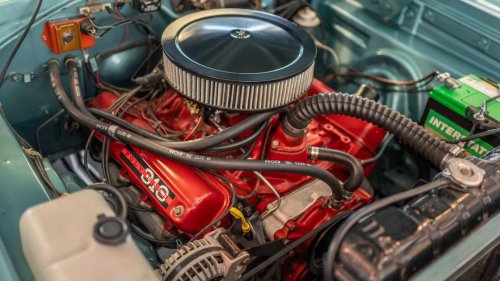
























When on the topic of Mopar engines, you'll hear all about the Hemi, max wedge, and 440. There is no shortage of people praising them out there. Make no mistake, the performance these mills deliver is bar none. They have what it takes to go toe to toe with the biggest and baddest competitors from all around the globe. Heck, the Hemi still reigns supreme in racing. But when it comes to sheer reliability, it's a small block that pulls away from the pack.Chrysler might not be as well-known for its small block engines as Chevy or Ford, but it produced some world-class champions in this division. While some might be quick to assume the 340 or the 360 were the best of them, real ones know it's the mean 318 that wears the crown. These engines could be found under the hood of anything with a Pentastar badge, not because it was big, loud, or particularly fast, but because you can count on it getting the job done no matter what. 1964: The Birth Of A Legend Via: Pinterest Chrysler engineers have been leaning on the 318 cubic inch displacement since the late '50s. The early 318 poly engines that appeared in 1957 were the first to use it. What made these engines unique was their unique polyspherical combustion chambers in the cylinder heads. That said, displacement is really all it has in common with the later 318 engines.The story of the 318 as we know it started in 1964. Chrysler debuted the motor size along with its new Light A or LA platform. While never directly called it by Chrysler, these are the motors most commonly known as Mopar's small blocks. The 273, 318, 340, and 360 are all LA engines.What makes the 318 so special is the fact that it had so much durability baked into the design, and struck a perfect balance in performance and fuel economy into a compact package that made it a viable engine for an economical version of pretty much any vehicle Chrysler designers could dream up. The blocks had thick main webs, wide bearing surfaces, stout connecting rods, some early versions had forged cranks, and water jackets kept them cool in virtually any condition.In the peak of the horsepower wars, the 1969 model year 318 produced a whopping 230 horsepower and 340 lb-ft of torque. While not the hottest motor of the era, anyone who ever drove a Dart Swinger with one under the hood will tell you they were a riot. Being unkillable made them even more fun to drive. The 318 Easily Outlasts Other Mopar V8s Mecum If we're talking sheer performance potential, the 318 is second from last when it comes to the LA engines. While not as far down the list as you might think overall, the 360 and 340 make more sense for builders to start with. Even Dodge and Plymouth leaned on these engines for their most powerful small-block muscle cars and trucks. Most notably was the use of the 340 Six-Pack in T/A Challengers and AAR 'Cudas. Those motors were conservatively rated to produce 290 horsepower and 345 lb-ft of torque.The larger LA engines, while not delicate, just weren't as tough as the 318. After all, longevity tends to dwindle as you push a motor harder and harder. 318 motors tend to live a much softer lifestyle at lower RPM. With no more than routine maintenance, you can safely count on these engines reaching 200,000 to 300,000 miles.A thread at RamForumz takes a roll call of high-mileage 318-powered trucks. The original poster declares their truck was at 264,000 miles at the time of posting, with dozens more in the same range. One commenter mentions his 318 hits, 312,000 miles before needing major repairs. Another thread at ForAbodiesOnly visits a similar topic, with one participant telling a story of a 318-equipped '79 Dodge Magnum with what they estimate to have more than 500,000 miles under its belt. The 318's Versatility Across The Mopar Lineup Mecum I'm not exaggerating when I say that the Chrysler corporation put the 318 in every last car that it possibly could. While most famous for its use in A-body cars like the Dodge Dart and early Plymouth Barracuda, these cars don't even begin to scratch the surface. The '69 Charger I'm restoring started life with one under the hood. That was the case for many Satellites, Challengers, 'Cudas, Coronets, you name it, if it's a Mopar, it likely had a 318 available to it during its production run.The reliability and solid power output made the 318 a great truck engine, too. D and W series trucks, Ramchargers, and all Trail Dusters all used this mighty small block to get the job done. Even the police saw fit to put it to work because they could count on it firing off no matter what. The Dodge Diplomat, Plymouth Volare, Dodge Monaco, and ST Regis could all have a 318 under the hood. Though they did prefer the 360 when it came to high-speed pursuit vehicles, which is the motor that wound up in the 'Lil Red Express, but that's a story for another time. Evolving With The Times Dodge All four of the LA engines are absolute legends in the automotive world. Between the 318 and 340, there is no shortage of tales of Mighty Mopar small blocks that defied all odds, and the 273 and 360, too. Times change, though, and technology advances. The LA platform was technically retired in 1992, when the Magnum engines arrived.In all reality, the Magnum engines were simply updated versions of the early LA engines. Chrysler engineers evolved the legendary platform to help it get with the times and adapt to the onset of OBD-II systems. Though, there's more going on than plugging the old motor into a computer and calling it a 5.2-liter instead of a 318 to sound more modern.LA and Magnum engines share a lot of the same basic DNA. In fact, you might not be able to spot the differences between the two if you don't know what you're looking for. However, Magnum engines were updated with revised cylinder heads, oiling systems, and intake manifolds to help make a more efficient, emissions-friendly platform. Modders And Builders Love It Too mecum Don't sell the 318 short of its true performance potential. It might not have had the factory numbers to rival the larger small blocks, but it could be tuned up to be a respectable competitor nonetheless. Getting more power out of a 318 is something many gearheads set out to do, with an entire sub-culture surrounding the prospect of making the underdog an absolute hell hound.The biggest setback for the 318 in terms of making more power is a poorly equipped top end. The cylinder heads and induction system simply don't flow. The right heads, cam, and intake could really wake them up with no compromise to reliability. Getting 300-350 horsepower out of them is something builders do on the regular. The Legendary Mopar savant, Uncle Tony, even built one that took out a 600-horsepower Ford truck in an eight-mile drag race in a four-door Coronet. Sure, it was running nitrous, but that's still a big win for the little 318. The Legacy Lives On Mecum So, what's really the greatest Mopar engine of all time? A 440 Six-Pack? A426 Hemi? Maybe it really is the 318. If you need a motor that can outlast anything on the roads, it's your best bet from Chrysler. Best of all, millions of them were produced, and you can find them cheap. The reliability and tuneability they offer make them a prime engine choice for a powerplant in a daily driver sleeper build.As much praise as the 318 deserves, it's worth pointing out that old Mopar engines are all extremely durable. While most fall short of the 318 in the high-mileage club, they can all take a tremendous amount of abuse without coming apart. So, no matter what's in your classic Dodge, Plymouth, or Chrysler, you really can't go wrong.