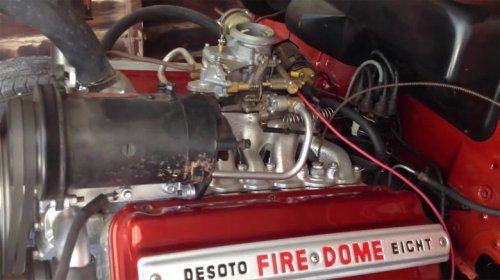
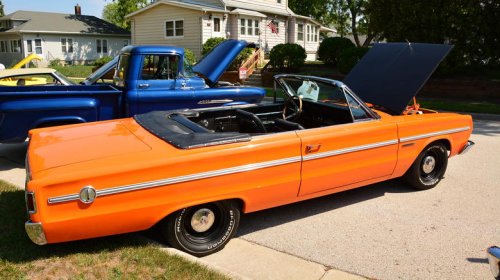
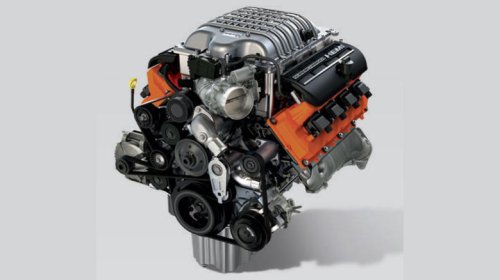
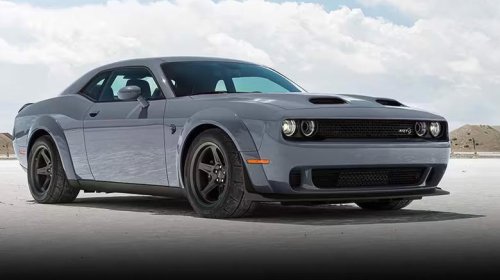
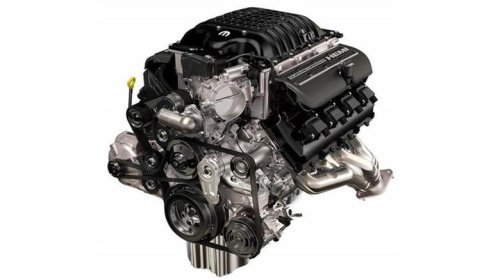
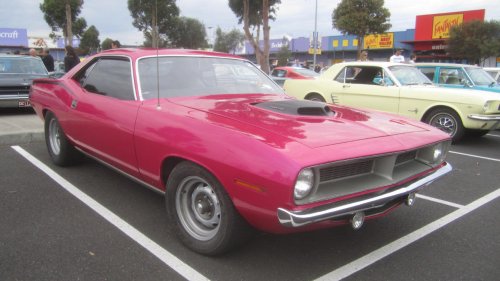
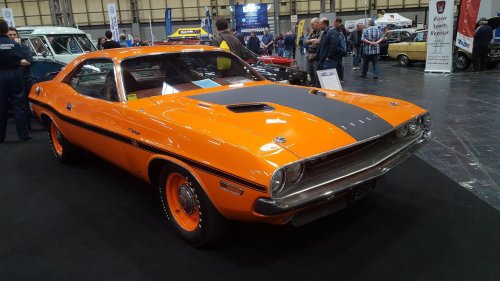
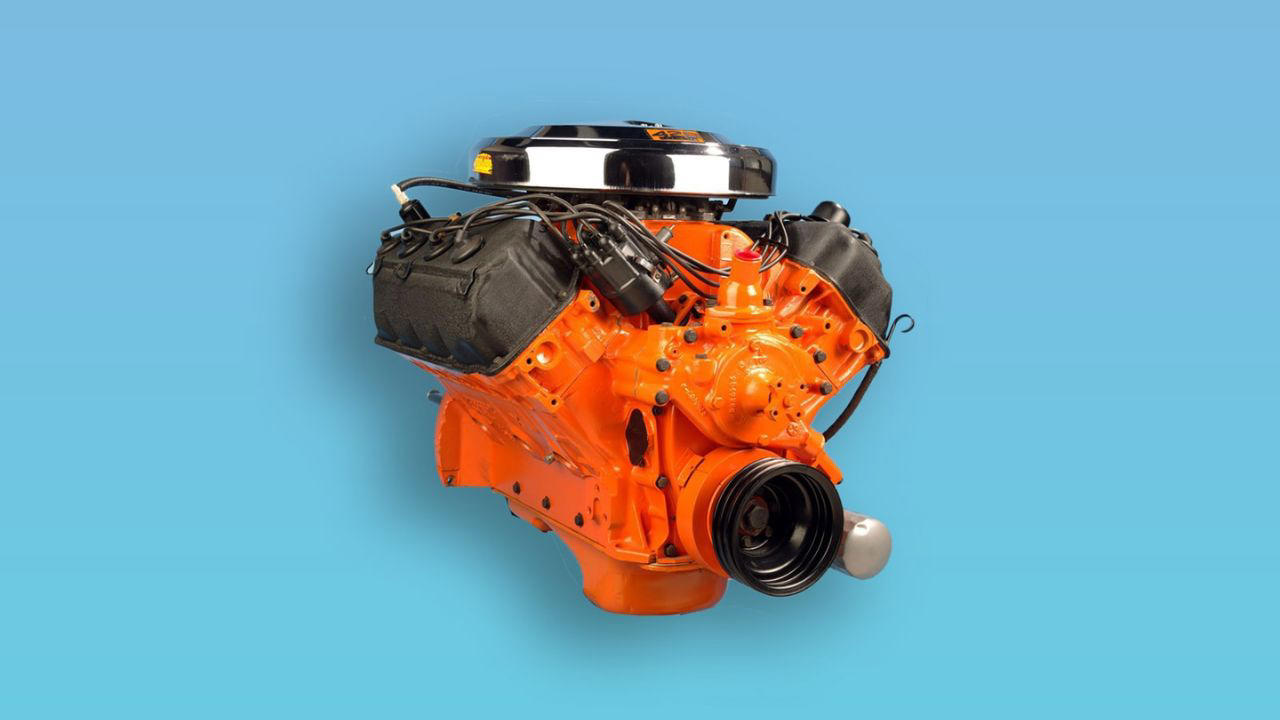
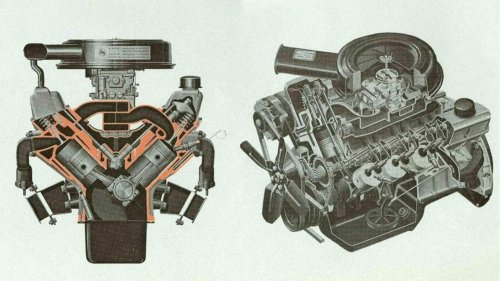
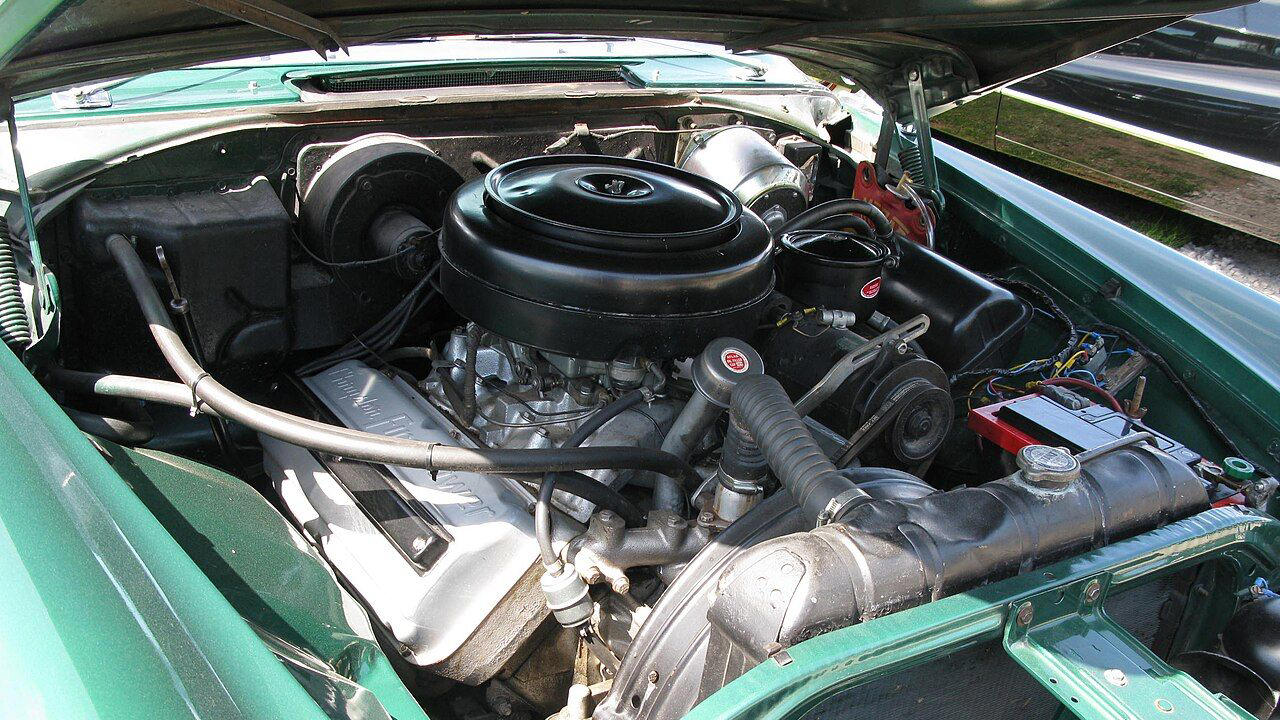
DeSoto Firedome Hemi (345 HP)DeSoto played a big role in the development of the early Chrysler Hemi engines. DeSoto was part of the Dodge Chrysler umbrella alongside Plymouth and other brands. While the brand was eventually phased out, it hit its stride in the 1950s. Part of that success is attributed to the DeSoto FireDome Hemi, which launched alongside the Chrysler Firepower Hemi around the same time. It's one of the first Hemi engines ever produced and DeSoto made a few of them in the 1950s. By decade's end, the DeSoto FireDome Hemi had achieved a maximum of 345 horsepower.The 345 cubic-inch engine was about as raucous as it could be for the era, producing one horsepower per cubic inch of displacement. It was put into the 1957 DeSoto Adventurer, which was the most powerful car DeSoto ever made. There isn't a lot of performance data available for the Adventurer, but some measurements have it doing zero to 60 MPH in 7.2 seconds and zero to 100 MPH in 22.2 seconds. Those seem rather pedestrian compared to today's vehicles, but back in the 1950s, it was pretty quick. Unfortunately, DeSoto wasn't long for the world, despite its success in 1957. A recession took out some of the brand's sales while Chrysler and Dodge started heading in another direction with its brand lineup. DeSoto would hold one for another few years, but ultimately kicked the bucket after the 1961 model year. Its success was brief but for a while, DeSoto had one of the strongest engines ever put into a car. Chrysler 426 Hemi V8 (425 HP)Chrysler began hitting its stride with the legendary Chrysler 426 Hemi V8. It was part of the American muscle car era in a pretty big way and earned some accolades and notoriety during its lifespan. The engine was originally built for NASCAR racing, which Chrysler paired with the 1964 Plymouth Belvedere. However, the engine was banned in 1965 after competitors complained that it gave its drivers an unfair advantage. It was a fair complaint as 426-powered cars took the first four spots at the Daytona 500 in 1964. Chrysler responded by making a less powerful version for 1966 that was then allowed back onto the NASCAR circuit. The street version of the 426 cubic inch engine could reach 425 horsepower at the peak of its power. It featured a lower compression ratio than the race version of the engine at 10.25:1 instead of 12.5:1 and also housed a different camshaft, intake, and exhaust manifold. The heads were also iron instead of aluminum like they were on the race engine. Word around the water cooler is that Chrysler fudged the numbers, and they might have been higher. The engine popped up in several cars in the 1960s and early 1970s, including the Dodge Dart, Dodge Coronet, Plymouth Fury, and Plymouth Belvedere. It eventually left production in the 1970s due to Chrysler and Dodge's greatest nemesis: federal emissions standards. After the engine left production, enterprising racers eventually modified the engine, giving it new life on the drag race scene for many years. Dodge Hellcat 6.2-liter Hemi V8 (717 HP)Now it's time to get into the meat and potatoes of the Chrysler and Dodge Hemi lineup. The Hellcat 6.2-liter Hemi V8 is an engine among engines in that it's supremely powerful and hilariously fun. It's one of the largest engines ever put into a production vehicle. When it was used in the 2015 Dodge Challenger SRT coupe, Dodge referred to it as the most powerful muscle car ever made. Later, it was used in the Ram 1500 TRX, which was, at that time, the most powerful production truck ever assembled. So, what makes the Hellcat so special? Well, for starters, it pumps out over 700 horsepower. The original variant in 2015 offered 707 horsepower and 650 pound-feet of torque. In 2019, the engine was revamped slightly to bump those numbers to 717 horsepower and 656 pound-feet of torque. The engine was extremely quick, propelling Dodge's heavy muscle cars from zero to 60 MPH in 4.1 seconds with a quarter mile time of 1.8 seconds at 124 MPH. Even in a truck, the engine impressed, recording a zero to 60 time of 4.5 seconds and a 12.9-second quarter mile. Unfortunately, Dodge and Chrysler put this engine out to pasture in 2023 thanks to, you guessed it, federal emissions standards. However, that didn't stop the muscle car titans from releasing a few more cars with even more absurd horsepower numbers, which we'll get into later. The Hellcat 6.2-liter V8 was a huge deal in the Dodge and Chrysler lineup, and it was even the basis for some of the other engines further down the list. Dodge Hellcat 6.2-liter V8 D170 (1,025 HP)The Dodge Hellcat 6.2-liter V8 D170 is a special engine because it is, to date, the strongest engine that Dodge or Chrysler have ever put into a production vehicle. Everything after this are crate engines designed for drag racing. The car this was put into is the 2023 Dodge Challenger SRT Demon 170, which is named for the engine, and it is one of the wildest cars to ever exist. It is, as of its release, the fastest production car to ever exist. It was part of Dodge's Last Call series before they discontinued the gas-powered Challenger and turned it into an EV like the Mustang Mach-E.So, let's get to the brass tacks. The engine makes an incredible 1,025 horsepower and 945 pound-feet of torque. It boasts a zero to 60 MPH time of 1.66 seconds and an NHRA-certified quarter mile of 8.91 seconds with a speed of 151.17 MPH. It accelerates so quickly that it produces two Gs of force on the driver. Every one of those stats is a world record for a production car. As the final car in Dodge's Last Call promotion, the car costs $96,666, with the triple sixes being an obvious nod to the car and engine. Now, there are some caveats. The engine only gets its rated horsepower on a 170-proof ethanol gas mixture, also known as E85. It can take regular gas, but it does lower the horsepower to 900 and the torque to 810 pound-feet. That's still higher than the 800-horsepower Demon from 2018. This is a special engine and a special car. While the Challenger will ride off into the EV-powered sunset, this special engine will remain available as the Hellephant C170 Hemi crate engine for drag race enthusiasts.Dodge Direct Connection 7.0-liter V8 Hellephant A30 and A170 (Up to 1,100 HP)Dodge Direct Connection 7.0-liter V8 Hellephant A30, which is also known as the 426 Supercharged Crate Hemi, and A170 are two of the most powerful crate engines that money can buy. The first, the A30, has been sold off and on since 2018, with its most recent offering being in mid-2023. It's a 426 cubic inch, all-aluminum engine with a 3.0-liter IHI supercharger and several upgrades from the engine it's based on, which is the Hellcat Redeye engine. All told, it makes 1,000 horsepower and 950 pound-feet of torque. The fact that it's designed to do it on 93-octane gas instead of E85 makes that number all the more impressive. However, if you decide to go with the E85 version of this engine, you'll be looking at the A170 model. It's specifically designed for E85 use, and the more combustible fuel grants it more than 1,100 horsepower, according to Dodge. Unfortunately, those numbers are estimates right now because the A170 hasn't officially been launched as of this writing. It's scheduled to come out sometime in mid-2024. Other than its thirst for E85, it's virtually the same engine as the A30, up to and including its aluminum construction and forged steel components. These engines are crate engines, so they were never launched in a production car by Chrysler or Dodge. These engines are designed for drag race use. You buy one, pop it into your car, and then drive it. Dodge posts disclaimers on the product pages of these engines that warn people against driving cars with these on the road due to local and federal emissions laws. Driving a car with one of these engines on the street is legal if it was manufactured before 1976.