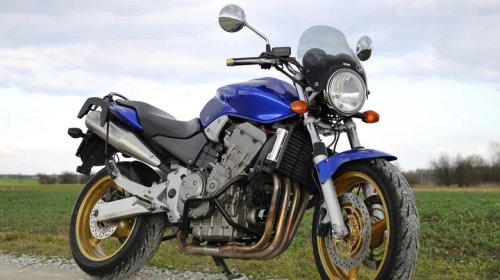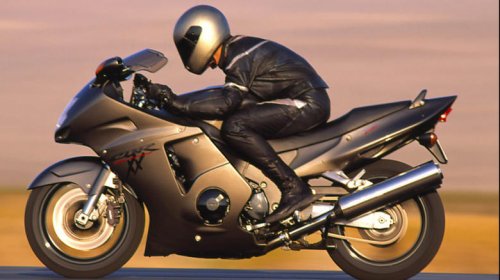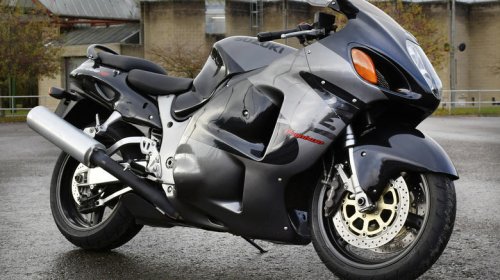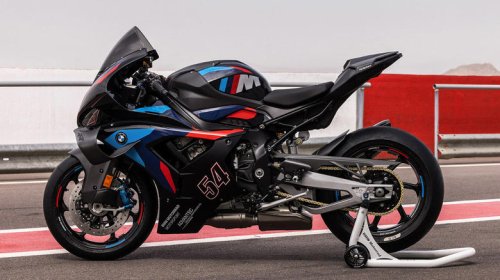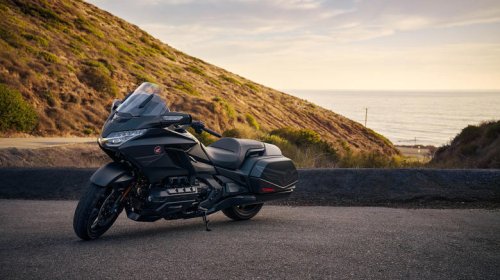
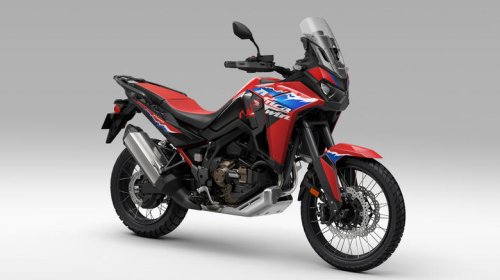
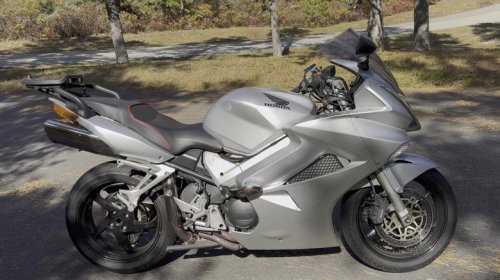
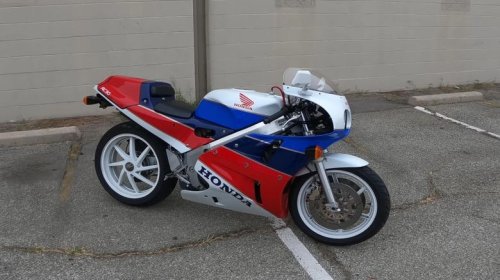
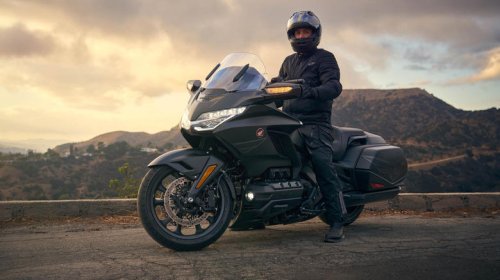
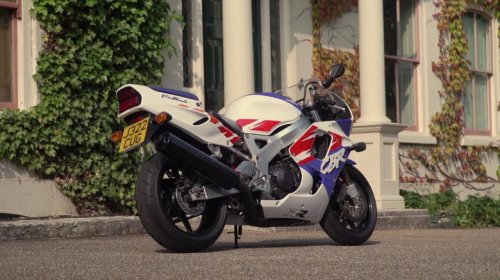
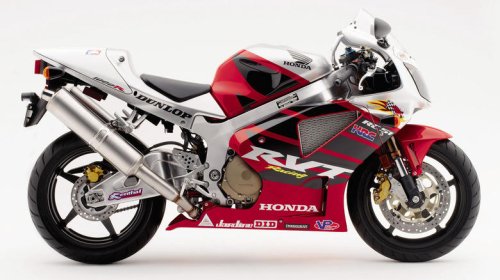
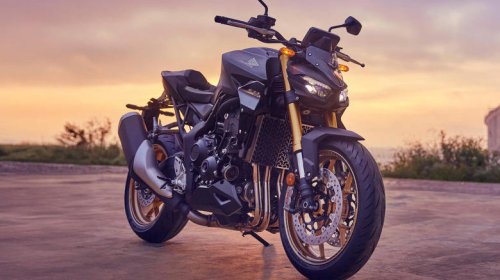
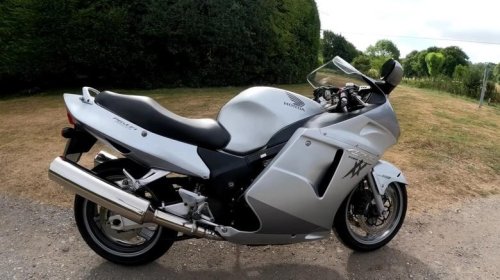
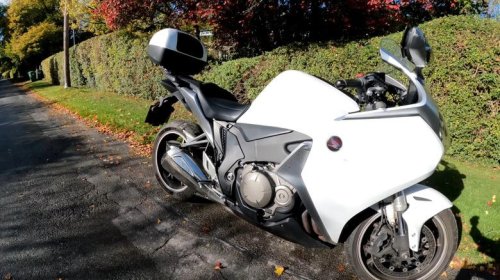
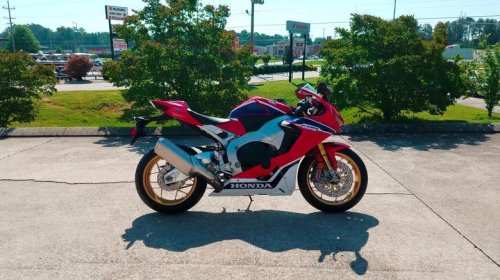
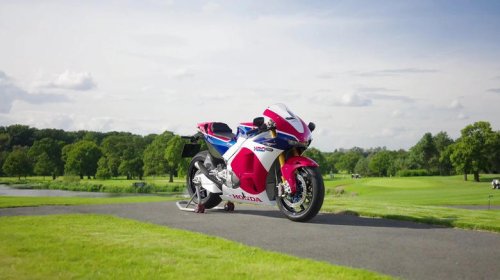
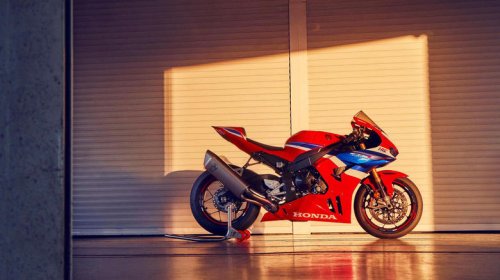


















A black Honda Gold wing from the 2025 model year finished in black metallic paint, parked on a curving mountain road.Honda is one of the most popular motorcycle brands in the entire world, and has built its reputation on rock-solid reliability that never lets people down. That's why the fact that it has a collection of insanely powerful engines is all the more impressive. While many other manufacturers increase their power outputs through ever-increasing displacement, forced induction, and other such methods, Honda has often chosen to engineer its way around the problem. The result is some of the most legendary and powerful naturally aspirated (and some not) engines in the world, many of which went on to become segment-defining units. The brand has, time and again, shown the world that it can produce remarkable power figures from relatively modest displacements. The inline-four cylinder architecture, for example, can rev into the low five-figure range and outperform other manufacturers with larger, heavier engines. The six-cylinder in the Honda Gold Wing is a fan favorite and has been for a couple of decades now. And the range in which these engines are available is equally impressive, from modest 750 cc four-bangers to 1,800 cc six-cylinders; from off-road bikes to cruisers, the company seemingly has something for every category. With all that said, here are 12 of the most powerful engines that Honda has ever made. 1,084 cc parallel-twinA red and black 2024 Honda Africa Twin equipped with the dual clutch transmission, parked against a studio white backdrop.Twin-cylinder engines are quite popular in the motorcycle world and can be classified into two main types: V-twin and parallel-twin engines. To grossly oversimplify the differences between the two, we can say that V-twin engines have the cylinders mounted at an angle, while parallel-twin cylinders are straight, and, well, parallel. It is the latter kind that is featured in the Honda CRF1100L, also known as the Africa Twin, which is an adventure (read: off-road) motorcycle from Honda. The engine displaces 1,084 cc across the aforementioned parallel-twin cylinders and comes with a bore of 92 mm and a stroke of 82.5 mm. It produces over 100 hp along with about 77 lb-ft of torque, which is channeled to the rear wheel via a six-speed gearbox that has a chain final drive. Peak torque for the 1,084 cc parallel-twin from Honda (at least in the Africa Twin; we couldn't find another model that uses it) comes in at the fairly respectable point of 6,250 rpm, while peak power comes slightly higher, at 7,500 rpm. But then again, Honda's engineering division would have thought of the end-user, who is likely someone who would want that grunt when off-roading. Other notable things about the engine are the fact that it is liquid-cooled, has cruise control as standard, and features an almost sportbike-like compression ratio of 10.5:1. 782 cc V4A beautiful chrome silver Honda VRF800 Sport tourer bike parked outdoors in the shade of some trees on a road.The next step up (that comes with about a 5% power increase from the Africa Twin's parallel-twin engine) is the 782 cc four-cylinder engine found in the VFR800. It's worth noting that Honda was the first manufacturer to mass-produce a four-cylinder engine in a V layout, and the engine in the VFR800 was a direct descendant of this program. For the uninitiated, the VFR line of motorcycles from Honda was the company's dedicated line of sport touring, or sporty-but-comfortable-for-long-distance motorcycles. After being in production for around four decades, from the 1980s, the line was discontinued in 2022. While the VFR models were in production, Honda fitted them with two of the most powerful and noteworthy engines from the brand, both of which we will cover. The first, as we mentioned, is the 782 cc V4 that came in the legendary VFR800, where it produced a grand total of 105 hp along with 55 lb-ft of torque. The transmission mated to this engine was a six-speed unit, and the assembly turned the rear wheel via a chain final drive. Being tuned for a more sporty feel, it should come as no surprise that the engine made peak power at a screaming 10,250 rpm, though torque peaked at a slightly tamer 8,500 rpm. The engine had a bore of 72 mm, a stroke of 48 mm, and had four valves per cylinder, though two valves per cylinder would deactivate below 6,800 rpm. 748 cc V4A race spec Honda VFR750R Interceptor, specifically the RC30 homologation model standing outside a building, finished in red, white, and blue.The next engine on our list was fitted to one of the rarest Honda motorbikes ever built, the VFR750R (RC30). It was a three-quarter-liter V4 unit that shipped inside the VFR750R. We want to talk specifically about the race-bred RC30 version of the VFR750R, though, which was a road-legal superbike that had no business being offered to consumers. You see, in the middle of the 1980s, a Honda racing bike called the RVF750 came out, and the RC30 was meant to be the public version of that bike. Power for the bike came from a 748 cc V4 from the same family as the one we looked at above, mated to a six-speed gearbox with chain final drive. This unit had a bore of 70 mm and a stroke of 49 mm, and fed fuel into the engine via quadruple 38 mm Keihin carbs. Power figures for the RC30 V4 stood at 118 hp at an ear-shattering 11,000 rpm, along with 54 lb-ft of torque at 9,800 rpm, which were impressive for the time period. Furthermore, the engine in the RC30 also used aerospace-grade (at the time) materials like duralumin, molybdenum, and a special kind of plastic for the fairings. 1,833 cc flat-sixA rider in full kit and helmet sitting atop a stationary Honda Gold Wing motorbike finished in black metallic.Possibly the most famous engine on this list is this next one, the six-cylinder behemoth found in the current-generation Honda Gold Wing. We'd like to remind you, dear reader, that a 2011 Toyota Corolla has an engine displacing 1.8 liters, which is roughly the same size as this gargantuan motorcycle engine — an unusual comparison. Specifically, the Gold Wing's engine displaces 1,833 cc via six cylinders arranged in a horizontally opposed layout, with four valves per cylinder. The massive 1.8-liter displacement is brought about via a bore of 73 mm and a stroke of 73 mm, meaning that the engine is classified as "square," which is relatively rare. Most bike engines would be either oversquare (where the bore is greater than the stroke) or undersquare (where the stroke is longer than the bore). Transmission options for the engine vary according to the different trims of the Honda Gold Wing, but there are two main options available. These are the standard six-speed (with reverse gear) manual transmission, or a seven-speed automatic that features dual wet-multiplate clutches. Power is aplenty, coming in at 125 hp, along with a whopping 125 lb-ft of torque, delivered to the rear wheel via a shaft final drive, regardless of transmission choice. 918 cc inline-fourA blue and white first-generation 1996 Honda CBR900 Fireblade parked outside Charles Darwin's house.Next up, we have one of the most iconic engines ever produced by Honda, which is the one from the CBR Fireblade. However, we're not just talking about any Fireblade here; we mean the CBR900RR T/V version introduced around 1996. It was in this period that the engine displacement was bumped from 893 cc up to 918 cc, enabling the engine to now make a grand total of 126 hp at 10,500 rpm, which would be further improved to 128 hp two years down the line. Torque for the initial 918 cc I-4 engine stood at 67 lb-ft at 8,750 rpm, and when output increased in 1998, torque rose only marginally to 67.2 lb-ft. Furthermore, while the peak hp rpm stayed the same between the two generations of the 918 cc engine, the 1998 version would make its peak torque at 9,000 rpm. However, the jump from 893 cc to 918 cc was also significant because the top speed of the bike went from around 160 mph to about 174 mph by the turn of the century, thanks to some clever engineering and weight reductions. After a relatively short production run from 1996 to 1999, the engine was uprated again to 929 cc, with a larger displacement and more power. 999 cc V-twinA side view of the Honda RC51, finished here in red and white livery, against a white studio background.The first of many liter-sized engines that we're going to be featuring on our list is this next one, found most notably in the RC51, another legendary Honda sportbike. It was being sold around the same time as the 929 cc CBR900-RR Fireblade, as the RC51 was sold from 2000 through 2006. Designed to compete specifically against Ducati's dominant V-twin superbikes and as a spiritual successor to the Honda RC45, which itself was a successor to the RC30 that we looked at above, Honda really cooked up a storm with this one. It was a purpose-built race bike that shipped with a 999 cc — so almost a liter — V-Twin engine angled at 90 degrees, mated to a six-speed transmission. When we say it was a racing machine, we mean it, because the RC51 managed to win the World Superbike championship twice. This and other motorsport achievements came about largely thanks to the strong power outputs of the V-twin engine, which stood at an eye-watering 133 hp, available at 10,000 rpm. Torque was pretty good too, coming in at 71 lb-ft, with peak torque arriving at 8,000 rpm, so it's really not surprising that the bike that this engine was fitted to had good racing chops. This engine too had four valves per cylinder, bringing the total to eight, along with an advanced fuel injection system for better performance. 998 cc inline-fourA steel gray Honda CB1000R Hornet motorbike standing on a paved surface, with the setting sun in the background.Now, we jump two decades forward (approximately), because our next Honda engine was fitted to the CB1000R; not to be confused with the race-ready CBR1000RR that we've been talking about above, and that will feature again further down. The CB1000R is still a sportbike, and a very high-performing one at that, but less so than its modern counterparts with more Rs in the name. The engine in question is a 998 cc four-cylinder that comes in an inline layout and is paired with a six-speed transmission that sends power to the wheel via a chain final drive system. The engine itself achieves this displacement via an oversquare configuration that features a bore of 75 mm and a stroke of 56.5 mm, with dual overhead cams. All said, the 998 I-4 from Honda makes an impressive 143 hp, with peak power available at 10,500 rpm. The torque figure clocks in at 77 lb-ft and is available from 8,250 rpm, which is really all there is to it. Motorcycle aficionados who are entrenched in Honda's world will notice that the bore, stroke, and other figures for the CB1000R are not that different from those of the more hardcore CBR1000R, and this probably just comes down to engine tuning. 1,137 cc inline-fourA silver-gray 2005 Honda CBR1100XX Super Blackbird parked on a small dirt road with grass and trees in the back.At one point in time, this next engine made the bike that it was fitted to the fastest production motorcycle in the world. It's the 1,137 cc inline-four that shipped inside the Honda CBR1100XX, which was christened the "Super Blackbird" by Honda. The engine had 16 valves in total — that's four per cylinder — dual overhead cams, and used a lot of exotic parts, and featured a bore of 79 mm and a stroke of 58 mm. Paired to a six-speed transmission with chain final drive, the Super Blackbird made over 160 hp and an equally staggering 88 lb-ft of torque. These power figures are what enabled the bike to dethrone the then-world-record-holder for motorcycle top speed, which was the ZX-11 from Kawasaki, by a whole 3.5 mph, with a final value of 178.5 mph. An interesting tidbit of information is that the Hayabusa (peregrine falcon) is the main natural predator of another bird, which was called the blackbird. This was clearly Suzuki being a bit tongue-in-cheek with the naming scheme. However, since the 'Busa did end up becoming the fastest bike on the planet for a while, shattering the Honda CBR1100XX's record just a couple of years later, it was absolutely justified. All in all, the Super Blackbird was one of the fastest Honda bikes ever built, kicking off an arms race that gave us some truly exceptional bikes. 1,237 cc V4A 2011 Honda VFR1200F Interceptor in white next to a hedge, parked at the side of an internal country road.We jump back into the trusty VFR line of sport touring motorbikes with this next engine, which came with the Honda VFR1200F. The engine itself displaced 1,237 cc across four cylinders in a traditional V layout, making it the second-largest engine on our list in terms of displacement, behind only the gargantuan Gold Wing, which is significantly larger than this. The bore and stroke were quite interesting, coming in at 81 mm and 60 mm, respectively, with each of the four cylinders getting four valves, for a total of 16. Also, the engine was not a 90-degree V4, as is common in the industry, but featured a shallower 76-degree angle between the cylinders. In terms of power, the bike had plenty, clocking in at around 170 hp and 95 lb-ft of torque. The 1,237 cc engine was mated to a six-speed transmission that turned the wheel via a shaft final drive. Notably, this engine was the first (from Honda) to come equipped with an (optional) dual-clutch gearbox, and yes, the motorbike got it before any four-wheeled cars from Honda did, which is a feat in itself. 999 cc inline-four (2017)A 2017 Honda Fireblade SP CBR1000RRR standing on pavement, with a main road and some plants in the backdrop.Next up is an engine from one of the most legendary motorcycles of the modern era, the 2017 Honda CBR1000RR Fireblade SP. Back in 2017, it was shipping with a 999 cc inline-four engine mated to a six-speed transmission and featuring chain final drive. The displacement was brought about via a bore of 76 mm and a stroke of 55 mm, and the engine featured things like electronically controlled suspension and special racing brakes as standard equipment. Power figures for this version of the engine were approaching small-car territory, clocking in at 189 hp and 84 lb-ft of torque. The hp peaked at around 13,000 rpm, while peak torque came about a bit earlier, at 11,000 rpm, making that generation of Fireblade one of the most powerful literbikes on the market that could probably hold its own even today, almost a decade on. It's worth noting that the figures we listed above are for the Fireblade SP, and this could potentially get confusing. You see, there were three main trims on offer at the time: the standard version, an SP, and an SP2 version. However, the ultimate SP2 version was for motorsport and homologation rules only, while the SP was a mass-market model that didn't have a limited production run. 999 cc V-four (2016)A red, white, and blue Honda RC213V-S street legal hyperbike standing on a roller rear wheel stand on a smal road, surrounded by grass.Just about a year before the Fireblade got its new 999 cc I-4 engine, Honda was already experimenting with this displacement in a bike called the RC213V-S. While not built for homologation purposes, the RC213V-S was as close to Honda's MotoGP contender bike at the time as road regulations would allow, because yes, this bike was completely street-legal. It shipped with a four-cylinder engine, with the cylinders arranged in a traditional 90-degree V layout, with a six-speed transmission and chain final drive. The total power output for this version of the one-liter V-four from Honda stood at a whopping 210+ hp on the upper end, and torque came in at an impressive 87 lb-ft, though both of these are claimed figures by Honda and not dyno-tested. It's also worth mentioning that the hp and torque figures that we just quoted above are for bikes that were equipped with a high-performance package known as the "Sports Kit," while the regular RC213V-S made do with a tamer 160 hp and 75 lb-ft of torque. Later down the line, Honda developed an internal evolution of the RC213V-S (informally referred to as "Part 2" by Cycle World) not meant for production. There were some requirements of the engine in the Part 2 that necessitated using parts that are otherwise considered less performant than others, such as the use of spring-actuated valves inside the combustion chamber in lieu of air-actuated (pneumatic) valves usually found in Honda's MotoGP-level racing bikes. 999 cc inline-four (2025)A red, white, and blue 2025 Honda CBR1000RR-R SP Fireblade motorbike parked against a sun-kissed industrial building.This next one features the same bike from earlier and the same engine, but with vastly increased horsepower, even though both are technically considered the same generation. We're talking, of course, about the Honda CBR1000RR-R SP, and the 999 cc inline-four architecture that we just took a look at. The modern 2025 Fireblade SP now makes an incredible 215 hp, alongside an equally astounding 83 lb-ft of torque, planting the model firmly in the hyperbike category. The caveat here is that this power figure was achieved in a special homologation version sold in the UK around 2022, which is when the special came out. Power is channeled to the rear wheel via chain final drive, after routing itself through a six-speed transmission. The alphabet-soup of a name aside, this engine is pretty similar to the one from the end of the 2010s, with a couple of key differences. The main upgrades were all to do with the air system, including new intakes and exhausts, along with other redesigned components, like more teeth on the final drive sprocket and some software tuning. Today, the latest CBR1000RR-R SP is considered one of the best sportbikes on the market and is pitted against other titans like the BMW S1000RR, BMW M1000RR, and Kawasaki Ninja ZX-10R. It remains a dominant force in the space and continues to rack up motorsport victories for Honda. We're excited to see what the brand can improve on this model down the line. Want the latest in tech and auto trends? Subscribe to our free newsletter for the latest headlines, expert guides, and how-to tips, one email at a time. You can also add us as a preferred search source on Google.