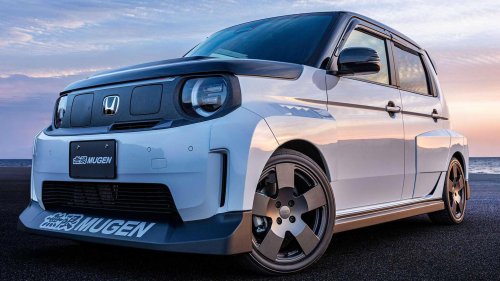
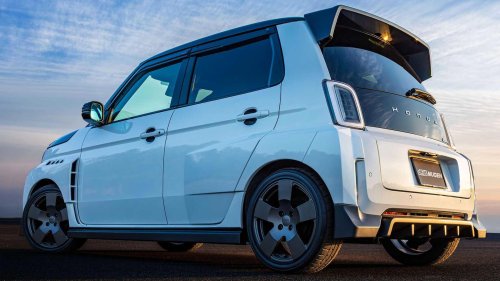
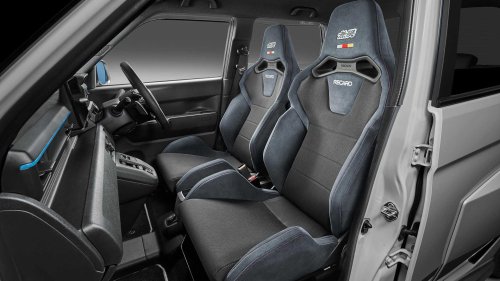
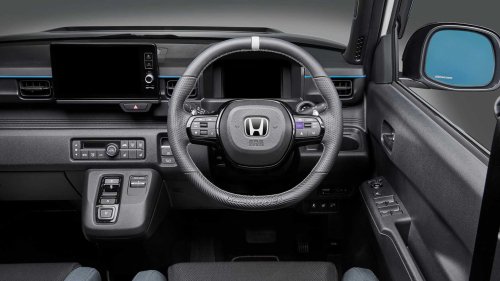
Honda stole our hearts when it revealed its Super-One. Based on the electric version of Honda's already adorable N-One kei hatchback, it brings similarly tiny renditions of classic hot hatch design cues like boxy fender flares and extra air scoops. Until today, we would've said that the Super-One looked plenty cool and aggressive. Today, though, we've seen what famed Honda tuner Mugen has created, and it makes the electric sportster in standard guise look positively plain in comparison.Mugen The Body Kit Makes It Even Wider While the big Mugen decal on the new front spoiler might be the first thing you notice, the real highlights of Mugen's restyling are the new fenders and flares. The front fenders are completely replaced with new fiberglass pieces with vents on the tops of the wheel wells and extensions for the front bumper. Mugen says these fenders, in addition to adding a combined 0.55 inch to the Super-One's stock 62-inch width, they're 20% lighter than the factory steel fenders. They're matched with rear fender flares adding the same amount of width. They have extensions that blend the rear flares into the doors and rear bumper.MugenMugen didn't stop there, of course. We already touched on the front spoiler, and Mugen also offers side skirts and a new rear diffuser to go with it. A new fiberglass hood is available with a sort of power dome design. Mugen claims it's 25% lighter than the stock hood. Other parts include forged 16-inch alloy wheels, a carbon fiber rear spoiler, carbon fiber mirror caps, decals.MugenThe interior gets some attention, too, though not all the parts are available just yet. Unfortunately, the unavailable parts are the most interesting: the sport steering wheel and the Recaro seats. The seats are especially appealing, as they seem to have much more aggressive bolsters, and the almost denim-blue microsuede looks beautiful. While Mugen works on making those parts a reality, you'll be able to add floor mats and door panel and sill appliqués with the tuner's brand on them. MugenMost of the exterior parts are only sold in unpainted form, though the front spoiler, side skirts, and rear diffuser can be had in gloss black for an extra charge. For the body parts alone, excluding decals, wheels, and any paintwork that will need to be done, you'll be spending ¥1,382,700, which comes to $8,669 at the time of writing. That's not cheap, but compared to the total cost of the car, this body kit is 40% of the price of a new Super-One, which is remarkable. It's a good thing it looks so amazing. Not that it matters for those of us in America, who won't get the car to begin with. It's A Shame We Won't Get The Super-One On paper, the Super-One doesn't sound hugely impressive, and while we hate to admit it, it probably isn't well-suited to America as a result. It makes a maximum of 94 horsepower, and it weighs a bit less than a Miata at 2,403 pounds. It's also rated for 170 miles, but on the quite generous WLTC test, so it likely would have less than 150 miles of range on the EPA test cycle. Even if Honda somehow found a way to sell it for less than a Chevy Bolt or Nissan Leaf in America, it would probably be a tough sell.Still, when we had the opportunity to drive a pre-production prototype, we were charmed. It's tiny and eager to corner. The artificial acceleration sounds are entertaining, and it has simulated gears like in the Prelude. It's not fast, but it's fun, and we'll always wish for more cars that are just fun. Even when we know that it probably wouldn't make any business sense.