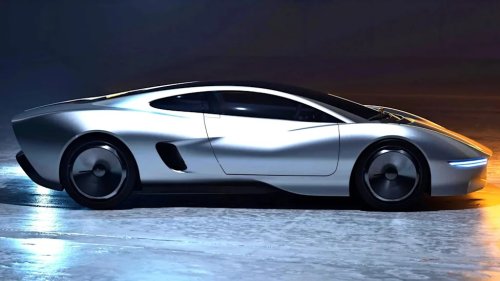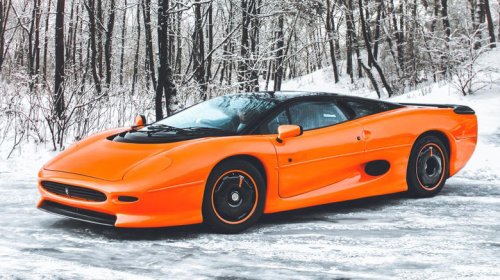
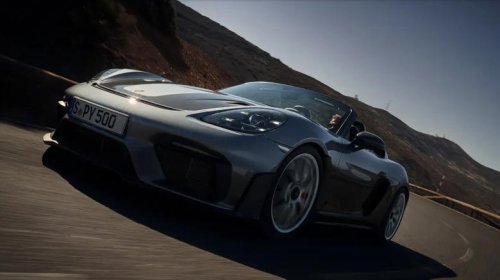
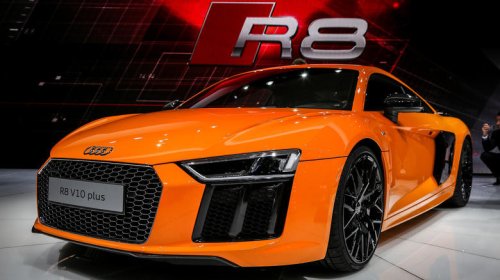
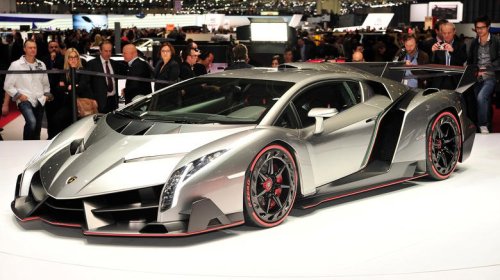
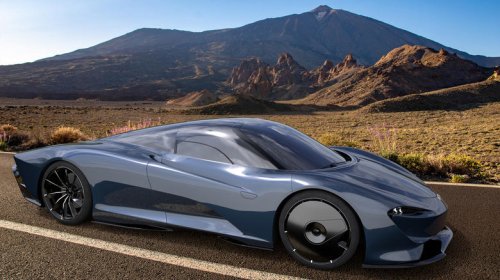
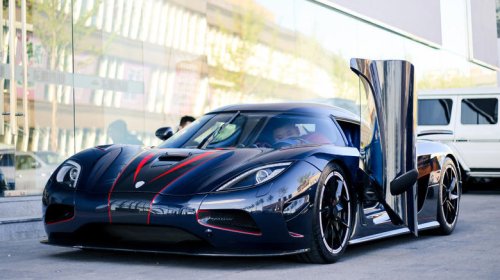
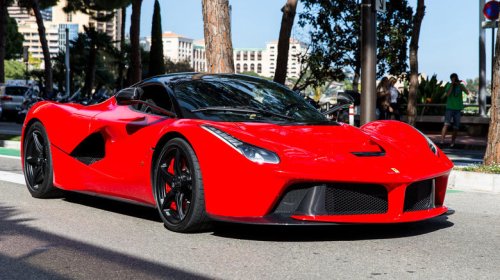


















Jaguar XJ220 – 3.6 secondsThe Jaguar XJ220 arrived in the early 1990s at a sweet spot in sports car history. The days of flashy poster cars with questionable performance and handling were behind us, and today's highly automated, multi-clutch, driver-assisted machines were still some years away from mass adoption. This was the era of 200-plus mile-per-hour supercars such as the Ferrari F40, the McLaren F1, the Lamborghini Diablo, and the Jaguar XJ220, in all their clunky, mechanical glory.While the XJ220 was initially intended to have a 12-cylinder, 48-valve powerplant, austerity measures saw its engine whittled down to a 6-cylinder, 3.5-liter variant that could still muster enough power to (almost) hit the 220 mile-per-hour benchmark. It sported a smoothly sculpted silhouette, with a large integrated spoiler, covered headlamps, and deeply recessed, curved air intakes in stark contrast to the angular side strakes that furnished the likes of the Testarossa and Countach before it.The XJ220 had rockstar looks, exceptional handling, and Le Mans-winning heritage — albeit before a dubious disqualification. It could reach speeds of over 210 mph and held a 0-60 mile-per-hour time of 3.6 seconds. Despite these qualities, it never achieved the same legendary status as some of its contemporaries, reflected in its relatively low resale value. However, even today, the XJ220 is still impressively stylish and incredibly fast.Porsche 718 Spyder RS – 3.2 secondsFerdinand Porsche was a controversial legend in the automotive world who helped shape the automobile industry as a whole. He created the Volkswagen Beetle and founded Porsche AG, a celebrated marque that needs no introduction as the brand behind many iconic masterpieces, including the ubiquitous rear-engined 911 and the mid-engined 718 Spyder RS.The 718 Spyder RS is Porsche's attempt to recapture the spirit of the roadster, an open-topped configuration that the brand has been perfecting since the mid-1950s with its original 550 Spyder. The new generation of Spyder has a high-revving four-liter, six-cylinder boxer engine. Driving this car with the roof and the engine singing at 9,000 rpm is the closest you can come to riding a motorcycle while on four wheels.Ultimately, the 718 Spyder RS is unmistakably a Porsche, even though the brand has evolved so much since its founder first laid out his original visionary designs. With its ability to hit 60 miles per hour in just 3.2 seconds, top speed of 191 miles per hour, clean aesthetics, and a fun and almost comfortable driving experience, we think Ferdinand would most likely be impressed.Audi R8 V10 Plus – 2.9 secondsThe end of the 20th century was an important time for Volkswagen AG, Audi's parent company. It went about buying a veritable smorgasbord of luxury performance car brands, including Bentley, Bugatti, and Lamborghini, the latter of which was placed under the stewardship of Audi AG. It was only a matter of time before Audi started producing supercars under its own marque, which came about in 2007 with the introduction of the Audi R8.The Audi R8 was a compact mid-engine coupe with an engine borrowed from the Lamborghini Gallardo matched to Audi's successful Quattro all-wheel drive system. It featured familiar design elements plucked from the Volkswagen and Audi catalog, such as the Karmann Ghia and Audi TT, albeit with a more streamlined, contemporary profile. The car was a great success, lauded by critics and the public, and even featured as Tony Stark's chosen wheels in the early Iron Man movies. However, as the new millennium marched on, the original R8, with a 0-60 time of around four seconds, needed an overhaul.The Audi R8 V10 Plus was released in 2015 with a revised V10 engine, a more chiseled look, and an advanced carbon-enriched structure that helped it shed a few pounds. Its specifications were further improved with the addition of a quick-shifting dual-clutch transmission, and it retained the multi-plate Quattro four-wheel-drive system for superior handling. These improvements were evident in the car's performance, with a new top speed of 207 miles per hour and a 0-60 time of just 2.9 seconds.Lamborghini Veneno – 2.9 secondsJoining the ranks of ultra-quick European roadsters is the Lamborghini Veneno, which marks yet another chapter in this much-venerated marque's storied history. When established as a manufacturer of tractors in the mid-20th century, few would have imagined the lofty heights the Italian brand would reach. It is now renowned as one of the foremost producers of performance cars, with all the resources and experience of its owner, Audi AG, at its disposal.Just 13 Lamborghini Venenos were made between 2013 and 2014, numbering four coupes and nine roadsters, adding considerable scarcity to this already highly valuable car. Even by Lamborghini's standards, it is a remarkable machine with a 221 mph top speed and the ability to reach 60 miles per hour in just 2.9 seconds. It features a 6.5-liter aspirated V12 engine within a body that is inspired by the aeronautical industry.Lamborghini still makes outstanding tractors, but it will always be remembered as the supercar's poster brand that marries flamboyant aesthetics with impressive performance. While other models, such as the hybrid Sian and the latest-generation rear-engined Countach LPI 800-4, may equal it in terms of performance, the Veneno remains unmatched in terms of exclusivity and desirability.McLaren Speedtail – 2.9 secondsAs the creator of the groundbreaking F1, McLaren has been a heavy hitter with a serious reputation to uphold among supercar manufacturers since the 1990s. While it has produced some impressive cars lately, including the exceptional 750S and P1, it has yet to match the industry-wide impact made by its original V12 trailblazer. However, it did finally create a car that outperformed the F1 a full 28 years later, and that is the McLaren Speedtail.The name Speedtail alludes to the car's teardrop-shaped, streamlined rear end, as the designers set out to create the most aerodynamic car possible. It was then equipped with a twin-turbocharged V8 engine with a hybrid electric motor working in parallel. The result is a highly efficient, 1,040 hp Hyper GT that will reach 60 miles per hour in 2.9 seconds and hit a top speed of 250 mph, almost 10 miles per hour faster than the F1.How the Speedtail achieves such a feat is far more interesting. Its carbon fiber bodywork at the rear bends and flexes to produce downforce at speed, eradicating the need for hinges and reducing turbulent air around the car. Turbulence is further reduced with static wheel covers that don't rotate, so surrounding air is less disturbed, improving aerodynamics. This commitment to research and development is another reason McLaren is still so highly revered since making big waves in the supercar market all those years ago.Koenigsegg Agera – 2.8 secondsSwedish brand Koenigsegg produces some of the world's most exclusive and expensive supercars. They are also among the fastest in the world, usually vying with Bugatti for the title of fastest car manufacturer upon releasing their latest products. The marque has had considerable success, breaking records by making the first Mega Car with a 1:1 power-to-weight ratio to beat the McLaren F1 in 2005 on its way to becoming the world's fastest production car with its CCR model.Koenigsegg's flagship Agera model eclipses its past record-breakers as one of the world's quickest production cars. Agera translates from Swedish as "to take action," and the company clearly meant business from the start, setting out to build a car that would leave others for dust. The result is a 960 hp beast that produces 1,100 newton-meters of torque and reaches 60 miles per hour from a standing start in 2.8 seconds.This type of performance comes from meticulous research and development, and no expense is spared in ensuring that every facet of the Agera is optimized. For example, it uses a carbon fiber chassis with integrated fuel tanks and carbon-kevlar sandwich bodywork. Another interesting component is its unique vortex-generating wheels that draw air into the brakes for cooling, which must be a reassuring feature if you ever reach its 277 mph top speed.Ferrari LaFerrari – 2.4 secondsWith the LaFerrari project, the prancing horse was up against stiff competition among the heavyweight supercar manufacturers. Its goal was to produce the most innovative car it had ever made, with technology that was to filter down to future Ferrari production cars. It also had to be incredibly quick while staying true to the marque's principles of driveability and aesthetics.Ferrari achieved its objective and turned in a car that balanced performance and efficient aerodynamics with a beautiful silhouette, resplendent with scissor doors. Yet beneath this carbon-fiber and Kevlar structure are advanced dynamics, including a Formula One-inspired kinetic energy system that uses regenerative braking technology to regulate torque and provide extra power as necessary. When required, it produces an additional 150 horsepower, giving the LaFerrari a maximum of 950 horses at your disposal.What Ferrari doesn't know about V12 engines isn't worth knowing, as the marque has been producing 12-cylinder variants since 1947's Columbo engine. The LaFerrari has the most advanced V12 it has ever made, making it the fastest mid-engine Ferrari ever built. It has a top speed of 218 miles per hour and a 0-60 acceleration of 2.4 seconds, beating even the comparable and highly advanced Valkyrie hybrid in speed off the line.