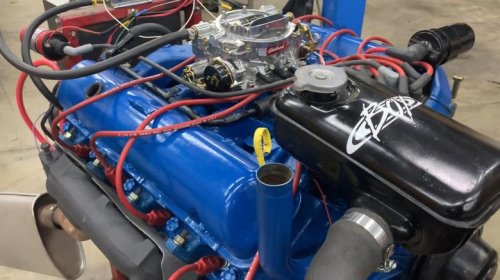
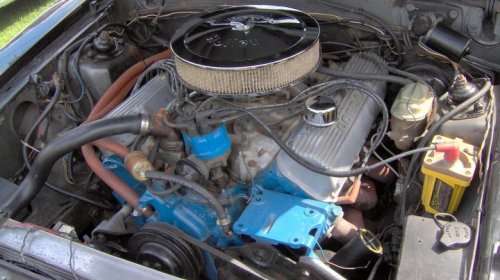
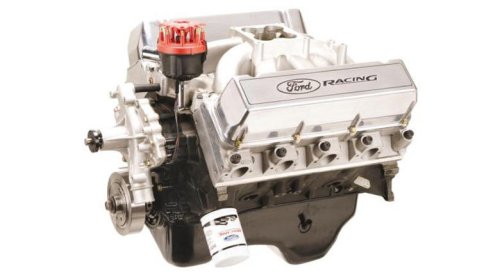
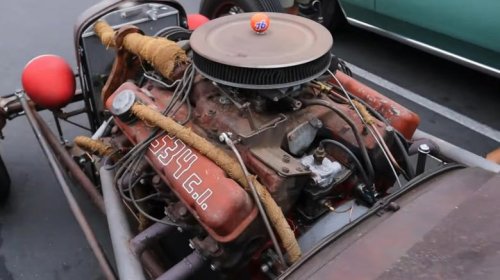
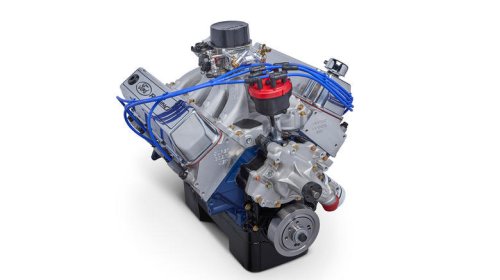

















7.5-liter MEL V8For most of its lifespan, Ford's MEL V8 engine family was ruled by a 7.0-liter unit that's likely best remembered for powering a range of Ford Motor Company vehicles in the late '50s and early-to-mid '60s and for being the first mass-produced American V8 to break the 400-horsepower barrier. In 1966, however, Ford decided it needed to update the MEL range and introduced a 7.5-liter unit to replace the 7.0-liter engine.This new 7.5-liter MEL V8's increased displacement came from a larger 4.38-inch bore and 3.83-inch stroke. Combined with hydraulic lifters and a four-barrel Carter AFB carburetor, the 7.5-liter MEL V8 output a gross 340 horsepower and 485 pound-feet of torque when it debuted in the 1966 Lincoln Continental. This wasn't a massive increase over the previous year's Continental,but an extra 20 horsepower and 20 pound-feet of torque wasn't anything to scoff at. Every little bit of extra power helped, especially considering the 1966 Continental weighed more than 5,000 pounds in all three configurations (coupe, sedan, and four-door convertible).Ford only built the 7.5-liter MEL V8 for a couple of years. By mid-1968, the company stopped building MEL V8s in favor of its new 385 family of big-block V8s, the 7.5-liter version of which would make its way into the 1969 Lincoln Continental.7.5-liter 385 V8The 7.5-liter incarnation of Ford's legendary 385 V8 saw immediate action in 1969, debuting in the Lincoln Continental Mark III to replace the similarly sized 7.5-liter MEL V8. The 385 had a 3.85-inch stroke — thus the name — and delivered a healthy 365 gross horsepower and 485 pound-feet of torque when it debuted, a marginal upgrade over its predecessor's 340 horsepower.Ford initially kept the 7.5-liter 385 V8 exclusive to the Lincoln Continental Mark III but changed tack in the early '70s. By 1973, prospective buyers could get the 7.5-liter 385 V8 in Mercurys, such as the Meteor and Marquis, and the 1973 Ford Thunderbird. Unfortunately, the engine that Ford made available in these cars wasn't quite the same as the one that debuted in 1969, with modifications to the motor and choke eventually leading to the 7.5-liter 385 only making a rated 200 horsepower and around 350 pound-feet of torque for most of the '70s.Ford stopped offering the 7.5-liter 385 as an option in passenger vehicles in 1978 but continued to make it available in trucks and vans for many decades. The engine received an upgrade to fuel injection in 1988 — improving its output to 245 horsepower and 400 pound-feet of torque — and remained in use through most of the '90s in vehicles such as the Ford Econoline. Ford stopped offering the engine as an option in 1997, with the 1998 Econoline moving to V8 and V10 Triton engines.8.4-liter 385 V8Despite pulling the 385 engines from passenger vehicles in the late 1990s, Ford never truly abandoned the 385 — case in point: the 2000s-era 8.4-liter 385 from Ford Racing. Ford Racing built this 8.4-liter V8 on a modified 460 short block with parts such as Eagle H-beam connecting rods, custom-forged 4.36-inch bore pistons, and a modular cast-iron 4.30-inch stroker crankshaft. The larger bore and stroke increased the engine's displacement despite using essentially the same block as the old 7.5-liter 385.Ford combined this short block with Super Cobra Jet aluminum cylinder heads (with better airflow than standard 460 heads and design contributions from engine builder Jon Kaase), a Super Cobra Jet valve train, and a Victor Jr. single-plane intake manifold designed expressly to work with Holley Dominator carburetors. Ford also specced a solid roller mechanical camshaft, which it claimed helped improve horsepower output above 3,500 RPM without sacrificing torque output in the lower rev range.The engine shipped mostly complete, with oil and water pumps, a multi-index timing chain, spark plugs, a flywheel, an oil pan, and valve covers included. This resulted in a cool 625 horsepower and 600 pound-feet of torque. Not bad for less than $8,000 — in mid-200s money, at least. Ford offered this 8.4-liter 385 until 2009 at least. It's unclear when the company discontinued the engine, but it disappeared from the catalog by the time Ford launched the 9.4-liter 385. More on that later.8.7-liter Super Duty V8Ford's 7.3-liter Godzilla V8 is an undeniably bulky truck engine. Still, it pales in comparison to the 8.7-liter behemoth the company put in a range of its heavy-duty trucks throughout the 1960s and 1970s, including the larger F and C-series Super Duty trucks (850, 950, 1000, and 1100). First built in 1958, the Ford Super Duty V8s came in three displacements, of which the 8.7-liter was the largest.The 8.7-liter Super Duty V8 had a 4.50-inch bore and 4.20-inch stroke and ran at a low (by modern standards) compression ratio of 7.5:1. Ford claimed gross power numbers of 270 horsepower and 481 pound-feet of torque, the latter starting at 1900 RPM. Ford didn't design the Super Duty V8 for outright performance. Instead, Ford designed these engines for reliability, with features like cooled spark plugs, dual thermostats, a three-stage cooling system, a built-in oil cooler, and sodium-cooled exhaust valves helping to keep the engine running at its best.Despite that, the 8.7-liter Super Duty V8 did have a surprising second life as a performance engine — albeit not on the road. New York-based Seamaster Marine Co. produced two Super Seamaster marine engines based on the Super Duty V8. The base model was essentially a stock 8.7-liter Super Duty V8, with the same 277 horsepower number Ford quoted as stock. However, it also offered a much beefier "Ti" model with twin turbos and a more credible 400 horsepower.9.4-liter 385 V8Ford's '00s 8.4-liter 385 wasn't the only time the company brought the 385 big block back in crate form. Following in the footsteps of custom engine builders and their high-power, high-displacement 385 V8s, Ford debuted the largest Ford-built incarnation of the 385 to date in 2018: A hulking 9.4-liter big block with a 4.50-inch bore and 4.50-inch stroke producing 655 horsepower and an impressive 710 pound-feet of torque.Like its other high-performance crate engines (including the Megazilla V8), this 9.4-liter 385 sports many high-quality parts from Ford Performance and other big-name brands. The impressive parts list features a forged steel crankshaft and forged steel H-beam connecting rods (both from Scat Performance), ARP bolts, Diamond Racing pistons, and a hydraulic roller camshaft. The cylinder heads are Ford's Super Cobra Jet aluminum heads with dual valve springs, while the intake manifold is an Edelbrock Victor 2966 with a Holley Street Avenger carburetor topping it off.Other trick engine components include a Jon Kaase oil pump, MSD distributor, Crower stainless steel rollers, and a bevy of in-house Ford Performance products for the timing chain, oil pan, spark plug wires, and vibration dampers. The engine comes almost entirely ready to go, with only a flywheel, water pump, and pulleys required to get it up and running in a vehicle. Unsurprisingly, this engine doesn't come cheap: expect to pay $19,750 for the privilege of cramming one into your hot rod's engine bay.