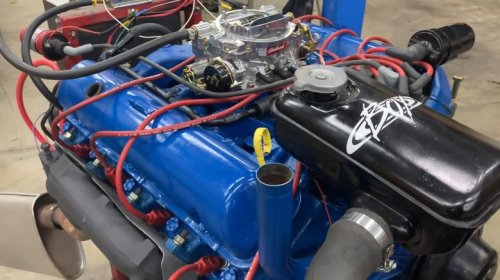
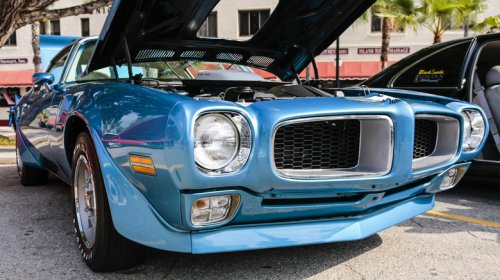
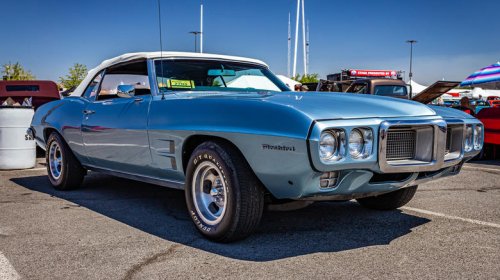
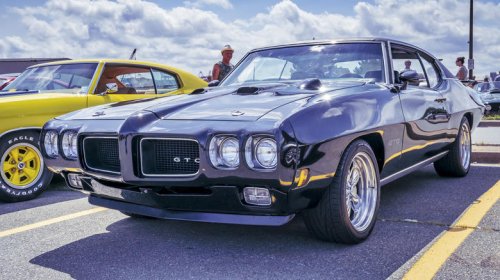
Pontiac 455 Super Duty (310 HP)The Pontiac 455 Super Duty, commonly shortened to the 455 SD, is cited by some as one of the last big American muscle car engines. Like many of Pontiac's engines, there were several variants produced by the automaker and some of them never made it to the production line. Thus, many horsepower figures have been thrown around. Pontiac did shove some versions of this thing into production vehicles, though, including the Firebird, Grand Prix, LeMans, and Grand Am. At the height of its powers, the 455 SD rolled off the line with 310 horsepower and 390 pound-feet of torque. Later models would see horsepower dip to 290 but torque increased to 395 pound-feet. The engine could trace its lineage from earlier generation engines, namely the Ram Air and the previous generation 455 High Output engine produced by Pontiac. Cars with this engine were pretty quick. One fully street-legal 1973 Pontiac Firebird Trans Am with the engine was clocked doing a quarter mile run in 13.751 seconds with a top speed of 103.56 MPH. Numbers from back then are a bit dodgy, but zero-to-60 times of around five to six seconds were not uncommon for this engine. The engine would only be produced for the 1973 and 1974 model years. In 1975, emissions standards saw Pontiac engines drop a lot of power. The 1975 Pontiac Firebird had a six-cylinder base engine with an optional 175 horsepower V8 engine. That made the 455 Super Duty one of the last American muscle car engines. Pontiac 370 (330 HP)The Pontiac 370 was one of the engines that helped kickstart the American muscle car era. It was only produced by Pontiac for one year in 1958, and it only came as an optional engine on the 1958 Pontiac Bonneville. For the most part, the 370 was used in racing applications, such as NASCAR, where it did pretty well as this was in an era where Pontiac was taking home a lot of NASCAR wins. It was the biggest engine that Pontiac had produced up to that point with 370 cubic inches of displacement, hence the name. Somewhat comically, the engine is also frequently referred to as the Tempest 395, which can make looking up the history of this engine a little tricky. The 370 is the displacement and the 395 figure is for the horsepower. When in its street configuration, the engine was capable of 240 horsepower. That was quite a bit for the 1950s. NASCAR versions of the engine saw the horsepower figures climb to 315 horsepower and 330 horsepower, depending on the carburetor setup. However, the "extra horsepower Tempest 395" variant was also available in consumer cars. This made the 370 one of the most powerful engines of its era. In addition to its complicated internals, the 370 had eight total variants that ranged from 240 horsepower and 354 pound-feet of torque up to 330 horsepower and 415 pound-feet of torque. While the engine was only produced for one year, there are at least eight versions of it floating around. In 1959, Pontiac would pivot to the Pontiac 389.Ram Air III (366 HP)At first glance, it would seem as though the Ram Air III was a predecessor to the Ram Air IV. However, both engines were in production vehicles together, with the Ram Air IV often being offered optionally. The Ram Air III was a 6.6-liter V8 with 400 cubic inches of displacement. Pontiac made this engine in 1969 and 1970, making it yet another engine that Pontiac only had around for a couple of years. It was most famously included in the 1969 and 1970 models of the Pontiac Trans Am. Horsepower figures are all over the place, with some reporting as little as 345 horsepower and others as much as 366 horsepower. A Pontiac GTO, dubbed "The Judge", featured the engine and it was capable of doing a quarter mile run in a hair over 14 seconds with top speeds over 100 MPH. In terms of pure performance, it was comparable to the Ram Air IV, although the IV had higher overall horsepower numbers. However, the Ram Air III was considered the superior street engine since the Ram Air IV's race car-like characteristics made it a pain to drive in stop-and-go traffic. While the engine was short-lived, the Ram Air III V8 would become one of Pontiac's most iconic engines, mostly thanks to The Judge. Pontiac went in a different direction in 1971 and GTO sales effectively plummeted as a result. Even so, the Ram Air III remained one of the most powerful Pontiac engines ever built. Ram Air IV (370 HP)The Pontiac Ram Air IV was another short-lived, but powerful Pontiac engine. Pontiac made the engine for the 1969 and 1970 model years, where it was commonly found in the Pontiac GTO, Judge, Firebird, and Trans Am. The engine was a 400 cubic inch V8 that originally started development as the Ram Air II in 1968. It was improved in 1969, skipped over the Ram Air III, and became the Ram Air IV. Like other Pontiac engines, it had a few variants and was also used in drag racing. The engine shipped from the factory with a rating of 345 horsepower and 430 pound-feet of torque, although those numbers are considered conservative. The engine was capable of up to 370 horsepower. There are fully restored versions of the engine that have topped out at around 365 horsepower. Like most cars from that era, numbers for fully stock versions of the engine are hard to find. However, the 1969 Firebird Trans Am with a Ram IV could do a 14-second quarter mile with a max speed of over 100 MPH, which was more than respectable for the time. Zero to 60 MPH times were in the low five-second range. Unlike many Pontiac engines, the Ram Air IV wasn't used much in racing. There are stories of enthusiasts souping up the engine and getting some excellent drag strip times. For example, the 1969 Pontiac GTO Ram Air IV, nicknamed "Lil Pancho". was reportedly the first GTO to get a 10-second quarter mile in an NHRA competition. However, like the Ram Air III, the IV was best known as the engine that powered The Judge. Pontiac 428 H.O. (425 HP)The Pontiac 428 High Output, commonly referred to as the 428 H.O., existed in the same era as the Ram Air III and Ram Air IV. Pontiac produced the engine from 1967 to 1969, and it was mostly used to power the Pontiac Bonneville and Catalina along with the brand's other full-sized cars. This was due to an internal GM mandate that midsize cars had to have engines that were 330 cubic inches or smaller. As you can imagine, the 428 cubic inches in the 428 H.O. far exceeded that value. The 428 is the natural successor to the 421. The bore changed to be wider but most of the rest of the engine specs remained the same. It served as the interim engine until the 455 launched a few years later. At its worst, the engine could make 270 horsepower and 472 pound-feet of torque. It later increased to 290 horsepower and 360 horsepower before reaching 375 horsepower and 440 pound-feet of torque with an available 390 horsepower variant. However, it was Royal Pontiac that unlocked the engine's true potential. It would offer customers a full tune for $650, which is over $5300 in 2024 when adjusted for inflation, which increased the horsepower to 425. However, like the 421 below, those numbers may be illegitimate, as horsepower numbers often were in the 1960s. Performance was also quite good, with cars doing zero to 60 MPH in the low six-second range with top speeds over 140 MPH. Those numbers are for the 375-horsepower variant, so the stronger versions are faster. Pontiac 366ci (575 HP)The astute Pontiac historians may be pointing out that now that we didn't talk about the 366 cubic inch variant of the Ram Air V. That's because the 366 version of the engine actually did get used. Like the rest of the Ram Air V lineup, there isn't a lot of information about this one. It was made specifically for NASCAR racing, although it never got to compete at the highest levels of the sport. The 366 was a modified 303, which was the smaller of the two displacements of the Ram Air V, the other being 400 cubic inches. As legend goes, Pontiac's Special Projects Division designed this engine specifically for racing, despite GM's edict at the time that forbade Pontiac from doing that anymore. Tom Nell, Pontiac's assistant race-engine engineer, essentially took a 303 engine, stuffed a bunch of modified parts into it, and mixed it with some Ram Air IV parts. The result was an engine that could do about 100 horsepower more than the 303 variant of the Ram Air V. Since the 303 version of the Ram Air V could do 475 horsepower, that meant the 366 could do about 575 horsepower. Allegedly, only 25 of 366 engines were ever produced, making it the rarest version of the Ram Air V. So, if the Ram Air V was so awesome, why wasn't it ever produced? Apparently, the SCCA changed its rules in 1970, right as the engine was ready to go. In addition, the new emissions laws threatened to kill the muscle car era by 1975 anyway and Pontiac's push rod manufacturer went bankrupt. With so many bad things happening at once, Pontiac felt it fit to cancel the engine.



















 +4 others