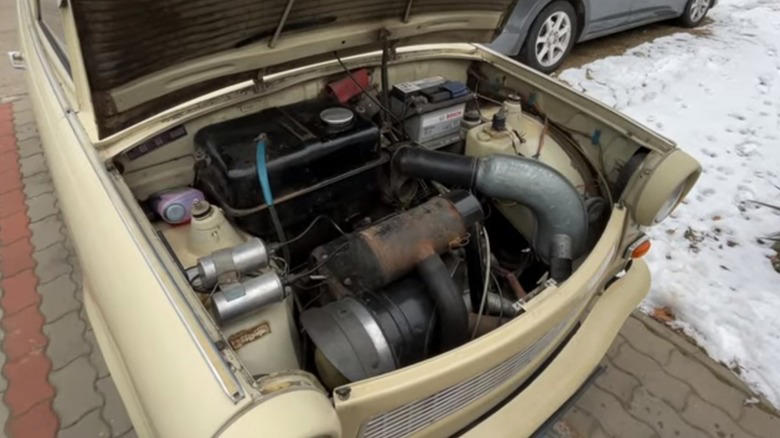
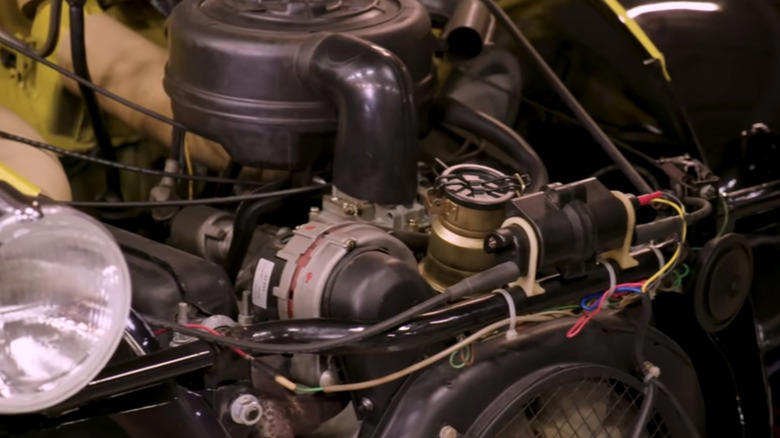
Trabant 601 twin-cylinderBefore the Iron Curtain fell in East Germany, there was Trabant, a state-run automaker producing woefully outdated cars from a woefully lacking availability of resources. In 1957, the East Germans introduced this car as a counterpart to the West German VW Beetle. It was a simple car meant to be easy to operate and maintain much like its West German counterpart. But even in 1957, it made the Beetle look like a paragon of sophistication. This is in part because the fuel tank is located under the hood and lacks a gauge, but the engine can probably take the most credit for the car's inadequacy.Few design or mechanical changes came to the Trabant in 40 years of production. Trabis, as they were called, are powered by a 600cc 2-cylinder air-cooled 2-stroke engine. With just 18 horsepower, a Trabi might make it to 60 mph. It's smoky and obnoxious little engine with minimal power that produces significantly more pollution than anything on the road today.Despite its shortcomings, the Trabi's engines are remarkably reliable, even if the car around them was held together by nothing but hope and sheer will. With only a few moving parts — two-strokes lack complex valvetrains — there are fewer to break. Since there was no East German Consumer Reports, reliability has to be drawn from anecdotes, but modern owners credit the simplicity of the engine for its generally good reliability, so long as you always add oil to the fuel.Citroën twinAfter WWII, France, which had been devastated, needed to get its economy and people back on the move. Having limited resources while building a car for people with limited incomes, Citroën came up with the brilliant 2CV. Plans for this car actually pre-dated the war, but they had to be hidden, including tooling and prototypes, from the Nazis during occupation. It was not until 1949 that the new car could be produced.Much of this car's ingenuity is tied to its chassis and suspension, and the lightweight and simple bodywork. The engine powering the diminutive car was initially a 375cc air-cooled horizontally opposed twin making just 9 horsepower. The first models featured a pull cord starter akin to those on lawnmowers but would soon be replaced by an electric version. Engine size and corresponding power increased through its 42 years of production to a 602cc unit with up to 33 horsepower.As it was built for a very affordable car, the 2CV engine is incredibly simple, using only a handful of parts to assemble. It also features clever designs to remain reliable. The spark plugs fire together on every power and exhaust stroke, eliminating the need for a distributor, and the cooling fan is driven directly from the crankshaft. Heads and cylinders were precision machined to fit without a gasket, eliminating another failure point. While some trouble spots can appear, including a plugged oil cooler, few common problems with this engine exist.