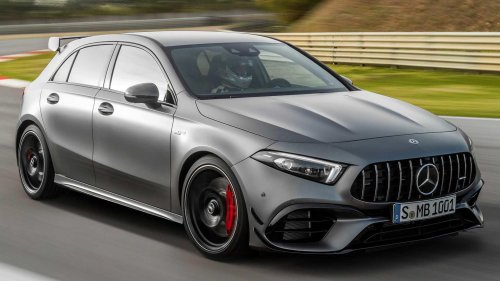
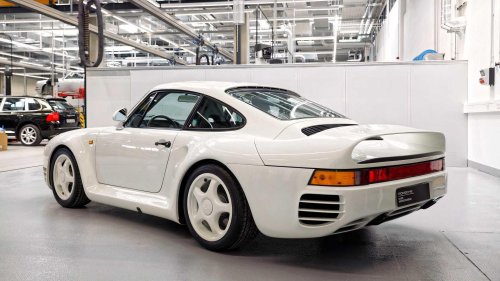
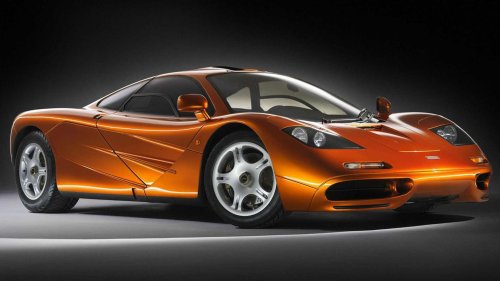
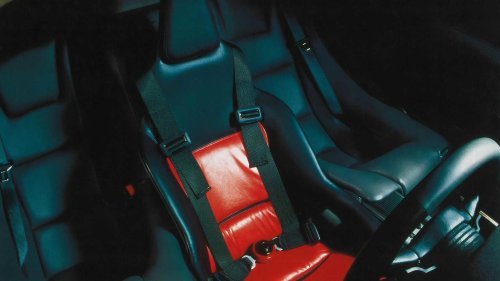
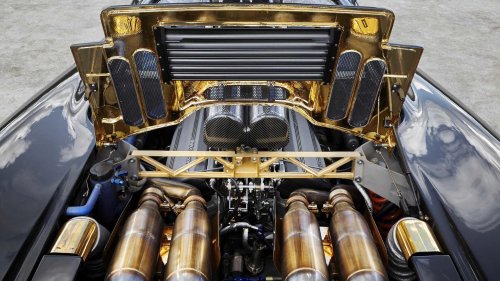
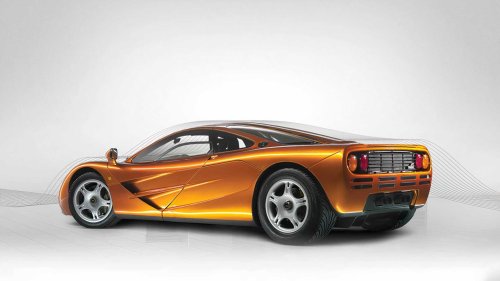



















In 2026, it's almost impossible to switch on YouTube without seeing another video of a normal-looking SUV drag racing a supercar. The power wars may have first started in the '60s in America, with muscle cars being regularly fitted with engines as big as a kei car. Now things seem to have spiraled out of control. Yes, there was that time called the Malaise Era, when "muscle cars" could be out-muscled by vacuum cleaners, but generally the trajectory has been for manufacturers to find ever more horsepower.When the Bugatti Veyron was launched in the mid-2000s, people couldn't believe its 1,000-horsepower output. VW went to great lengths to explain the challenges of squeezing that much oomph out of a W16 with four turbochargers. But if that's where the world was at the turn of the millennium, what was considered otherworldly power in the '90s? The answer is a McLaren that may come as a surprise. The Supercars Of The '80s Were As Powerful As Hot Hatches Mercedes-Benz These days, earth-shattering power and performance never seem to be far away. The soon-to-depart Mercedes-AMG A45 is a four-cylinder hot hatch with 415 horsepower. The Ferrari F40, aka the first road car to crack 200 mph, had 478 horsepower from a twin-turbo V8, not that much more than the A45. The latest BMW M5 (a model line that started in the '80s with the 286-horsepower E28 M5) now has 717 horsepower, which would have been unfathomable in even a supercar not that long ago. Then there are those SUVs with close to 1,000 horsepower, which seems a bit excessive for a vehicle largely used to pick up the kids from school. The '90s Were When The Horsepower Wars Really Kicked Off Porsche We can probably blame the Ferrari F40 and its arch-nemesis, the Porsche 959, for really kicking things off. The Lamborghini Countach and Ferrari Testarossa had been the '80s poster supercars. However, these were cars that just about cracked five seconds to 60 mph. The F40 and 959 (444 horsepower) not only went under four seconds, they had top speeds hovering around 200 mph.Then came the flawed-but-brilliant Jaguar XJ220, powered by a 542-horsepower 3.5-liter twin-turbocharged V6 out of a Metro. Even the Dodge Viper, a car with about as much tech as a skateboard, had 400 horsepower from its 8.0-liter V10 engine. But none of the big power supercars above could get close to the most potent machine of the '90s. It was so fast that they even came up with a new category for it. The McLaren F1 Was The Most Powerful Car Of The '90s McLaren The McLaren F1 is so groundbreaking, it's easy to forget that it arrived way back in 1992. Not only would the F1 be the most powerful car of that year, it would continue to be for the rest of the decade. The F1 was also McLaren's first-ever road car, which adds even more kudos to the fact many describe it as the best car ever built.At the heart of the F1 is a bespoke 6.1-liter V12 engine producing 627-horsepower and 480 lb-ft of torque. It was developed by Paul Rosche and his team at BMW Motorsport. The S70/2 unit may have had some DNA from the M70, a unit used in the 7-Series and 8-Series, but it is a far more exotic creation backed by a six-speed gearbox.The McLaren mill has titanium connecting rods, four valves per cylinder, individual throttle bodies for each cylinder, and VANOS variable valve timing. Then there was a dry sump lubrication system, and a carbon fiber intake manifold and airbox. The 12-cylinder developed so much heat that McLaren lined the engine bay with pure gold. The McLaren F1 Was A Whole New Type Of Supercar McLaren The idea for the F1 came about when four McLaren racing directors were waiting for a flight back to England from Milan in 1988. They discussed the idea of building an ultimate road car. But unlike many great ideas dreamed up while away in the sun, this one came to fruition. When the McLaren F1 was unveiled, its central, F1-style driving position and lightweight carbon fiber monocoque (a world first that took 3,000 man-hours to make), titanium subframe, and magnesium alloy wheels were enough to get headlines. Still, it was the sheer speed that blew everyone away.That 627-horsepower V12 propelled the F1 to 60 mph in 3.2 seconds, 100 mph in 6.3 seconds, and on to a top speed of 240.1 mph. The quarter mile is covered in 11.1 seconds at 138 mph. The McLaren F1 was so fast that people came up with a new category to describe it: the hypercar. The McLaren Held On To The Most Powerful Title For A Decade McLaren By the end of the '90s, the 2,425-pound McLaren was still one of the most powerful production cars on the planet. In fact, it still remains the fastest naturally aspirated car of all time.There were some other big power supercars of the '90s, like the Lamborghini Diablo getting 485 horsepower out of a 5.7-liter V12. There was also the 202 mph Ferrari F50 that was fitted with a 513-horsepower 4.7-liter V12, while the epic Porsche 911 GT1 Strassenversion has 536 horsepower. The real curveball of the era is the wild 1999 Aston Martin V8 Vantage Le Mans V600 with its 5.3-liter V8 bolstered by twin Eaton superchargers. The British bruiser got close to the F1 with 600 horsepower and 605 lb-ft of torque. The F1 Is The World's Most Iconic Modern Hypercar McLarenToday, the McLaren F1 is arguably the world's most iconic hypercar. The fact that it kick started McLaren's road car business, stands almost alone in its three-seater layout, and so fast (even by today's standards), all make it that little bit more special than many other supercars and hypercars. There is also something in the way that designer Gordon Murray created the F1 with performance and driving outweighing everything else that makes the car so loved by true enthusiasts.These days you need to find $20,500,000 to buy one of the 64 standard road cars. Mind you, there are another 28 GTR race cars and 14 are LM, GT, and prototypes. A 1995 McLaren F1 LM with 680 horsepower will cost $33,000,000. The F1 may be the most powerful car of the '90s, but you'll have to go a long way to find one more expensive too.Sources: Hagerty.com