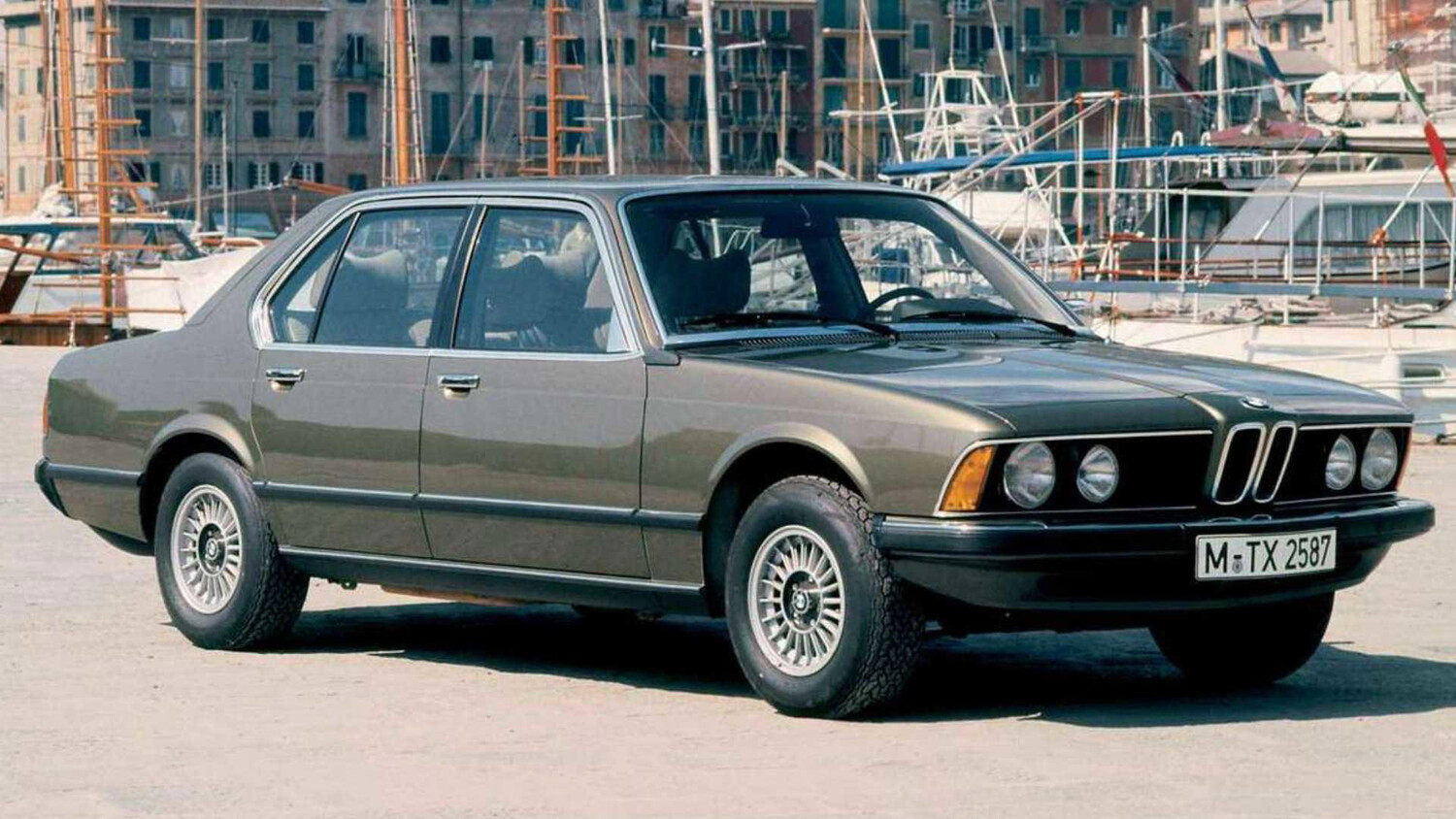
The BMW 7 Series is a stylish, sleek sedan with a long history. Each of the seven generations has its own perks and issues. If classic BMWs are your thing, you may have considered adding a vintage 7 Series to your collection. However, it can be difficult to decide which version is right for you.For car enthusiasts who can’t live without a manual transmission, the choice is immediately narrowed down to the first three generations. Of these three, we think the E32 is a particularly good option. Here is an overview of this fascinating model and why it could be the vintage Bimmer of your dreams. The 7 Series Lineup Over The Years BMW The 7 Series is a model that has been part of the BMW family for a long time, and is just a year away from celebrating its 50th birthday. It was introduced in 1977 as a successor to the New Six, also known as the E3 or, in North America, as the Bavaria. Introduced in 1968, the New Six/E3 marked BMW’s return to producing a full-size luxury sedan after a five-year hiatus. A coupe version of the New Six, based on a shortened version of the same platform and known as the E9, was also produced at the same time.The E3 arrived in North America a year after the model’s debut. Within a few months, a version called the “Bavaria” joined the lineup for the American market, combining the configuration of one model (the 2500) with the larger engine of another (the 2800). The E3 remained on sale for nearly a decade, until the 7 Series arrived to replace it.BMW Unlike its predecessor, the 7 Series was only made available in sedan form. The model’s first generation (known internally as the E23) was also powered entirely by inline-six engines. Subsequent generations added V8 and V12 engines into the mix as well.The 7 Series’ second (E32) generation, however, reintroduced something that had previously been available on the E3: a long-wheelbase variant of the model. This would continue to be offered for the following four generations of the model: the E38, E65/66, F01/F02, and G11/G12.The seventh and current generation, known as the G70, was introduced for the 2023 model year and has recently undergone a facelift for 2027. Today, the 7 Series lineup on offer in North America includes an inline-six-powered version, available in hybrid form with one electric motor, and a twin-turbo V8-powered version, the most powerful member of the lineup at 536 hp. A single transmission option is available, an eight-speed automatic. The Manual Generations BMW The first three generations of the 7 Series (the E23, E32, and E38) offered a manual transmission as part of their lineup, while subsequent ones did not. The E23 was the first, introducing several new tech features that BMW had not offered before. These included a more sophisticated climate control system, a control panel with warning lights to alert the driver of faults, an onboard computer, and a Dictaphone for the business executive on the move.Power came from a lineup of inline-six engines, varying in size and output by region and model year. In North America, the E23 7 Series was initially available with a 3.2-liter version of the M30 inline-six engine. A 3.4-liter version joined the lineup as part of a 1983 facelift.BMW The second-gen E32 model entered production in 1986, although the E23 remained on sale in North America until the following year. The North American E32 was powered by a choice of three engines: a 3.4-liter inline-six, a 4.0-liter V8, or a 5.0-liter V12. Transmission options included a four- or five-speed automatic and a five-speed manual.The third and last manual generation of the 7 Series was the E38. While inline-six engines were offered elsewhere in the world, in North America this model was powered by a choice of two engines: a 4.4-liter V8 or a 5.4-liter V12.While a manual transmission was part of the E38 generation’s lineup in Europe, the versions sold on the US market were only available with an automatic transmission. The only ways you can get a manual E38 7 Series in the US are by importing one (as the model is now over 25 years old) or by swapping in a new transmission. One popular option among E38 7 Series owners is to swap in the powertrain – a 4.9-liter V8 and a six-speed manual transmission – from the E39-generation M5. The E32 Generation 7 Series And What Makes It Special BMWTaste in cars can be highly subjective, but as far as we’re concerned, the E32 is the best of the bunch amongst the 7 Series’ manual generations. Its classy, updated design introduced iconic features, such as the L-shaped taillights, which later appeared on other BMW models.The E32 was introduced in 1987. It was initially launched with two versions of the M30 engine (3.0 and 3.4 liters, respectively). However, within a year, a 5.0-liter V12, the most powerful in the lineup with an output of 296-300 hp, was also introduced. The V12 was not just a first for BMW, but also a milestone for the German car industry as a whole: the V12-powered E32 7 Series was the first German passenger car to feature a V12 since before World War II. The previous holder of that title had been the Maybach Zeppelin DS8, which had a small production run of about 100 units in 1939.BMW In 1991, a V8-powered version joined the 7 Series family. The M60 powered it, BMW's first V8 engine since the early 1960s. While both a 3.0-liter and a 4.0-liter version were available globally, only the latter was sold in the US.The model was also used as a base for a curious prototype that never reached production: the Goldfisch, a V16-powered car built in 1987. At the heart of the Goldfisch was a 6.7-liter V16, based on the production model’s V12 and paired with a six-speed manual transmission.The E32 7 Series was available in both standard- and long-wheelbase versions, unlike the first-generation model. It was also one of the most technologically advanced cars of its era, introducing several features that had not been offered in the E23. These include traction control, dual-zone climate control, Xenon headlights, and double-glazed windows.The suspension was significantly upgraded over the previous generation: the E32 featured an adaptive suspension with EDC (Electronic Damper Control), providing a more stable and comfortable ride. The high quality of the model’s interior is also a strong factor in why it makes such an attractive option for classic BMW buyers today.Another notable characteristic of the E32 generation is that it was the last 7 Series to be powered by the M30 engine. Introduced in 1968, this engine got the nickname of “Big Six” or “Senior Six” when, around a decade later, the smaller M20 inline-six engine made its debut. The M30 earned a place in Ward’s “Top Engines Of The 20th Century” list and is still beloved by BMW enthusiasts today. The E32 7 Series On The Used Market: Prices And Reliability BMW If you’re shopping for a classic BMW, and the E32 7 Series sounds like it could be your next set of wheels, there are plenty of options out there for you. The lower end of the range sits around $6,000. At this price point, you’re more likely to find older cars, cars with higher mileage, or examples with a poorer maintenance record.Maintenance is especially crucial when dealing with a model whose youngest examples are now over 30 years old, so unless you’re willing to spend large amounts of time and money working on your car, it’s probably wisest to move a little further up in the price range. The most expensive examples of the E32 will set you back around $30,000. They are more likely to be in better shape and with fewer miles on the clock.BMW There are a few issues you should keep an eye out for. On the V8 engine, the Nikasil (nickel-silicon carbide) coating on the cylinders is prone to flaking off and failing, leading to the engine running less smoothly or even not starting at all. The V12, meanwhile, suffers from sump gasket issues. The hydraulic self-leveling suspension, most commonly seen in the long-wheelbase variant of the model, is also prone to failure. Lastly, the Servotronic power steering system is another potential pain point.As with any older car, the E32 7 Series needs careful maintenance and upkeep to be kept in top shape; however, if this does not sound like a daunting prospect at all, and you’re happy to put in a little extra work to enjoy your dream car, it could make a fantastic addition to your garage.