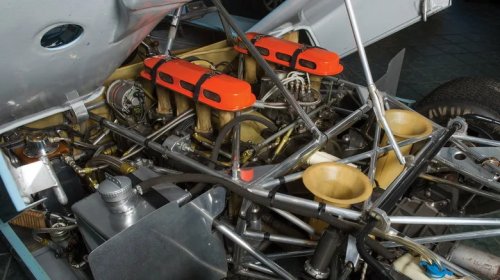
With an oil crisis, emissions regulations, and economic uncertainty on the cards, the '70s pretty much had a full house when it came to killing off fast cars. No one seemed to have told the boutique Italian sports and supercar manufacturers, however. These kinds of people had more to worry about, such as whether their Persol sunglasses matched with their Aspinol driving gloves, or whether they could park directly outside the casino, or suffer the indignity of walking ten yards to the entrance.Supercar manufacturers may not have found it always easy to find customers – with some iffy partnerships and creations along the way – but the lengthy queues outside the gas stations weren't exactly toning down the horsepower in this particular sector. In fact, plenty of wild creations hit the showroom floors in the '70s. There were plenty of supercars with healthy horsepower numbers to choose from, but one that stands above the rest, and that includes its younger, more hardcore-looking siblings from a few years later. The Lamborghini Miura SV Was The Most Powerful Supercar In The '70s 1971 Miura SV 2 1971 Lamborghini Miura SV Specs Source: LamborghiniThere is plenty to say about the Lamborghini Miura, from official stats and facts, to wild stories that have probably been retold a hundred times through the fug of Toscano cigars. But before we go any further, just look at the Miura SV. The car, which made its public debut in 1966, is unquestionably one of the most beautiful things ever to roll on four wheels. The fact that it has a Lamborghini V12 mounted in the middle shows that dreams do indeed exist.The design is the work of Carrozzeria Bertone, and is typified by the long and low front, the low slung body that measures just 110 cms in height, and details such as the rounded headlights surrounded by the trademark Lamborghini eyelashes of the time. Anyone Who Was Anyone In The '70s Owned A Miura Rumor has it that Ferruccio Lamborghini didn't really want a car like the Miura – mid-engined, race-style supercars were too Ferrari – and his personal love was for more serene, fast grand tourers. Two young engineers, Giampaolo Dallara and Paolo Stanzani, helped bring the legendary Miura to life, with the 4-liter V12 engine transversely mid-mounted.Ever since its role in the 1969 film “The Italian Job”, the Miura became synonymous with the continental dolce vita, and interest in both the car and the brand started to grow. If you were a big-name star in the early '70s, the Miura was the car to have. Miles Davis famously owned, and crashed, a Miura, and Rod Stewart and Frank Sinatra were also said to have got the keys to one of Lamborghini's new supercars. Power Steadily Crept Up In The Lamborghini Miura The V12 engine began with 350 horsepower at 7,000 rpm in the original P400, but it wasn't long before this rating began to grow. The output went up to 370 horsepower at 7,700rpm in the P400 S, before Lamborghini unveiled the ultimate Miura. The SV of 1971 saw power increase again, to 385 hp at 7,850 rpm, making it not only the most powerful supercar of that year, but it was a title it would hold on to for the rest of the decade. A Closer Look At The Lamborghini Miura SV1971 Miura SV engine Highlights Of The Lamborghini Miura Jota More hardcore appearance with wider arches and eyelashes removed Power increased to 385 horsepower Lower nose to reduce front-end lift The SV version of the Miura was a very special and wild version of the Italian supercar. The car featured a stronger chassis, larger rear tires, bigger wheel arches to fit wider 15-inch wheels, tweaked suspension, and an independent gearbox lubrication system. The eyelashes were removed to give it a slightly more hardcore appearance, too. That sculpted nose had also been lowered slightly to reduce front-end lift. Some later SVs received a split sump, meaning a separate oil supply for the transaxle and engine. The big news, however, was the increase in power. Lamborghini Made The Miura The Most Powerful Supercar Of The Decade Lamborghini's engineers coaxed 385 horsepower out of the V12, giving the car eye-watering performance for the day. The sprint to 60 mph from standstill took just 5.8 seconds, and the top speed of the SV was quoted as a terrifying 180 mph. It's worth noting at this point that when mass production of the Countach started at the Lamborghini factory in Sant’Agata Bolognese, the earliest Countach LP 400s had 375 horsepower from their mid-rear-mounted 3.9-liter V12s. The later L400 S has less, rated at 355 horsepower. There Was An Even More Powerful Lamborghini Miura In the '70s, Lamborghini development driver Bob Wallace apparently had some spare time on his hands. Wallace dreamed of a faster, more hardcore Miura, and, promising to work weekends, was given all the parts and tools necessary to make it a reality. The result was a car with a few hundred pounds shaved off, and, thanks to more aggressive camshafts and boosted compression ratio, a power increase to 440 horsepower. A more aggressive chin spoiler was fitted so that the car didn't turn into a four-wheeled aircraft wing.It is said that although Lamborghini wanted the car to be scrapped when the SV was introduced, the Jota was sold in 1972 to a private buyer. The one-off Miura didn't last long, however. The accounts of what happened next are varied, but many say that the Jota barrel rolled into a field and burst into flames. Nothing was salvageable, aside from the engine. Customers Got Wind Of The Jota And Wanted A Slice Of The Action Strangely, this wasn't the end of the car or the story. When customers got wind of this ultra-Miura, orders started coming in for similarly specced cars. The result was just four factory SV/Js that were built to a similar spec to the Jota, with one owner, says Lamborghini, being the Shah of Persia. Another is the car in the video above, nicknamed 'The Corsican', and despite being priceless, is still used in breathtaking fashion today. Buying A Lamborghini Miura SV in 2025 RM Sotheby'sBetween 1966 and 1968, 265 P400 Miuras were built. Lamborghini started selling more of its mid-engined supercar in 1969 with the launch of the P400 Miura S – 338 were sold between 1969 and 1971. The Miura SV was on sale between 1971 and 1973, and during that time, 150 cars were delivered. It doesn't matter which year you choose; the prices for a Miura SV are the same in good condition, says Hagerty Valuation Tools. You'll need $3,500,000.


















 +26 others