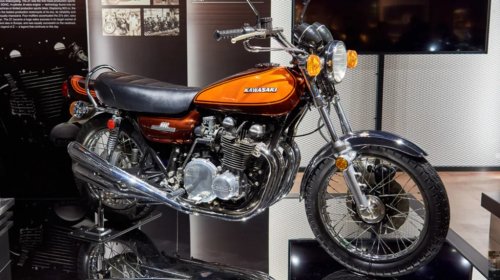
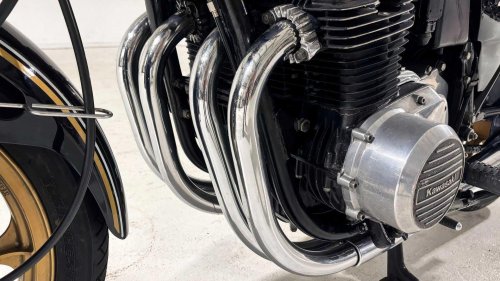
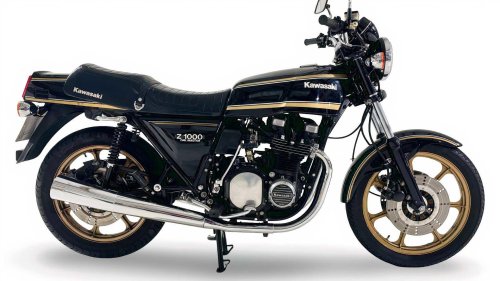
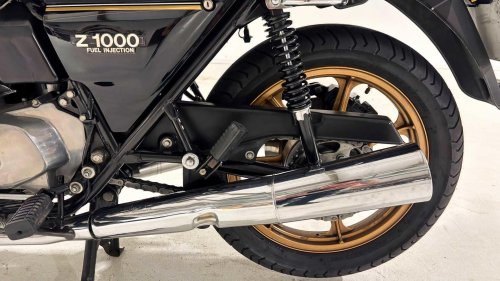
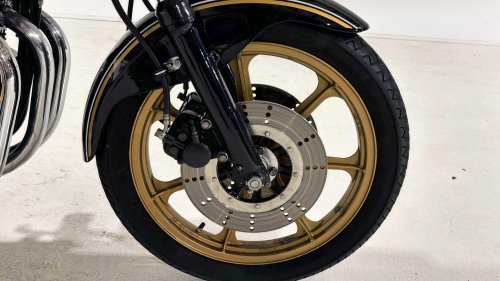
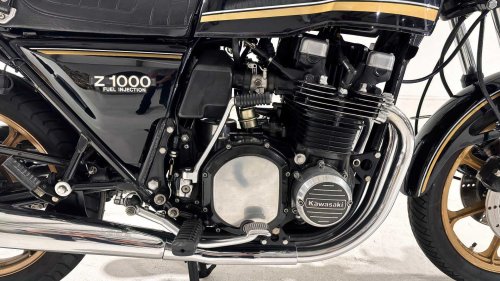
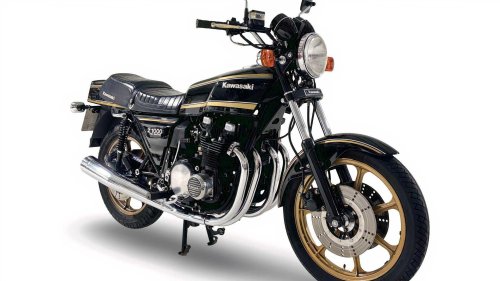
Motorcycles have been slower to adopt new technologies than their four-wheeled counterparts in many cases. A lot of people would argue that’s part of their appeal rather than something to be frowned upon and we totally agree, as riders tend to value unadulterated mechanical charm far more than most drivers. But it’s not just about buyers’ expectations, mind you, because various other factors were always at play to justify this evolutionary lag. Notable examples include packaging constraints, higher sensitivity to additional weight, and tighter pricing margins making it harder to implement fresh tech. Such limitations are why we often see bikes sticking to certain tried-and-true setups long after they become obsolete in cars. Quicker Than Cars, But Following Their Technology BonhamsTake, for instance, the widespread adoption of liquid cooling, which happened during the 1930s in the automotive realm but only around five decades later for motorcycles. ABS was common in cars by the '90s while only becoming available on bikes on a large scale after 2010, whereas forced induction remains a rarity among two-wheelers to this day. Today we want to focus on fuel injection systems, though, and there is once again a discrepancy between the two segments. On the one hand, automakers were already experimenting with EFIs before the Second World War, and the technology was commonplace by the ‘80s. Carburetors are literally unheard of in new cars, but that’s still not the case with bikes in our day and age.Several dual-sports like the Suzuki DR650S and Honda XR650L still rely on carbs, as do many models built for developing markets. Electronic fuel injection started gaining serious ground in the motorcycle world as late as the 2000s, though a number of outliers did implement it earlier on. And there’s a bit of nuance here, because the very first fuel-injected bike was the Munch 1200 TTS-E from 1973. However, it used a crude and unreliable mechanical arrangement as opposed to an electrical one like those we see today, so let us focus specifically on EFI. When was that kind of system first used on a production motorcycle? A UJM Icon: The Kawasaki Z1000H BonhamsTo answer that, we’ll have to go back to the dawn of the 1980s, when Japanese manufacturers were in fierce competition with one another and constantly trying to gain the upper hand. There we are met by the Kawasaki Z1000H, part of the old-school Z lineup that played a key role in shaping the golden UJM (Universal Japanese Motorcycle) era. Although produced in relatively small quantities and more of an experiment rather than a full commitment, history remembers it as the pioneer of EFI in motorcycling. But before the Z1000H, there were models like the Z900, the carbureted Z1000, and earlier on, the mighty Z1 which started it all. Already Making History Before EFI BonhamsThe Z1 was Kawasaki’s response to the Honda CB750 Four, whose story as an absolute game-changer has been told more times than anyone could count. Honda's supremacy was short-lived, however, as the CB750's time as the coolest motorcycle on the block ended with the Z1's arrival in 1972. The Kawasaki had a bigger 903cc inline-four with dual overhead cams and 82 horsepower on tap, considerably more than the 67-horsepower Honda flagship. Top speed was north of 130 mph, and the Z1 went on to become a cult classic loved by everyone with the passing of time. The Z’s Evolution Continues BonhamsCome 1976, it made way for the Z900 (badged as KZ900 in the U.S.) to act as something of a transitional model with some improvements. The Z1000 — or KZ1000, as Americans know it — arrived one year later, boasting a 1,015cc engine with revised crankcases and beefier internals. A disc brake was now present at the rear, and the contemporary press often praised the bike for its solid stopping power. Then there was the performance-focused Z1-R from 1978, which took things to a whole new level.It had dual brake rotors at the front and 90 horsepower at its disposal, translating to quarter-mile runs of around 12 seconds, according to period tests. The Z1-R was a true legend of its time, but Kawasaki still had some big plans in store for the Z family. It expanded into the cruiser segment with the LTD versions, while retaining that high-performance DNA on the later Z1000R Eddie Lawson Replica. As implied by its name, the machine was an outright race replica inspired by Eddie Lawson's success in AMA Superbike during the early '80s. But what about the fuel-injected Kawasaki Z1000H from 1980? Where does it fit into this whole picture, and what impact did it have? EFI Was There, But No One Really Cared BonhamsAside from its fueling system, the H variant was virtually identical to the standard Z1000, so it employed the same air-cooled DOHC four-banger rated at around 95 horsepower and 66 pound-feet of torque. As for its electronic fuel injection module, it was developed in collaboration with Bosch and was based on early designs for cars. Controlled by an analog ECU, it replaced the carburetors with electronically governed fuel injectors as well as intake, engine temperature, and throttle position sensors. Nothing special by today's standards—just a proof of concept showing that EFI could be successfully implemented on motorcycles.But the technology was still in its infancy, while adding an extra layer of complexity over carbs that a lot of people didn’t want to deal with. Thus, Kawasaki’s experiment didn’t lead to widespread popularization throughout the industry, and it would take two decades for most other manufacturers to catch on. Only about 1,000 copies of the Z1000H have been produced, making it extremely rare and highly desirable for collectors today. To be clear, it has plenty of allure even if it wasn’t a huge success commercially, because its historical significance as the first bike to embrace EFI cannot be denied. A Sign Of Things To Come BonhamsThe world simply needed time to catch up, as the Kawasaki Z1000H was just too far ahead of the curve for its own good. We must salute its contribution to what came much later, when companies deemed it necessary to adopt EFI technology due to regulatory demands. And they weren’t starting from scratch, all thanks to the classic Kawasaki that walked so they could run. Fuel injection is one of those things we take for granted, forgetting all the headaches inherently associated with carburetors, like constant syncing and rejetting or having to start your bike on a cold morning. EFI did away with these issues and made riders’ lives easier, so it doesn’t hurt to remember where it all began back in the ‘80s.



















 +67 others