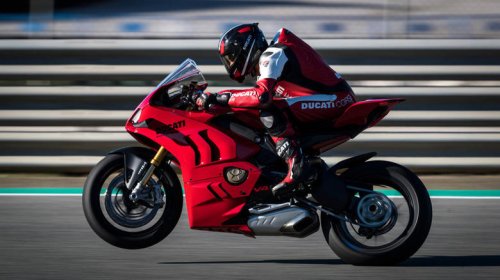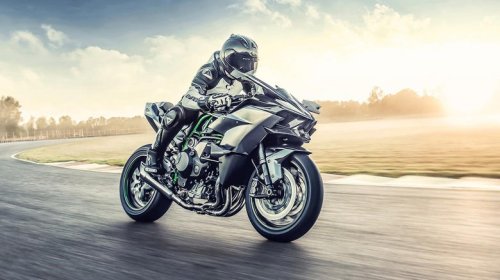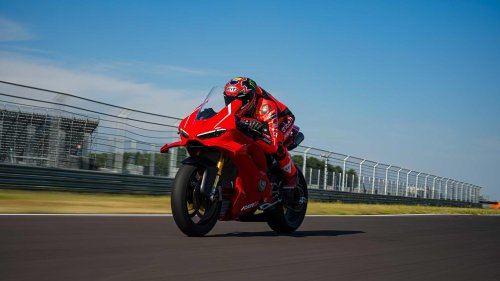
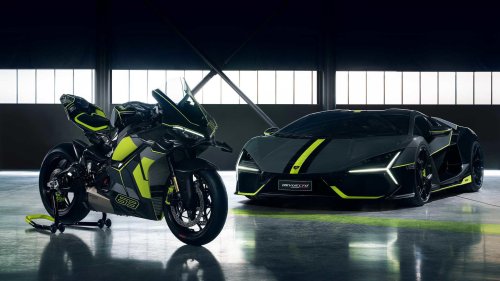
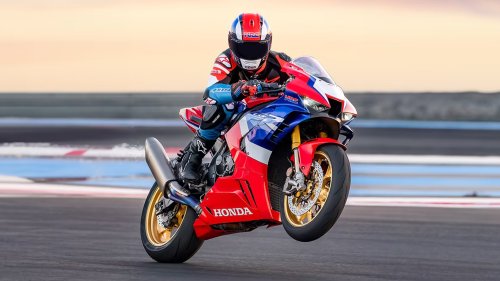
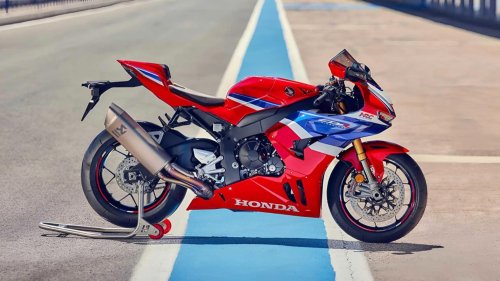
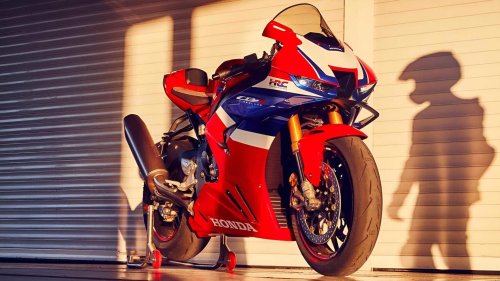
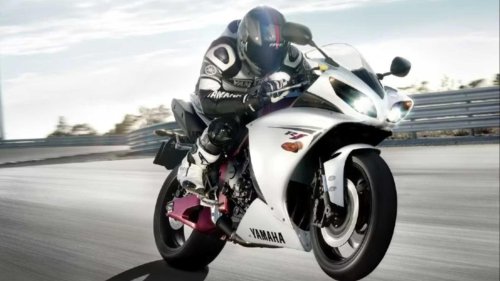



















In the world of motorcycles, each country’s bikes have a different flavor. Japanese bikes tend to be reliable, American bikes tend to be powerful, Italian bikes tend to be exciting, and British bikes tend to be broken down at the side of the road. Each bike’s design and performance conforms to its country’s tastes, with riders having to choose what they want from a bike and sticking with that country.With this, it’s very rare that a manufacturer will deviate from their country’s favored characteristics. It's rare, but not unheard of. And there’s one Japanese sport bike that takes inspiration from Italy’s finest. Japanese And Italian Bikes Prioritize Two Different Things DucatiThough both huge proponents of the motorcycle, Japan and Italy have two entirely different attitudes towards it. Japanese bikes, like your Hondas, Kawasakis, Suzukis, and Yamahas, are all willing and reliable work horses. They're user-friendly, mass-produced, and, in the case of three of those four, manufactured by companies who also make cars (Kawasaki the sole exception here).Italian bikes, on the other hand, are more about passion, performance, and speed. Every twist of the throttle is about eliciting more feeling from the rider.The biggest brands like Ducati, Aprilia, Moto Guzzi and MV Agusta don’t bother with anything with more than two wheels, as they just aren’t as exciting. You’ll largely see the same with Italian car brands, sticking to their proverbial wheelhouses, though they have on occasion dipped a single toe into the water of motorcycles. Ferrari has understandably remained true to its four-wheeled roots, but Lamborghini worked with Ducati in 2025 to create a motorbike inspired by the Revuelto (the Ducati Panigale V4 Lamborghini), while Maserati did make motorcycles and mopeds until 1960.LamborghiniIt demonstrates the attitude both countries have towards the motorcycle. Japan sees a motorcycle as a vehicle, a tool to get from A to B, hence why manufacturers often make both cars and bikes simultaneously. Italy also sees them as transport, sure, but they’re not just a way of getting around. Bikes are a love affair, an expression of artistic individuality, and a way of life.One need only look at MotoGP to see this distinction in the sporting world. The country with the most manufacturer race wins? Japan, with 658 wins from four constructors to Italy’s 316 wins from eight teams. The country with the most individual race winners? Italy, with 944 race wins from 91 riders to Japan’s 189 wins from 39 riders. The Japanese make the bikes, the Italians race them.They’re two sides of the same coin — both are fiercely passionate about motorcycles, but they go about their motorcycling very differently and want very different things from them. At least, that’s usually been the case. In an automotive equivalent to Itameshi (a Japanese cuisine that combines traditional Japanese and Italian food), there was one bike that combined the best of both countries and took the world by storm. The Honda CBR1000RR-R Fireblade Combines The Best Of Both HondaHonda already knew that the Fireblade was a winning proposition as the original Fireblade, released in 1992, rewrote what a superbike was. Wanting more power and better handling from a sports bike, Honda designer Tadao Baba took a leaf out of Colin Chapman’s book and “added lightness” to achieve it rather than simply throwing more power at the bike. This was a revelation, as the 900cc bike was able to keep up with much more powerful, yet heavier, bikes.The Fireblade has gone through many iterations and refinements since its first offering in 1992, each one following the same mantra of making a superbike with accessible performance. After a move to a more powerful 1,000cc engine came in 2004, the 'Blade became much more of a track-spec weapon. This incorporated more MotoGP tech into the bike, drawing on the at-the-time three consecutive MotoGP titles with Italian Valentino Rossi.It went through what Honda calls “a sea change” in 2017, as the bike got a complete overhaul. Semi-active Ohlins suspension and Brembo brake calipers were added (both European parts, with Brembo in particular being Italian), though the real revelation was the bike’s electronics.HondaSee, it took elements from their hugely successful MotoGP bike, the Honda RC213V. The bike had already proved itself on the track, racing since 2012 and taking four Riders’ titles and four Constructors’ titles before the 2017 road bike was launched. That road-legal 2017 model would include a five-axis inertial measurement unit, nine levels of torque control, ABS, wheelie control, rear lift control, and even more electronics to boot in a bike that, again, was road legal.The same European parts made their way across to the 2020 version, as did the aggressive aero found on the race bike. The winglets underneath the handlebars, the point at the end of the seat, and the dramatic angles of the bike all gave it an appearance similar in some ways to that of the Ducati Panigale V4, as the Fireblade swapped its former subtlety for a more brash, race-inspired aesthetic.This similarity wasn’t by accident. Nor was Honda’s decision to release the bike at EICMA in Milan, Italy. They wanted to position the 2020 version as a direct response to Ducati’s Panigale which, since its 2018 release, had taken some of the prestige away from the Fireblade. Honda, and Japanese bikes at large, still had that reputation for being engineering marvels that, while cool, perhaps lacked the same excitement that came with an Italian bike.Honda UKIt wasn’t just the aesthetics that were tweaked for the 2020 version, though. The Fireblade's engine received a significant upgrade, going from 189 horsepower to 214.5 horsepower. This put it almost on par with the 216-horsepower Panigale, though the Fireblade retained some of its original DNA in that it made that power from a 1,000cc engine, compared to the 1,103cc engine that the Panigale housed.It was a hit with reviewers, though those reviews weren’t without their gripes. The track-readiness seemed prioritized over the road handling, creating a bumpier ride, and the position also felt like the bike was a track machine that happened to be road legal, but aside from that, it was a success. Honda had taken the fight to Ducati and, while it might not have dethroned Ducati in the way it had hoped, it was the brand’s greatest example of Itameshi to date. Not A Common Mixture, But There Are Others YamahaWhile the most recent Fireblade might be the most prominent example, it’s not the only Japanese bike that could apply for dual nationality. Take, for example, the Yamaha R1. The high-revving (14,300 rpm redline) sportsbike also has an aggressive, race-inspired design taking inspiration from Italian sportsbikes. In fact, Yamaha released a special Valentino Rossi tribute R1 in 2021 to commemorate the Italian’s tenure with the brand, combining the two countries once again.You could also, depending on your definition, cite the Bimota brand. While not a Japanese brand taking inspiration from an Italian brand, this is an Italian brand partly owned by a Japanese marque, as Kawasaki purchased a 49 percent stake in the Italian company in 2019.Whatever your preference, bikes and cuisine remain related in their adherence to national tastes. And while you can find many Japanese fusions, you won't find Italians blending their signature flavor with anyone else—be it food, bikes, or anything else.