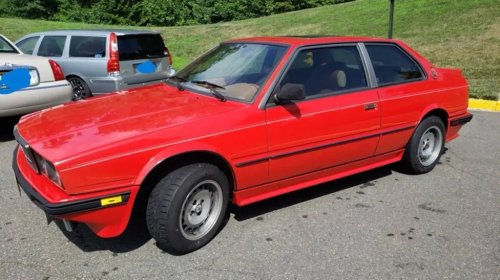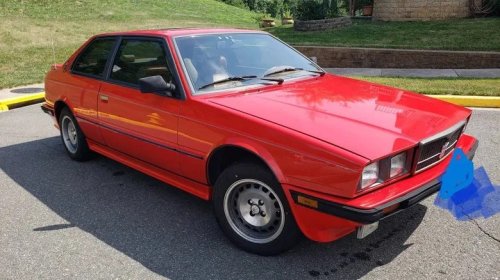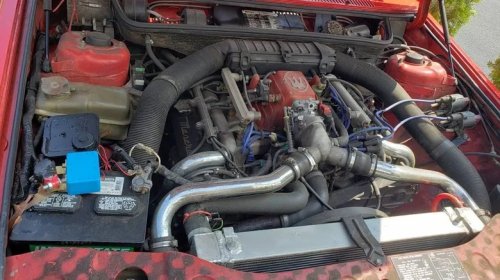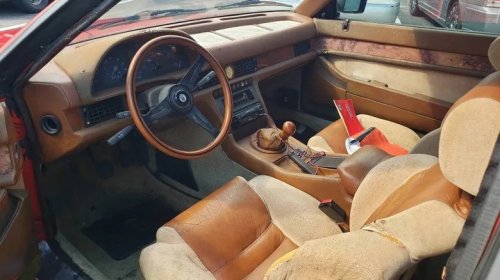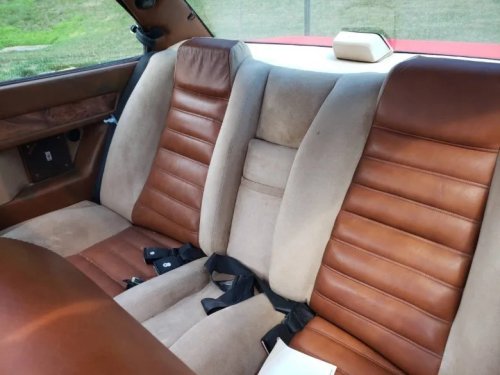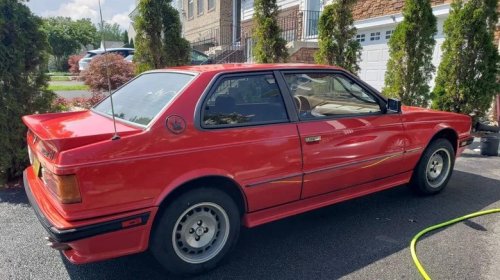
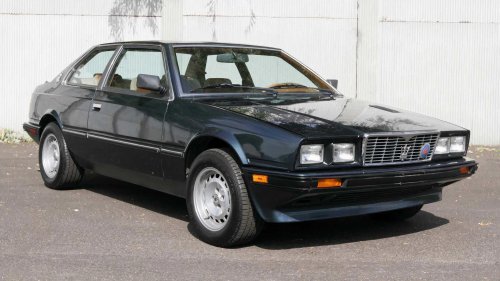
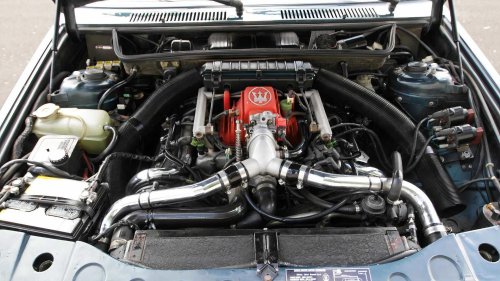
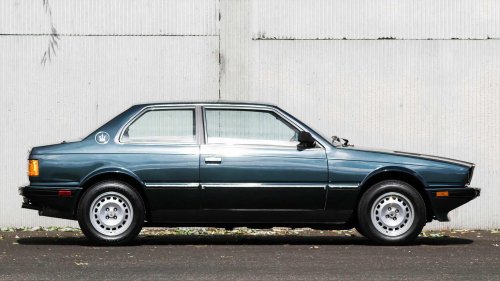
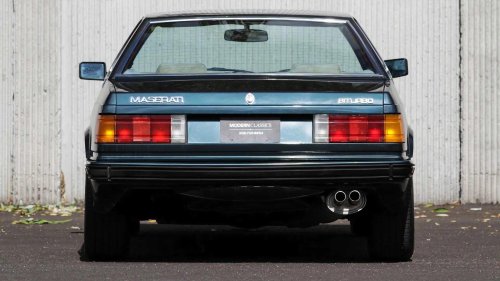




















Walk through any modern supercar showroom and almost every car you see shares a feature that was unimaginable four decades ago. Twin turbochargers are now standard equipment on the Ferrari 296, the McLaren 750S, the Mercedes-AMG GT, the Porsche 911 Turbo, and virtually every performance V6 and V8 on the market. The layout that uses two small turbos instead of one large one has become the default answer for manufacturers chasing both response and output. None of it would have happened without a single Italian coupe that arrived in late 1981 wearing a Maserati badge, a manufacturer fighting for its survival, and carrying an engine layout that nobody else had been willing to put into series production. When One Turbocharger Was Still Considered Exotic Via: USA Today The turbocharger was not new in 1981. General Motors had fitted one to the 1962 Oldsmobile Jetfire with mixed results, Porsche had used turbocharging to devastating effect in the 911 Turbo from 1975, and Saab had built its reputation around the 99 Turbo beginning in 1977. Audi's Quattro had just introduced the world to forced induction combined with all-wheel drive. These were the machines that defined what a turbocharged car looked like at the start of the 1980s, and every single one of them used a single turbocharger. The defining problem was turbo lag. A single large turbo needed time to build boost, and the delay between throttle input and power delivery was the trade-off every manufacturer accepted in exchange for the performance benefits of forced induction.Engineers understood in principle that two smaller turbochargers would spool faster than one large unit, reducing lag and sharpening response. The theory was sound. The practical challenges of packaging two turbochargers into an engine bay, managing the plumbing, and controlling the boost from two separate compressors had kept everyone from attempting it in a production car. Formula One teams had experimented with twin-turbo layouts, but translating the idea to a road car meant solving problems nobody had solved yet. The manufacturer that would attempt it first was not the one most people would have guessed. The Maserati Biturbo Put Two Turbochargers On A Production V6 Before Anyone Else Bring A TrailerThe Maserati Biturbo was launched on December 14, 1981, the anniversary of the Maserati brand itself. Designed by Pierangelo Andreani under the direction of Alejandro de Tomaso, the Biturbo was intended to drag the Italian manufacturer into volume production and keep the company solvent. De Tomaso had taken control of Maserati in 1975 after Citroën's bankruptcy, and he needed a car that could compete with the BMW 3 Series on price while offering more performance and more prestige than anything wearing a German badge.The Biturbo's 2.0-liter 90-degree V6 displaced 1,996cc, used an aluminum block with wet Nikasil-coated liners, and featured three valves per cylinder with a single overhead camshaft per bank. A pair of IHI turbochargers, one per cylinder bank, fed the engine through a single Weber downdraft carburetor. Output stood at 180 hp at 6,000 rpm, a figure that placed the Biturbo comfortably ahead of most executive coupes on sale when it launched and gave it genuine sports car credentials at a price that undercut the established European competition.Performance was competitive with almost everything in its class. The Biturbo reached 60 mph in approximately 6.5 seconds and continued to a 134 mph top speed, numbers that undercut the contemporary BMW lineup and put the little Maserati within reach of far more expensive European sports cars. The 2.0-liter displacement was a deliberate commercial decision. Italian vehicle tax at the time applied a crushing 38% VAT to cars with engines over 2,000cc, against 19% for smaller engines, which meant the Biturbo's sub-2.0-liter V6 was essential to reaching domestic buyers at a viable price. The V6 Architecture That Made Twin-Turbocharging Practical Bring A Trailer The engineering breakthrough that made the Biturbo possible came from Giordano Casarini, a former Ferrari engineer who joined Maserati in 1976. Casarini's first attempt at forced induction used a single turbocharger mounted between the cylinder banks in the valley of the V6, but thermal problems made the installation unworkable. The solution was to split the exhaust flow between two smaller IHI turbochargers, one mounted on each side of the engine, each fed by its own bank of three cylinders.The 90-degree V-angle that made the engine slightly unusual for a V6 became an advantage, giving each turbo its own clean exhaust path without the cross-bank plumbing that would have complicated an inline or narrower V layout. Running 0.8 bar of boost, the twin-turbo setup delivered 180 hp from a naturally aspirated architecture that had struggled to produce 150 hp on its own. The parallel twin-turbo layout Casarini pioneered on the Biturbo's V6 has since been refined and adopted by virtually every twin-turbo V6 and V8 in production, from the Nissan GT-R to the Ferrari 296 and the current generation of twin-turbocharged supercars. The Reliability Problems That Nearly Buried The Innovation Bring A Trailer The Biturbo's engineering credentials were matched by its reputation for temperamental behavior. Early cars suffered from inconsistent build quality, carburetor issues that made cold starting unreliable, turbo failures that were expensive to rectify, and electrical gremlins that tested the patience of even the most committed owners. The blow-through carburetor arrangement was particularly blamed for driveability and reliability problems, and Maserati did not switch to fuel injection until 1987.American buyers, who received the Biturbo from 1984 onward with a larger 2.5-liter V6 producing 185 hp, were particularly unforgiving. Inconsistent dealer support and a parts supply chain that was not ready for volume Maserati ownership sent the car's reputation into freefall within a couple of years of its US introduction. Maserati imported roughly 5,000 Biturbos to the US market between 1984 and 1990 before pulling out of the country entirely. The reputation followed the car for the next three decades and overshadowed its place in automotive engineering history. What The Maserati Biturbo Costs Today Bring A TrailerThe Maserati Biturbo is one of the strangest value propositions in the classic car market. A car that introduced the twin-turbocharged engine layout to series production, built by one of the most storied names in Italian performance, now trades for less than a used commuter sedan. Market data shows a 1984 Biturbo in good condition valued at roughly $4,900, which puts the first twin-turbocharged production car in the same price bracket as a high-mileage Ford Focus. A 1987 Biturbo Spyder with 27,000 documented miles sold for $7,500 at auction in December 2024. Even the more desirable later coupes with fuel injection and the 2.8-liter engine rarely break into five-figure territory unless they are exceptional examples.The gap between the Biturbo's engineering significance and its market value is the result of four decades of bad word-of-mouth. The cars that suffered the worst reliability problems were the early US-market examples from 1984 and 1985, and those stories became the dominant narrative for the entire model line. Later cars, particularly the fuel-injected Biturbo i and Si models from 1987 onward, addressed most of the early complaints. For collectors willing to look past the reputation and commit to a car with solid service history, the Biturbo offers a piece of automotive history that genuinely shaped how modern performance cars are built. The layout that was invented here is now the industry standard. The car that invented it remains available for bargain money.Sources: Hagerty, Maserati, Bring a Trailer, Classic.com.