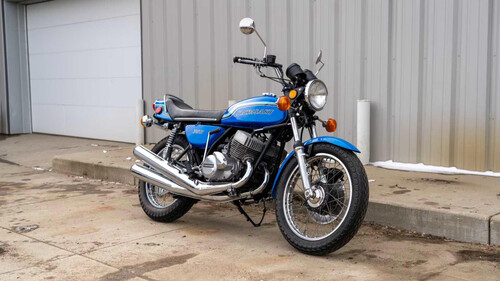
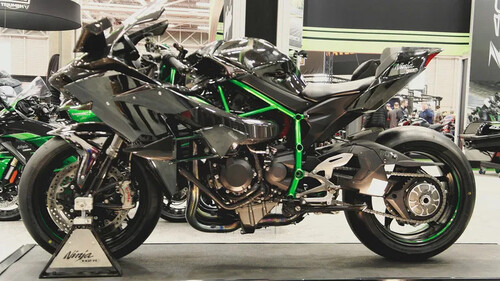
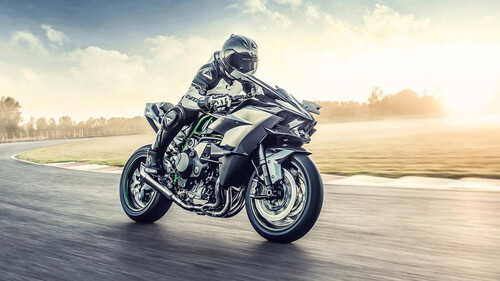
It’s no secret that Kawasaki loves to go wild from time to time, creating some of the most memorable bikes the world has ever seen. One such instance was in 1972, when the iconic Z1 was released to go head-to-head with Honda’s CB750 and steal its spot in the limelight. Then you had the two-stroke beast known as the H2 Mach IV, commonly referred to as the “widowmaker” due to its punchy 74-horsepower triple and its narrow power band. Fast-forward to the present day, and you’ve got the brutal Ninja H2 with that supercharged 998cc powerplant - an absolute beast on every level. No Stranger To Pushing The Performance Envelope Web Bike WorldThis bad boy is capable of delivering 240 horsepower at 11,500 rpm, but things get even crazier with the track-focused H2R. It has a whopping 322 ponies and 121 pound-feet of torque on tap, all resulting in a top speed of 249 mph. Clearly, Kawasaki won’t shy away from pushing the limits, but what about the time when it gave us a fully-fledged tourer infused with superbike genetics? That’s right; the most outrageous sport-tourer out there was a Kawi, which should come as no surprise given the company’s track record. It represented the pinnacle of sport-touring brilliance right before the ADV takeover, when a big chunk of the market turned to adventure bikes for their long-distance riding needs. What Made People Turn To ADVs? Iconic Motorbike AuctionsAt this point, one might pause and wonder how a machine like the BMW R 1300 GS is able to make up for what those sport-tourers had to offer. It’s certainly no match for them in terms of speed, and the overall riding experience is completely different with those upright ergonomics. Well, the whole ordeal boils down to changing market demands, as buyers’ interest in what the sport-touring segment had to offer simply faded away. Adventure bikes, by contrast, sold a lifestyle centered around freedom and exploration, which became far more appealing than cruising on the highway at superbike-worthy speed. But the sport-touring category certainly went out with a bang, thanks in no small part to the legendary Kawasaki we’ll be featuring today. A Ninja Superbike, But With A Suit And Tie Web Bike WorldThe motorcycle we’re referring to here is none other than the Concours 14, also known as the GTR1400 outside the United States. In essence, the Japanese manufacturer was wondering what might happen if it took a massive superbike engine and turned it into a mile-muncher that would give BMW’s luxury tourers a good run for their money. Kawasaki’s core philosophy for the Concours 14 was unlike that of Bavaria’s K 1200 GT or the Honda Gold Wing, placing a much larger emphasis on performance while remaining comfortable for extended rides. At its core, there was the Ninja ZX-14’s monstrous 1,352cc inline-four motor.It had been retuned for low-end and mid-range torque on the Concours 14, providing smoother power delivery and a less aggressive throttle response. One of the stand-out features of this liquid-cooled colossus was its variable valve timing, rarely seen in the motorcycling world at the time. In addition, Kawasaki offered an optional ram-air intake setup for those looking to make things just a little more exciting, but the four-cylinder mill packed a serious punch even without it. Peak power occurs at 8,800 rpm with 156 horsepower propelling you forward, while a maximum torque output of 103 pound-feet will be generated at 6,200 revs. Tons Of Power, And A Chassis To Match Iconic Motorbike AuctionsEven though these figures are slightly lower than the ZX-14’s, they were more than enough to make the Concours 14 the world’s most powerful sport-tourer at the time of its release. A six-speed gearbox sent all that force to the rear wheel via a driveshaft, complete with Kawasaki’s Tetra-Lever technology to eliminate shaft jacking. The bike employs an aluminum monocoque frame where the engine acts as a stressed member, similar to the construction you’d see on the Ninja. Front-end suspension duties were assigned to adjustable upside-down forks measuring 1.7 inches in diameter, while the rear end came with Kawasaki’s proprietary Uni-Trak arrangement.For stopping power, the bike relied on dual 12.2-inch floating discs and four-piston Nissin calipers up north, along with a single 10.6-inch rotor and a two-piston caliper down south. Optional ABS was available at launch, but it became standard equipment further down the line. In fact, the Connie came with a bunch of snazzy electronic features to confidently rival what BMW had to offer, including keyless ignition, linked braking and traction control. This meant that it wasn’t just fast, but also a technological tour de force dialed all the way up to eleven. And despite a dry weight exceeding 600 pounds, Kawasaki’s sport-touring phenom was nimble and very responsive for a motorcycle in its class. Technical Specifications Top speed was electronically limited at 155 mph, though early models with no governor were said to reach a blistering 186 mph. That’s absolutely bonkers for any motorcycle calling itself a tourer, so the Concours 14 was on a whole other level compared to the outgoing ZG1000 model (GTR1000 in other markets) it was replacing. And the specimen in question was no slouch, either, using the same liquid-cooled 997cc powerhouse as the GPZ1000RX. But, as great as it might’ve been, this was simply no match for what Kawasaki went on to unleash in 2007. So how did the new Connie stack up against its biggest rivals, the BMW K 1300 GT and Yamaha’s FJR1300? Why The Concours 14 Was So Special KawasakiWell, each of them used a different formula to achieve the same goal of high-speed touring. The Beemer relied largely on comfort, luxury and prestige, whereas the FJR was more balanced, highly dependable and easy to live with in the real world. And then there was the Concours, the most performance-biased of the three and as close as you could get to a superbike in tourer’s clothing. That’s precisely what made it so remarkable, because a bike with storage panniers and over 600 pounds of bulk should have no business going 186 mph! Kawasaki’s marvel most certainly did, though, completely resetting people’s expectations of how sporty a touring machine could be. What Ultimately Killed It Web Bike WorldIt stayed in production for 15 years until 2022, receiving relatively mild upgrades along the way like the addition of traction control in 2010. What brought about the end for the Kawasaki Concours 14 wasn’t anything to do with it being flawed, as buyers eventually changed their priorities and started favoring adventure bikes for long-distance travel. They became more interested in versatility and comfort instead of outright performance or superbike-worthy highway thrills, so the Concours along with so many other sport-tourers quietly faded into irrelevance.Times changed and the world moved on, but the Ninja-derived couch rocket from Japan still has a dedicated cult following keeping its spirit alive to this day. With the advent of ADVs as a dominant force on the market, it’s very unlikely that something akin to the Concours 14 will ever be built again. And so it stands tall as the purest expression of a performance-oriented touring machine, which somehow managed to fuse superbike DNA with practicality and comfort over long distances. It did so in spectacular fashion, and its production run would have certainly continued if the world hadn’t stopped caring.