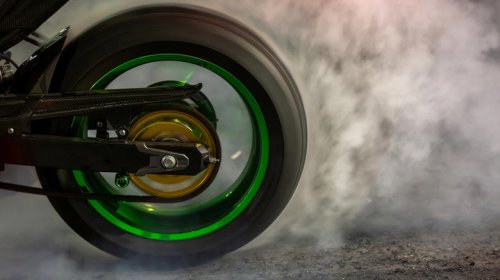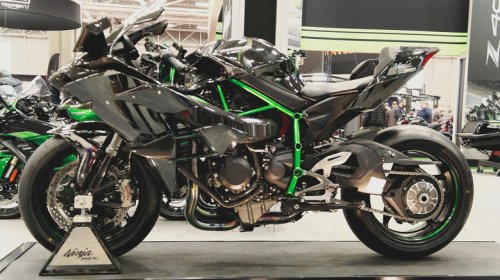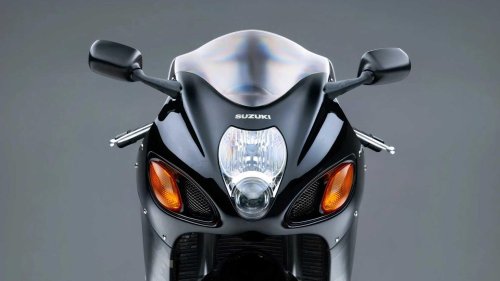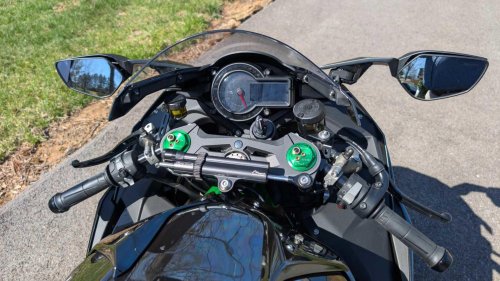
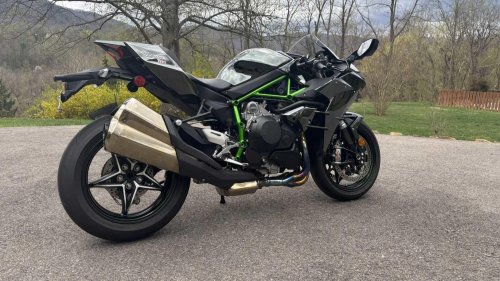
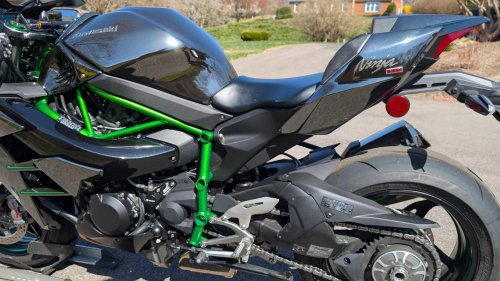
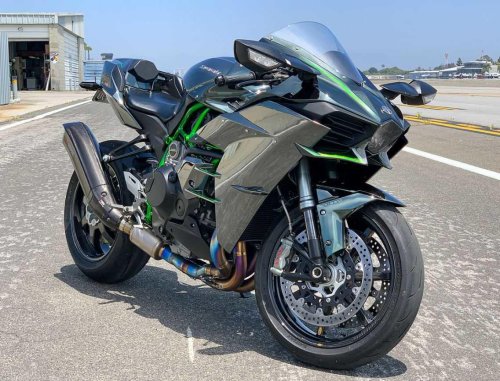
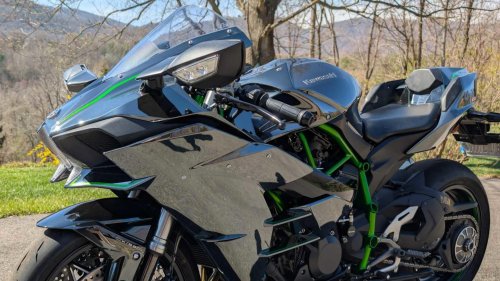
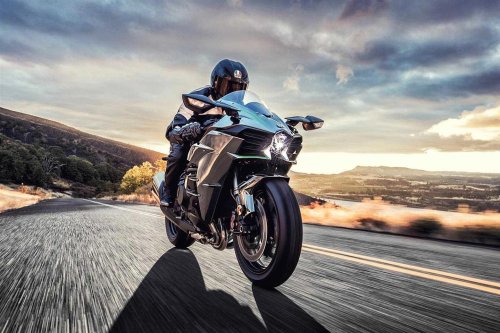
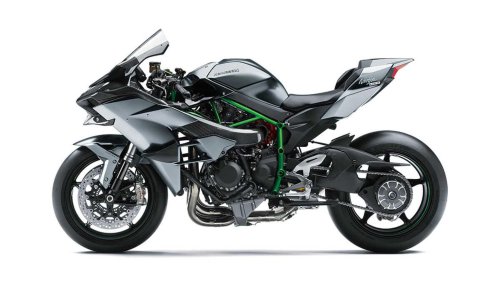



















By the mid-2010s the motorcycle industry had spent a decade in an unofficial horsepower truce. The 186 mph gentleman's agreement had taken the top-speed war off the table, so manufacturers shifted energy to other metrics: electronics, track performance, weight reduction. The naturally aspirated liter-bike had pressed hard against its ceiling, and nobody seemed particularly interested in changing the rules. Then Kawasaki arrived at the 2014 Intermot show and announced it had built a supercharged, street-legal motorcycle. UPDATE: 2026/03/31 05:10 EST BY JARED SOLOMON This article has been updated with additional context on Kawasaki's engineering impact and real-world ownership considerations.The engineering did not come from the motorcycle division. It came from the aerospace and gas turbine arms of Kawasaki Heavy Industries, a corporation that builds jet engines, submarines, and bullet trains alongside motorcycles. What that division produced for a 998cc inline-four reached a number that had never appeared on a road-legal production motorcycle in forced induction form. Whether that claim is entirely clean depends on which unit of measurement you use, and that distinction matters more than it might first appear. The Arms Race Nobody Talked About Bring a Trailer The 2009 BMW S1000RR redefined what a liter-bike could do. It arrived at 199 hp and forced every manufacturer to respond. Yamaha followed with the 2015 R1 at 197 hp. Ducati's 1299 Panigale claimed 205 hp from a 1,285cc twin. Aprilia's RSV4 RF was in the same territory. Every major manufacturer was pressing against the ceiling of what a naturally aspirated 1,000cc engine could produce in road-legal form.Kawasaki had experimented with supercharging in marine applications, including the 2006 Jet Ski Ultra 250X, which extracted 250 horsepower from a supercharged 1,498cc four-cylinder. The knowledge was there. The engineering challenge was packaging a centrifugal supercharger into a motorcycle that could still be ridden on public roads, something no mainstream manufacturer had accomplished in the modern era. None of their competitors had the same industrial infrastructure sitting in-house. What Kawasaki was building would settle a 200-horsepower debate that had been running since 2011, and settle it conclusively. The Kawasaki Ninja H2 And Why 200 hp Belongs to It Bring a TrailerThe same PS vs imperial hp caveat applies to the H2. Kawasaki rated it at 200 PS at 11,000 rpm stationary, which converts to 197.2 imperial hp at the crank without ram air. With ram air at speed, that rose to 210 PS or approximately 207 imperial hp. The distinction from the ZX-10R becomes clear on a dyno. The ZX-10R measured around 170 horsepower at the rear wheel. Independent dyno testing of the stock H2 returned 189.8 horsepower at the rear wheel, a meaningfully stronger result than the naturally aspirated competition, and one delivered with the supercharger's characteristic flat, sustained torque curve rather than the narrow peak of a high-compression, naturally aspirated engine. The H2 also achieved its figures through a fundamentally different method: forced induction purpose-built for the application, not aggressive naturally aspirated tuning.That context matters because the 2011 ZX-10R had its own 200 hp claim. Kawasaki marketed it with a headline of 200.1 PS at the crank. PS is metric horsepower, Pferdestärke, a unit approximately 1.4 percent smaller than imperial hp. That 200.1 PS figure converts to around 197.3 imperial horsepower without ram-air, only reaching the metric 200 mark with ram-air effect included, and measuring around 170 horsepower at the rear wheel independently. The honest framing: neither bike reaches 200 imperial horsepower at the crank on a static dyno. But the H2 is the first production motorcycle to operate at that level of output in any practical sense, the first to use a factory supercharger to do it, and the first to be tested and sold as a genuine 200-horsepower street machine. The Supercharger Kawasaki Built From Scratch Bring a Trailer No off-the-shelf centrifugal supercharger could meet the H2's requirements for size, efficiency, and output. Kawasaki's engineers turned to the company's Gas Turbine and Machinery division, which designs and builds jet turbine engines, and commissioned a purpose-built unit. The result was a 69mm impeller machined from a single billet of aluminum using five-axis CNC equipment. At maximum engine speed, the impeller shaft spins at close to 130,000 rpm, approximately 9.2 times the crankshaft speed.The centrifugal design was chosen deliberately. It generates less heat than scroll or screw-type alternatives, which allowed Kawasaki to omit an intercooler and keep the package compact enough for a motorcycle chassis. The airbox operates at up to 2.4 times atmospheric pressure. The impeller moves over 200 liters of air per second at full speed, fed through a ram-air intake on the left side of the fairing that adds further pressure at speed. Compression ratio sits at just 8.5:1, low by liter-bike standards, because the supercharger supplies the charge density that compression ratio alone would otherwise need to provide. Kawasaki did not bolt a supercharger to an existing engine. It designed the supercharger first and built the engine around it. Why The H2 Changed Motorcycle Engineering—Not Just Performance What makes the Ninja H2 significant isn’t just the headline horsepower figure—it’s how it forced the industry to rethink what a modern superbike could be. For over a decade, manufacturers had been extracting marginal gains through higher rev limits, lighter internals, and increasingly complex electronics. The H2 took a completely different path by increasing air density instead of chasing engine speed.That shift has long-term implications. Forced induction allows engineers to make more power without pushing components to the same extreme mechanical stress levels required by naturally aspirated engines chasing peak output. It also changes how power is delivered. Instead of a sharp, peaky top-end rush, the H2 produces a broad, linear surge of torque that builds relentlessly with speed.In practical terms, that meant: Stronger midrange acceleration than any liter-bike rival at the time Less dependence on ultra-high RPM to access peak performance A fundamentally different riding experience compared to traditional superbikes Even today, more than a decade later, no major manufacturer has followed Kawasaki with a direct supercharged superbike competitor. That alone underlines how far outside the conventional development path the H2 really was. What the Ninja H2 Is Worth Today Bring a TrailerThe H2 holds its value considerably better than naturally aspirated rivals from the same era. Sales data across 30 comparable transactions shows a broad range reflecting condition, with a 6-mile 2015 example selling at Mecum Houston for $20,350 and current asking prices for sub-2,000-mile examples sitting around $25,000, matching the original MSRP. That is a narrow depreciation curve for an eleven-year-old motorcycle, and reflects limited production numbers, the bike's position as the first factory-supercharged production motorcycle, and the difficulty of finding an unmodified example. By contrast, a comparable 2015 BMW S1000RR or Yamaha R1 trades well under $12,000 in good condition. New 2026 H2 ABS models are retailing at around $34,400, which usefully frames what a clean original 2015 should command today. The Real-World Cost Of Owning A Supercharged Superbike The Ninja H2’s engineering complexity doesn’t just affect performance—it directly impacts ownership. Unlike naturally aspirated rivals, the H2 requires tighter tolerances, specialized servicing, and stricter maintenance schedules to keep the supercharger system operating correctly.Insurance costs are typically higher due to the bike’s rarity and performance ceiling, and replacement parts—especially for the supercharger assembly—are significantly more expensive than equivalent components on conventional liter-bikes. Fuel consumption is also noticeably heavier under aggressive riding, reflecting the increased air and fuel demand under boost.However, those higher running costs are partially offset by one key factor: stability in value. As shown in market data, the H2 depreciates far less than its contemporaries, meaning owners often recover a larger percentage of their initial investment when selling.For buyers, the equation is simple: Higher upfront and maintenance costs Significantly stronger long-term value retention Ownership of a genuinely rare, historically important machine That combination is unusual in the superbike segment, where most models follow a steep depreciation curve within just a few years. Ninja H2 Variants and What Separates Them Kawasaki The H2 range expanded significantly after launch. The base H2 and H2 Carbon are the street-legal superbike variants. The Carbon added carbon fiber bodywork and was limited to 120 units for the 2017 model year, selling out within three months. The H2 SX and SX SE arrived for 2018 as sport touring derivatives, with a taller fairing, luggage provisions, radar-based cruise control, and an engine tune oriented toward usable midrange rather than peak output.The Ninja H2R stands apart. Track-only, not road legal, rated at 310 hp stationary and 326 hp with ram air, it shares the supercharger architecture but runs higher boost, carbon fiber bodywork, aerodynamic winglets, and a different exhaust system. It launched at around $41,000, and 2015 examples with under 1,000 miles are currently listed above $49,000, already showing collector movement. For buyers focused on the founding moment of the supercharged production motorcycle era, the 2015 base H2 is the correct target: first year, original specification, lowest production numbers in the range.Sources: Motorcycle.com (Tech Specs), Classic.com, Motorcycle News, Bring a Trailer, Mecum.