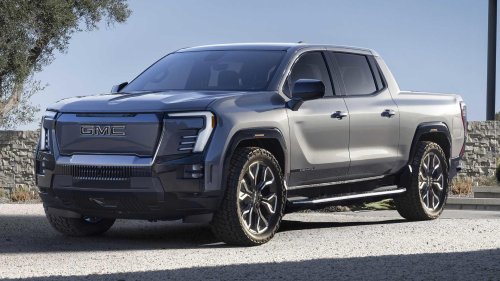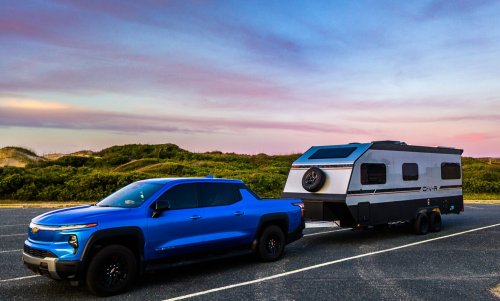
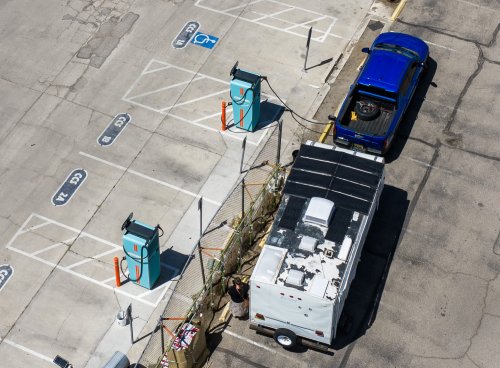
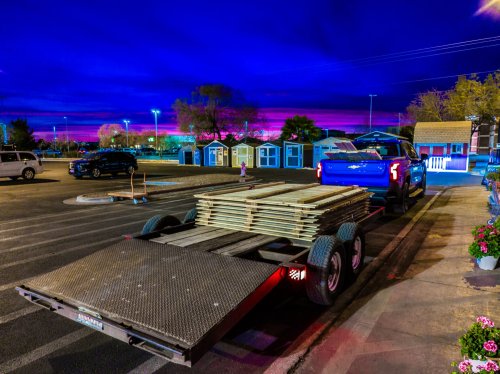
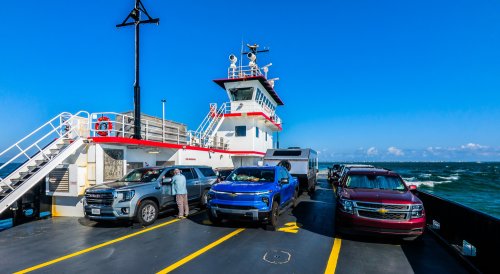



















Startups like Evotrex, Pebble, and Lightship are heavily pushing “active-assist” trailers. These are campers with their own built-in battery packs and electric motors designed to eliminate EV towing range anxiety. They basically push themselves down the highway to take the load off your tow vehicle, letting you go longer between charges. It sounds brilliant at first glance and it may legitimately be the answer for many people. But, putting all of that battery in the trailer comes with some limitations and problems that many people aren’t talking about. It’s time we addressed them! Before we dive into each problem, I want to quickly tell you how I figured most of this out: by getting actual experience traveling all over the country pulling trailers with EVs. Between my Bolt EUV and my Silverado EV, I’ve towed over 13,000 miles visiting national parks, state parks, and really cool boondocking locations on other public lands. If this is a topic you’d like to follow more, I’d like to invite you to check out my personal project, Charge to the Parks. We are dedicated to proving you can explore America’s wildest and most beautiful places on electric power. If you want to follow my daily adventures and see what I’m testing next, come hang out with me on BlueSky, too. </Shameless Plug> Now, let’s look at some of what I’ve learned: Problem #1: Charging The Trailer When you look closely at how these companies actually expect you to charge these powered trailers, the reality gets weird fast. Evotrex includes a gas-powered generator built into the trailer to charge your EV, and you can’t charge the trailer at a DC fast charging station. This make it a fundamentally a gas-burning setup that turns your electric RVing rig into a hybrid. I know that’s great for some people, but if I wanted to burn fossil fuels, I’d buy a diesel pickup and have an easy time “charging” in 5 minutes using the many pull-thru lanes available at truck stops. Pebble can be DC fast charged, but that introduces a new problem: charging both the trailer and the truck at the same time. In a pull-thru space with long enough cables (I don’t think that even the awesome Pilot/Flying J stations can do this), that will work. Everywhere else (read: real-world charging stations), you’re going to be backing the trailer into a stall, plugging it in, unhitching, putting your truck in the adjacent stall, charging it, then hitching everything back up to leave. That adds serious time to each stop! Pebble lets you use a phone app to remote-control your trailer into the second charging stall, which is going to be helpful at a tight charging station. But, you’re still hitching and unhitching at every stop in the real world, and that sucks. I managed to avoid unhooking the trailer for charging in all but two situations, but it required creativity. At this iONNA station in Willcox, Arizona, I managed to get a charge from an adjacent parking lot. you’re not going to be able to do that with a trailer that also needs a charge. With my Silverado EV, all of the battery is in the truck. At pull-thru stalls, I simply charge the truck. At most non-pull-thru stalls, I find a way to get the truck close enough to charge without unhitching, even if it means blocking an extra stall or two at a station that’s mostly empty. On my recent 9,000-mile trip, I only had to unhook at two charging stations, so a Pebble would be a downgrade in experience. Problem #2: Setting Up A Basecamp Another failure of the powered trailer concept becomes obvious the second you pull into the backcountry. When you go boondocking on public lands, you don’t stay attached to the camper. You drop the trailer to set up base camp, unhitch, and use your truck to explore trails, go hiking, or drive into town. If your trailer’s solar can’t keep up, you can always go into town, charge, and come back with a mostly full battery to run your camp. If your massive, expensive battery bank is permanently built into the trailer, you can’t take the battery into town to charge without breaking camp and putting everything away. In that time, someone else might come and take your awesome spot! With a big battery truck, most of the battery power goes with you into town, and you can bring it back mostly full. Problem 3: Towing Other Trailers If automakers use the existence of powered trailers as an excuse to put tiny, nerfed battery packs into their electric trucks, we run into an even bigger problem. Even if we ignore the first two problems and say “Mission Accomplished” like Dubya, there’s still the problem of any other trailers you want or need to tow. This car hauler that I pressed into service at Home Depot doesn’t have a motor or batteries. My truck will still pull it just as far as my camper, and likely further because it’s low-profile. What happens when you need to tow a U-Haul trailer when moving? What about a rented Bobcat or trencher for construction? Or a boat?. None of those other trailers are ever going to have a $50,000 battery pack built into them. You’ll get great range towing the camper, but terrible range pulling everything else. Putting the battery capacity in the truck solves all of your other towing problems. The Future Problem: Falling Prices & Rising Density We also need to look at the trajectory of battery technology. Pack prices have fallen below $110 per kWh, and next-generation tech like semi-solid and solid-state cells are hitting 350 to 400 Wh/kg in real-world vehicle testing. As batteries continue to get significantly lighter, cheaper, and more energy-dense, it’ll eventually make absolutely zero sense to fragment your energy storage across two vehicles. The economics will dictate packing that energy directly into the truck frame, giving us great range and native towing capability without the over-complicated trailer hardware or charging headaches. When battery cells get smaller and get lighter, automakers are simply going to shove in more storage, even if that keeps the truck heavy. Why? Because we need the range and having a heavy truck means it sticks to the road like a magnet. The wind can’t blow you around as easily. Passing semi-trucks can’t pull you into their lane like a giant vacuum cleaner. If the trailer sways, it sways. The truck isn’t going anywhere. There won’t come a time when it doesn’t make sense to have a heavy tow vehicle with amazing range, and it will never make sense to have the trailer be heavy enough to boss the truck around. Keep the Trailer Simple In the end, it comes down to this: Why buy two separate electric vehicles just to go camping? It adds dead weight, extreme retail costs that easily push past $120,000, and difficult software complications. Put the battery in the truck you drive every day, and it does the same thing with less trouble and expense. Before you go, don’t forget to visit Charge to the Parks to see how we’ve been putting our electric rig to the ultimate test in the wild. You can also catch my real-time updates and join the conversation over on BlueSky. Let’s keep the adventure going! My Silverado EV and inTech OVR Navigate on a ferry from Hatteras to Ocracoke. All images by Jennifer Sensiba.