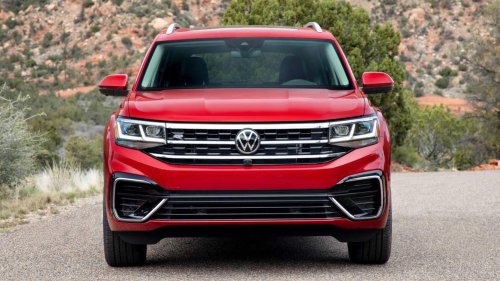
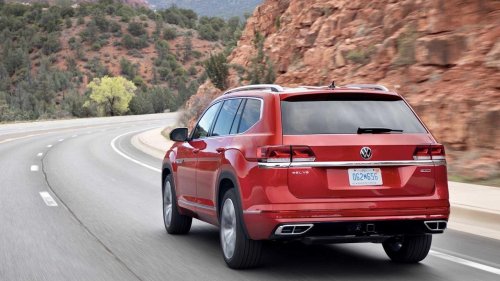
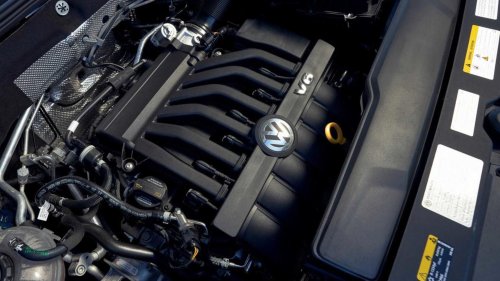
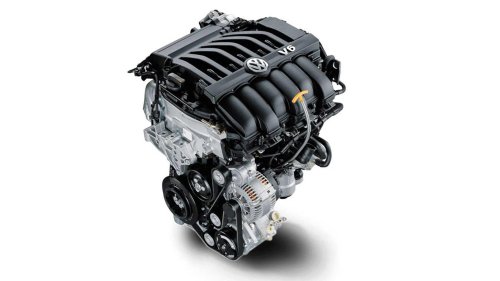
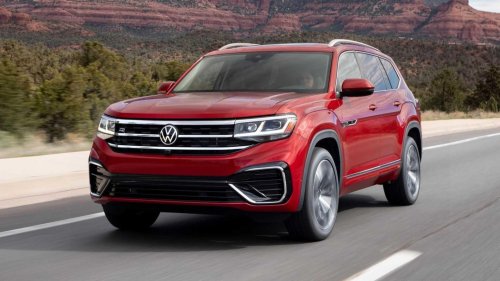
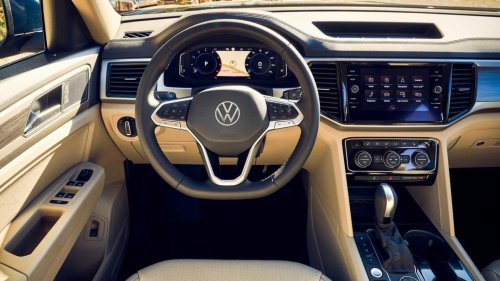
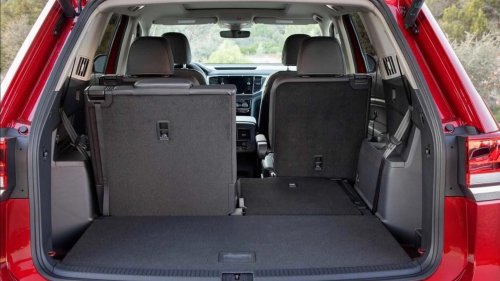
Jump LinksThe world of automotive engines used to be such a fascinating place. OEMs could come up with some really weird and wonderful creations to power a variety of their everyday vehicles. Just look at Volkswagen as an example, with its air-cooled flat fours, tunable twenty-valve mills, stout V6 powerplants, and Frankenstein-like W8s. Sadly, the engine field is much more black-and-white these days, but there are still opportunities to enjoy some of those older engines in unassuming vehicles on used-car lots.A case in point is a 2023 Volkswagen Atlas SEL Premium 4Motion, which is often available with average mileage and an asking price of around $30,000. What you see is what you get in the form of a large three-row family SUV with a panoramic roof, captain's chairs, and tons of room. But under the hood is a six-cylinder engine that harkens back to those more exciting days. The Atlas Was Built For America First VolkswagenThe late model Atlas that you find at an urban used car lot may look ordinary in many respects, but it could also be one of the last affordable ways to access a venerable Volkswagen engine. Under the hood is a 3.6-liter VR6 engine, which is a family of powerplants available in a variety of models, including the Corrado sports coupe, the R32, the Touareg, and even the Eurovan.Volkswagen wanted to make the Atlas a great all-rounder for the American market, introducing a vehicle specifically designed for the USA. VW built the vehicle in Chattanooga, Tennessee, and launched it into a very competitive field.VW had big plans for the Atlas and didn't want it to feel like a traditional product from the automaker. Some of the company's earlier offerings felt more European in philosophy and sometimes seemed more apologetic than practical. VW knew it had to up the ante if it wanted to compete with vehicles like the Honda Pilot, Toyota Highlander, or Ford Explorer. It designed the 2018 Atlas to be intentionally spacious and large while remaining honest in its mission. The Atlas would appeal to buyers who wanted usable third-row space and comfortable highway manners without any pretense or compromise.VolkswagenAt launch, buyers could choose between a turbo 2.0-liter four-cylinder and the company's naturally aspirated 3.6-liter VR6. With the VR6, they’d get 276 hp and 266 lb-ft of torque, sent through an eight-speed automatic transmission to available 4Motion all-wheel drive.The VR6 felt particularly smooth, with linear throttle response and predictable power delivery. It was an excellent performer at highway speeds and perfectly suited to long, boring American interstates. But almost as soon as Volkswagen tempted the market with this six-cylinder family SUV option, the industry started to move in the other direction. The VR6 Became An Accidental Survivor VolkswagenThe Volkswagen VR6 engine originated in the late 1980s and was one of the most distinctive engines the company ever produced. It had an unusual narrow cylinder bank angle, so engineers could squeeze six cylinders into a space that would ordinarily be best for an inline four. This design also allowed the company to use a single cylinder head, and the overall dimensions were great for transverse mounting platforms.Over the decades, American enthusiasts could get the VR6 in multiple forms, such as the Corrado SLC from the early 1990s. In later years, it came aboard the MK3 GTI VR6 and the Touareg, eventually gracing the R32 models that helped to define Volkswagen's performance culture at the turn of the century. VW even shared the VR6 with Porsche for use in the Cayenne.VolkswagenOf course, the heyday of those great engines did not last, and by the late 2010s, conditions had changed. Turbocharged four-cylinder engines became the norm, delivering power efficiently while meeting tightening emission standards. Automakers followed this formula en masse as they tried to balance efficiency with modularity. Volkswagen complied as well, introducing its EA888 turbo-four across much of its range, and, sadly, the business case for keeping a naturally aspirated six-cylinder crossover engine was now increasingly weak.Still, Volkswagen kept the VR6 alive longer in the Atlas than many had expected. The company felt that the size and mission of this SUV still suited the engine's relaxed torque delivery to a degree, and thought that American buyers would still look for six-cylinder smoothness in some of their larger family vehicles. But the writing was on the wall in 2024, when Volkswagen replaced the VR6 engine with a revised turbo 2.0-liter engine aboard the Atlas. The company opted not to produce a farewell edition to say a proper goodbye to the VR6 and simply turned the page instead. The New Turbo Engine Is Probably Better For Most Buyers VolkswagenWhile some rued the disappearance of the VR6, the replacement Atlas engine was never a disastrous downgrade. In fact, you could argue that it improved the Atlas by delivering more torque than the outgoing VR6. The turbocharged four-cylinder also provided torque far lower down in the rev range, making the vehicle more responsive in everyday driving situations than the older VR6. In addition, the newer drivetrain reduced front-end weight and improved fuel economy, both of which are sizable advantages in a family crossover.The Atlas VR6 was never particularly fast, and it typically took in the high-seven-second range to reach 60 mph in independent tests. While that was perfectly adequate for its mission, it was never remotely sporty. Fuel economy also lagged many competitors, with EPA figures of around 18 miles per gallon city and 24 mpg highway for both front-wheel-drive and AWD versions.Compared to the newer turbo four-cylinder option, the VR6 was probably more costly to own. For example, you’d have to watch out for issues around the timing chain tensioner and water pump failures. But still, the VR6 earned a loyal following over the decades and offered far more character to Atlas owners than the replacement turbo four. The VR6 had a very distinctive sound and a level of progressive, smooth power delivery that was quite rare in mainstream vehicles, especially in this price bracket. The Atlas VR6 Makes More Sense Now Than It Did When New Volkswagen Depreciation has fundamentally altered the value equation for the Atlas VR6. When it was new, a well-equipped VR6 trim might push deep into the $40,000 range and occasionally past $50,000 with options. There were plenty of strong alternatives from Toyota, Hyundai, Honda, Ford, and Jeep, and while the Atlas was able to compete in this field, it didn't dominate the segment. But it does present an interesting proposition now that used vehicle pricing changes the conversation.VR6-powered examples of the 2023 Atlas are less common than the turbocharged models. The CarBuzz Marketplace shows the base front-wheel-drive version going for an average of $32,321. The range-topping SEL Premium R-Line 4Motion isn't much more at $33,844. You can regularly find late-model VR6-equipped SEL or SEL Premium models around the $30,000 mark, depending on market conditions or mileage. That's not a bad price at all for a modern three-row SUV with upscale features, respectable towing capability, ample passenger space, and a satisfyingly distinctive engine note.For context, just over $30,000 or so is the same kind of price you might pay for a fairly average new compact crossover. But with an Atlas, you’re also getting third-row usability that’s legitimately adult-friendly, and there's enough cargo capacity for most. The Atlas VR6 is a great vehicle if you regularly take long-distance trips. With the right configuration, you can tow up to 5,000 pounds, adding another layer of real-world practicality. This Might Be The Last Time A Six-Cylinder Volkswagen Feels So Ordinary VolkswagenWhen it came out, the Volkswagen Atlas VR6 wasn't necessarily anything special. Instead, Volkswagen wanted it to appeal as broadly as possible to suburban America as a straightforward, comfortable, and practical family SUV. But the VR6 engine did help make it stand out, especially as the vehicle was effectively caught between eras. This was a transitional moment when more companies were opting for small four-cylinder crossovers, downsized turbocharged engines, and electrification, rather than smooth six-cylinder motors.Today, the Atlas operates in a realistic financial space. An enthusiast can experience the VR6 formula without having to spend collector car money or tolerate too many reliability compromises. And even though the Atlas may never have been the best three-row SUV of its generation, it's still a perfectly capable and practical machine that happens to have Volkswagen's final six-cylinder engine.



















 +26 others