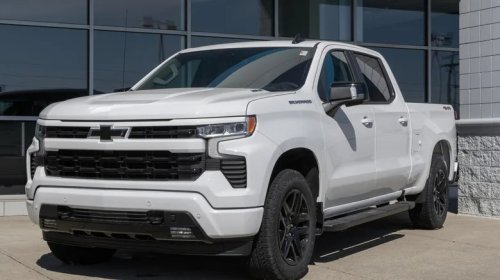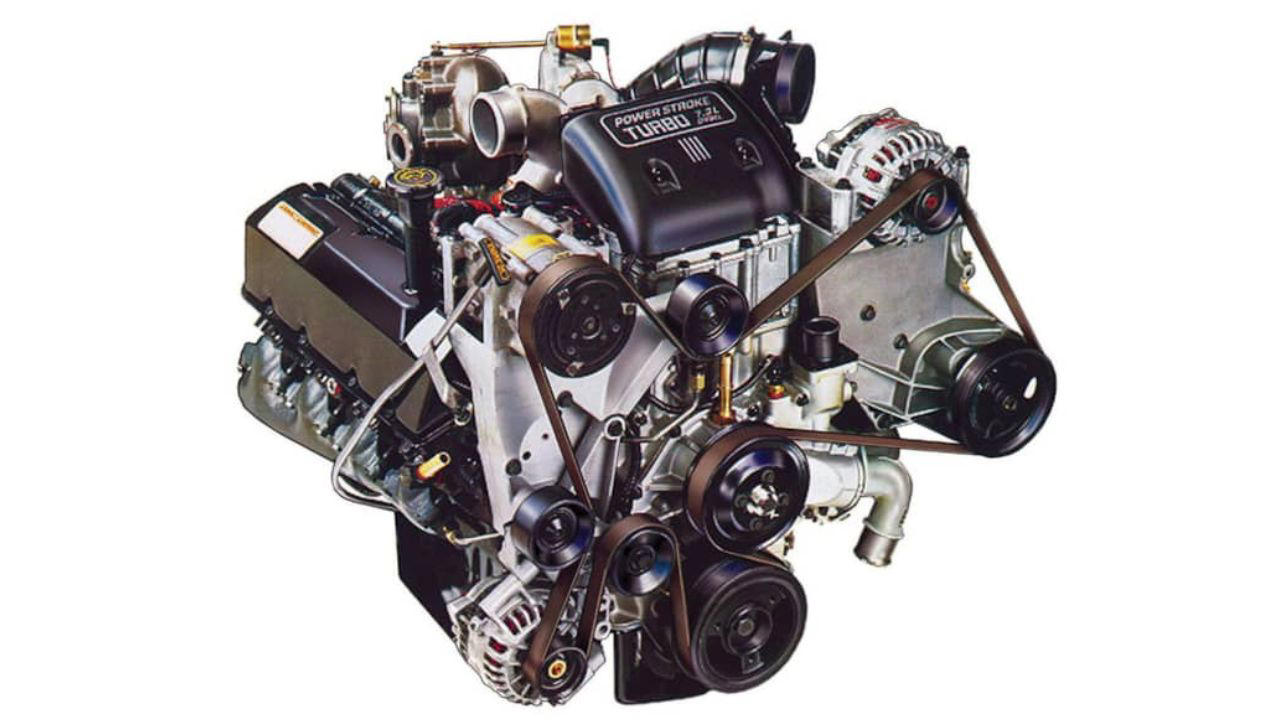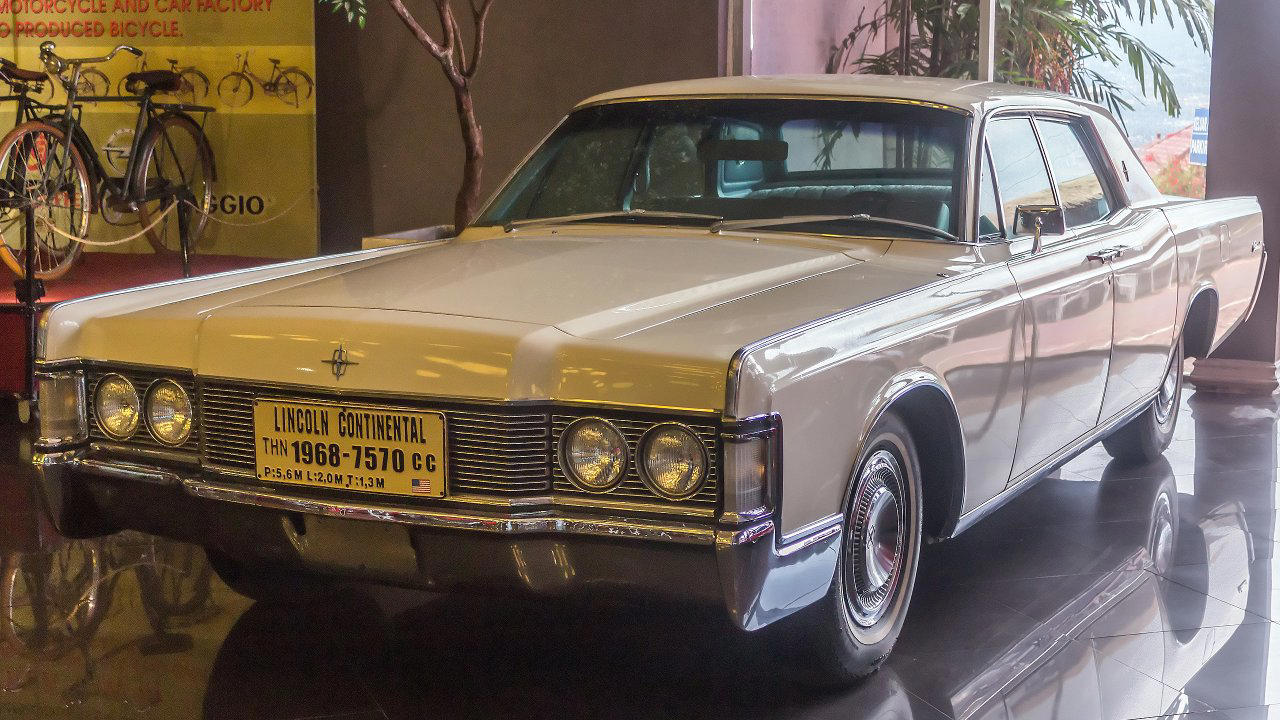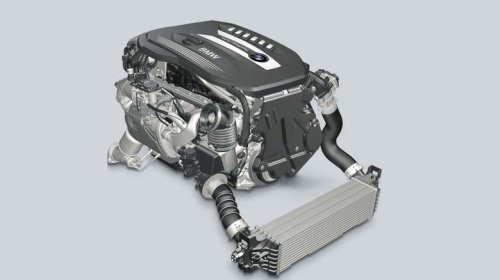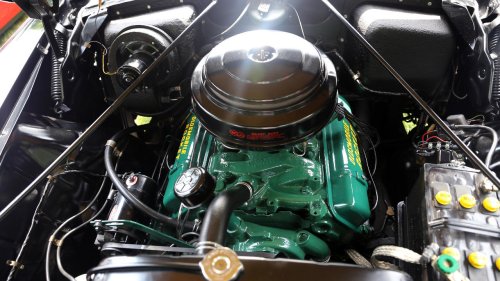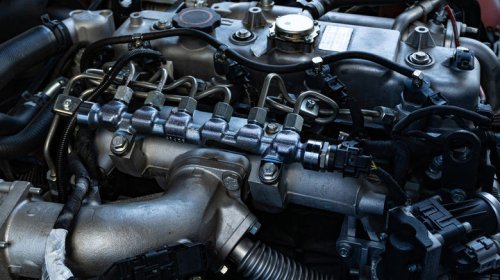
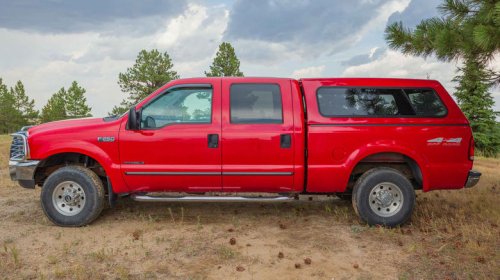



















serpalacio/Shutterstock When Rudolf Diesel (yes, really) first conceived of a design for a sparkplugless engine that used heat and compression to ignite fuel in each cylinder, he was chasing a theoretical design premise meant to chase maximum efficiency. Diesel motors do accomplish this, with their denser, slower-burning fuel contributing to significant mileage gains compared to gasoline counterparts. Yet as is so often the case with efficiency plays, the benefits didn't stop there. Just as turbocharging technology aimed at efficiency can also be wielded to deliver raw performance power, diesel tech has since manifested itself in everything from stump-pulling torque and long-haul durability to refined smoothness for a luxurious highway cruiser. So even though modern diesel engines outsell gas in heavy-duty trucks, that's by no means the end of the story. Today we're going to walk you through some of the beefiest,most inspiring diesel V8s ever built, along with some of the vehicles they powered. And no, this isn't going to be a collection of full-sized pickups with Cummins stickers on the back, though that's probably most because most of the iconic Cummins implementations that comes to mind — including the 2027 Ram Power Wagon with over 1,000 pound-feet of torque — happen to be six-cylinders, and this list is a V8 party. Navistar-Ford 7.3-liter Power Stroke Patrish Jackson/Shutterstock Despite having a V10 sibling, the 7.3-liter Power Stroke V8 was the largest motor in Ford's lineup in 1999 (the 10-cylinder was a mere 6.8 liters). It's among Jalopnik readers' most popular power plants, and it's easy to see why, especially in period. This diesel motor cranked out 235 horsepower at a time when you didn't get that out of a base-model Camry, as well as 500 pound-feet of torque, which is really the vaunted figure when you're talking about truck capabilities with truck people. That power was delivered at rumbling 1,600 to 2,700 rpm and made for a heck of a splash at the turn of the automotive century. It was part of a collaboration between Ford and Navistar, which ended messily in 2007 with a lot of finger-pointing. But up until then, that 7.3-liter Power Stroke lived iconically inside the 1999 Ford F-250 Super Duty, which was as emblematic of American pickup prowess then as the modern F-250 is now. During a period when truck owners hadn't yet completely embraced a willingness to take up two parking spaces at Target, the F-250 was unrepentantly big and presented buyers with a dizzying array of customization and convenience options that today's pampered truck owners might take for granted. Capability, comfort, and maybe even a little bit of status had officially crossed paths. Ford 6.7-liter Power Stroke Ford You can draw a straight line from last entry's 7.3-liter to today's 6.7, and there's a whole lot more story to tell than what looks like a modest downgrade in displacement. That's because Ford's 6.7-liter Power Stroke V8 has iterations leaning into modern tech and engine design to deliver 500 horsepower and 1,200 pound-feet of torque. Developed fully in-house by Ford (see messy Navistar breakup, above), this is the one that helped shape the modern heavy-duty truck segment into a torque and towing arms race. Even though you can also pair this motor with the F-350 and F-450 there's still no more natural place to find one than under the hood of the F-250. While it's easy to nerd out on torque curves and towing specs, it's even easier to gawk at metrics of pure novelty, such as the 5.5-second 0-60 time wrung out of a truck that seats six and weighs more than 8,000 pounds. Unless you find yourself on the other side of the American truck holy war (say hi to your peeing Calvin sticker for us), the Ford Super Duty is a work truck among work trucks and yes, still rocks the diesel (if you order it that way). GM 6.6-liter Duramax Chevrolet You don't need to have a great handle on the subtle (and not-so-subtle) differences between the Duramax LML, L5P, LB7, and LBZ diesel engines to know that if you're on the Chevy side of that previously mentioned American truck holy war, this is *the* diesel. As far as power, today that translates to 470 horsepower and 975 pound-feet of torque, trading blows perfectly adequately against the Ford equivalent. Helping to get the power down is the Allison 10-speed automatic transmission, which General Motors claims helps extract as much as 25% additional performance out of the motor, with final drive ratios geared with low-speed towing and steep grades in mind. That means that the Chevy Silverado HD gets more diesel torque and more gears, which might show up more in real-world performance than the power figures alone would suggest. Reviewers such as Car and Driver largely came to this conclusion exactly, giving the Chevy a nod for torque and towing while acknowledging that the F-250 mostly runs the table on paper. It's no wonder the Ford/Chevy rivalry endures, though this is the last you'll hear from either of them on this list. Toyota 1VD-FTV Toyota When we did a roundup of reliable diesel engines that just won't quit, there were plenty of Toyota motors to choose from, and the 1VD-FTV was certainly one of them. At 4.5 liters it was never playing the same game as the American brutes already covered above, but the 1VD-FTV made about 202 horsepower and 317 pound-feet of torque. (You'll usually see these power figures in Nm, because the 1VD-FTV didn't have a U.S. implementation, instead winning acclaim elsewhere, largely in Australia, South Africa, and Europe.) The 1VD-FTV earned its bulletproof reputation under the hood of the Toyota Land Cruiser 70, which had an impressive run crawling across continents from 2007 all the way up to 2024. A vehicle that lawyers for Toyota were willing to describe in print as "indestructible" did indeed largely live up to that reputation, perhaps less so in the United States where we just get a boring hybrid. But hey, as long as we're talking about things that most of us can't have, we'll just point out that a diesel Land Cruiser 70 Series did make a retro comeback in Japan — so close and yet so far. Audi 4.2 TDI Audi Audi's 4.2 TDI is proof that serious torque doesn't have to be for hauling loads or ripping stumps out of the ground, as effortless low-end power can also translate into a refined, buttery-smooth luxury driving experience. We're talking about a V8 twin-turbo diesel engine with dual overhead cams and VW's TDI direct injection (and yes, Volkswagen does continue to defend trademarking the acronym for "turbocharged direct injection," with success varying by country). The motor delivers 322 horsepower and 479 pound-feet of torque. You may or may not find these figures personally impressive, but the real message here is that this performance wasn't aimed at helping a big trucks move big things — it was to help an elegant sedan accelerate not just quickly, but effortlessly. That's where the Audi A8 4.2 TDI Quattro comes in. With a premise similar to that of the departed 12-cylinder A8 — more power than you need to make acceleration smooth, not harsh — the torquey V8 delivers a brisk autobahn-friendly highway experience with a minimum of fuss.You could argue that it isn't the most exciting application, but it does get the job done. So while one might argue that the Quattro can make a 4,600-pound long-wheelbase diesel sedan a rally god, we're pretty sure that's not what Audi had in mind when it built the car driven by the guy who fired your dad. BMW M67 BMW In the late 1990s, BMW had pretty well established it could deliver performance and refinement with its diesel offerings, but the M67 was developed exclusively for the flagship sedan. Good for 242 horsepower and 413 pound-feet of torque, like the A8 it delivered refinement and long-legged authority that could make diesel feel luxurious. BMW would go as far as to call the M67-equipped 7-Series "the connoisseur's choice" in the lineup, with buyers choosing it as often as 85% in some European markets. So yes, the BMW 740d was the choice of a decent chunk of buyers and was about as sporty as one could reasonably ask a '90s long-wheelbase sedan to be. The engine's smooth power delivery helped mask its diesel origins in a segment where refinement mattered as much as outright performance. And while modern BMW may have had a Dieselgate moment in Germany, there was definitely a time when turn-of-this-century BMW prestige was embodied by the 740d. Land Rover 4.4 TDV8 Stoqliq/Shutterstock Okay, that's enough of romanticized German diesels eating up the kilometers on nicely paved European highways. Similar in spirit to Toyota's implementation in the Land Cruiser 70, Land Rover took effortless low-end power and general stoutness to the trails with its TDV8. The 4.4-liter twin sequential turbo V8 put out 313 hp and 516 pound-feet of torque, compatible with a fancy 8HP70 eight-speed automatic transmission that aimed to smooth out power delivery for a refined ride. Of course, while Toyota dropped its diesel into a near-invincible off-roader that will likely be chugging across remote corners of other continents after we're all dead, Land Rover put its into a Range Rover you'd be much more likely to find on the street (probably an expensive street). That's because the 2011 Range Rover was as close as you're going to get to an official pivot by the company into establishing the model as a full-blown luxury-first SUV. That said, the V8 diesel Range Rover keeps the earlier models' historic capability and durability, leaving hard-to-please reviewers like Top Gear continuing to call it "the greatest vehicle in the world." Even if the Range Rover brochures are more likely to show a beautiful couple returning from an evening out than a 4x4 crashing through a splashy creek. Scania V8 diesel family Mike Mareen/Shutterstock We've said before that it's a hard road for the American truck driver, and as much as we like to gawk over cool industrial concept trucks around here, today we're talking about a piece of perhaps unsexy but no less legendary hardware that lives at the heart of the industry — any of Scania's V8 diesels. This is serious work equipment, so there are obviously a bunch of variants, but think 590 to 770 horsepower and torque of 2,065 pound-feet or more. It's serious stuff, is what we're saying. You'll find these Scania V8s powering all manner of Scania vehicles. If you're in the United States you might not really see them around, so we'll just assure you that across the Atlantic the Scania vs. Volvo battle for big-truck supremacy is very much a thing. We don't know if lewd stickers in back windows are a part of this rivalry, but we hope they are. Sweden has trucks, but does it have "Calvin & Hobbes"? Detroit Diesel 8V71 Retro Car/YouTube If some of the engines on this list are known for refinement or cutting-edge engineering, the Detroit Diesel 8V71 earned its reputation the old-fashioned way: by showing up, working hard, and refusing to die. Delivering 370 horsepower and 1,064 pound-feet of torque with the turbocharged setup, which is really something when you consider that we're talking about a motor that first rolled out in its V configuration in 1957. Detroit Diesel leaned on fuel economy as a selling point of the 8V71, all the way up to the tagline "Fuel Squeezer Plus" (per Powerline Components). The 8V71 generally became a go-to workhorse engine for no-nonsense applications including farming, boating, and the military up until it was discontinued in 1995. You'd also find it under the hood of the GMC Astro. If you aren't familiar with the Astro, it's the '90s-era semi truck you see when you close your eyes and think of a '90s-era semi truck. While Detroit Diesel no longer exists in the same form as in its heyday, it still represents something special to those who remember and appreciate the work that these power plants did in carrying the country forward. It's not going to rocket you effortlessly down the autobahn, but it still counts for something.